







Question: ECON 214: Intermediate Macro (2018/19, T2) Assignment 1 due on January 24th National Accounts and Price Indices Consider an economy that only produces three types
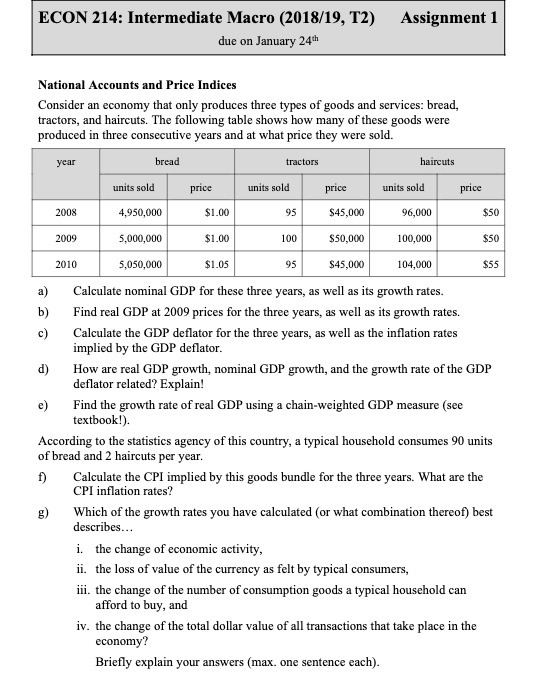
ECON 214: Intermediate Macro (2018/19, T2) Assignment 1 due on January 24th National Accounts and Price Indices Consider an economy that only produces three types of goods and services: bread, tractors, and haircuts. The following table shows how many of these goods were produced in three consecutive years and at what price they were sold. year bread tractors haircuts units sold price units sold price units sold price 2008 4,950,000 $1.00 95 $45.000 96,000 $50 2009 5,000,000 $1.00 100 $50,000 100,000 $50 2010 5,050,000 $1.05 95 $45,000 104,000 $55 a Calculate nominal GDP for these three years, as well as its growth rates. b) Find real GDP at 2009 prices for the three years, as well as its growth rates. c) Calculate the GDP deflator for the three years, as well as the inflation rates implied by the GDP deflator. d) How are real GDP growth, nominal GDP growth, and the growth rate of the GDP deflator related? Explain! e) Find the growth rate of real GDP using a chain-weighted GDP measure (see textbook!). According to the statistics agency of this country, a typical household consumes 90 units of bread and 2 haircuts per year. f) Calculate the CPI implied by this goods bundle for the three years. What are the CPI inflation rates? g) Which of the growth rates you have calculated (or what combination thereof) best describes... i. the change of economic activity, ii. the loss of value of the currency as felt by typical consumers, iii. the change of the number of consumption goods a typical household can afford to buy, and iv. the change of the total dollar value of all transactions that take place in the economy? Briefly explain your answers (max. one sentence each)
Step by Step Solution
There are 3 Steps involved in it

Get step-by-step solutions from verified subject matter experts
 Study Help