



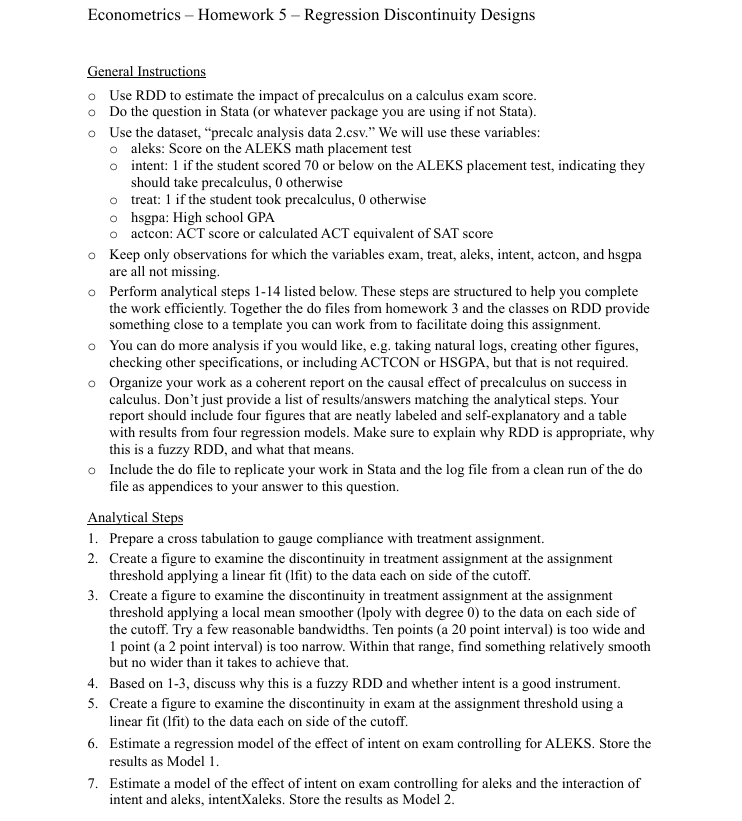
Question: Econometrics - Homework 5 - Regression Discontinuity Designs General Instructions - Use RDD to estimate the impact of precalculus on a calculus exam score. -
Econometrics Homework Regression Discontinuity Designs
General Instructions
Use RDD to estimate the impact of precalculus on a calculus exam score.
Do the question in Stata or whatever package you are using if not Stata
Use the dataset, "precalc analysis data csv We will use these variables:
aleks: Score on the ALEKS math placement test
intent: if the student scored or below on the ALEKS placement test, indicating they should take precalculus, otherwise
treat: if the student took precalculus, otherwise
hsgpa: High school GPA
actcon: ACT score or calculated ACT equivalent of SAT score
Keep only observations for which the variables exam, treat, aleks, intent, actcon, and hsgpa are all not missing.
Perform analytical steps listed below. These steps are structured to help you complete the work efficiently. Together the do files from homework and the classes on RDD provide something close to a template you can work from to facilitate doing this assignment.
You can do more analysis if you would like, eg taking natural logs creating other figures, checking other specifications, or including ACTCON or HSGPA, but that is not required.
Organize your work as a coherent report on the causal effect of precalculus on success in calculus. Don't just provide a list of resultsanswers matching the analytical steps. Your report should include four figures that are neatly labeled and selfexplanatory and a table with results from four regression models. Make sure to explain why RDD is appropriate, why this is a fuzzy RDD and what that means.
Include the do file to replicate your work in Stata and the log file from a clean run of the do file as appendices to your answer to this question.
Analytical Steps
Prepare a cross tabulation to gauge compliance with treatment assignment.
Create a figure to examine the discontinuity in treatment assignment at the assignment threshold applying a linear fit lfit to the data each on side of the cutoff.
Create a figure to examine the discontinuity in treatment assignment at the assignment threshold applying a local mean smoother lpoly with degree to the data on each side of the cutoff. Try a few reasonable bandwidths. Ten points a point interval is too wide and point a point interval is too narrow. Within that range, find something relatively smooth but no wider than it takes to achieve that.
Based on discuss why this is a fuzzy RDD and whether intent is a good instrument.
Create a figure to examine the discontinuity in exam at the assignment threshold using a linear fit lfit to the data each on side of the cutoff.
Estimate a regression model of the effect of intent on exam controlling for ALEKS. Store the results as Model
Estimate a model of the effect of intent on exam controlling for aleks and the interaction of intent and aleks, intentXaleks. Store the results as Model Econometrics Homework Regression Discontinuity Designs
Check the variance inflation factors after the prior regression and use them to explain the problem with interpreting the results of that regression.
Estimate a model of the effect of intent on the probability of treatment controlling for aleks. Explain the meaning of the coefficient on intent. Store the result as Model Generate predicted values of treatment based on this regression, named predtreat.
Use the results of Models and to estimate the LATE. Explain your process and interpret the LATE.
Estimate a model of the effect of predicted treatment on exam controlling for aleks. Interpret the coefficient on predicted treatment. Save the results as Model Explain its relationship to the LATE calculated in step Generate predicted values for exam based on this regression, named predexam.
Create a figure to examine the discontinuity in exam at the assignment threshold applying a local mean smoother lpoly with degree to exam on each side of the cutoff. Try a few reasonable bandwidths. Ten points a point interval is too wide and point a point interval is too narrow. Within that range, find something relatively smooth but no wider than it takes to achieve smoothness.
How do you interpret the results of the figure from How does it compare to the results from
Use the etable command to prepare a neat table of the results from the four estimated regression models to include in your write up
Step by Step Solution
There are 3 Steps involved in it
1 Expert Approved Answer
Step: 1 Unlock

Question Has Been Solved by an Expert!
Get step-by-step solutions from verified subject matter experts
Step: 2 Unlock
Step: 3 Unlock