







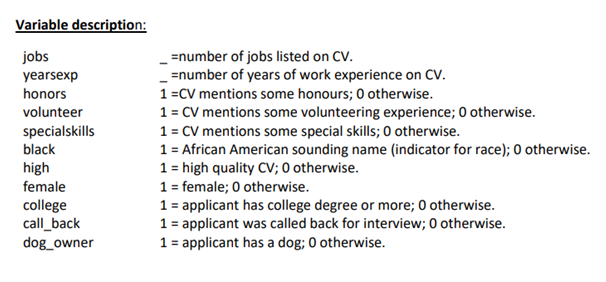
Question: Econometrics: Just looking for the Stata code for questions 2-4 please Variable description: ( begin{array}{lll}text { jobs } & =text { =number of jobs listed
Econometrics: Just looking for the Stata code for questions 2-4 please
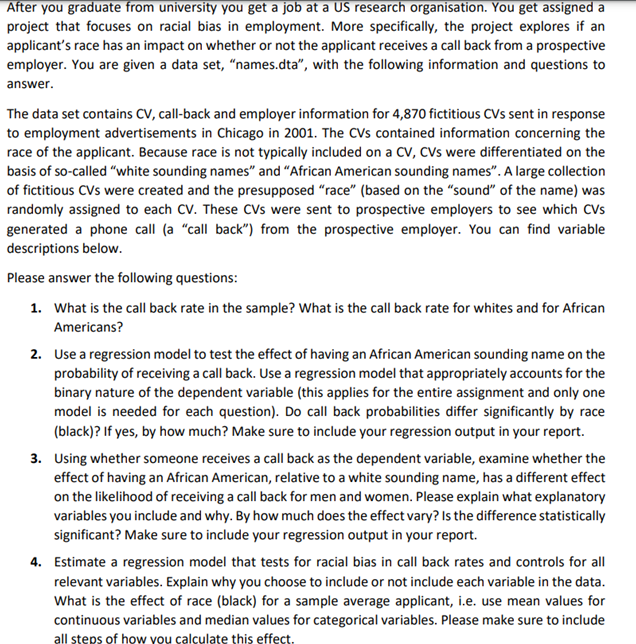
Variable description: \( \begin{array}{lll}\text { jobs } & =\text { =number of jobs listed on CV. } \\ \text { yearsexp } & -\text { =number of years of work experience on CV. } \\ \text { honors } & 1 & =\text { CV mentions some honours; } 0 \text { otherwise. } \\ \text { volunteer } & 1 & =\text { CV mentions some volunteering experience; } 0 \text { otherwise. } \\ \text { specialskills } & 1 & =\text { CV mentions some special skills; } 0 \text { otherwise. } \\ \text { black } & 1 & =\text { African American sounding name (indicator for race); } 0 \text { otherwise. } \\ \text { high } & 1 & =\text { high quality CV; } 0 \text { otherwise. } \\ \text { female } & 1 & =\text { female; } 0 \text { otherwise. } \\ \text { college } & 1 & =\text { applicant has college degree or more; } 0 \text { otherwise. } \\ \text { call_back } & 1 & =\text { applicant was called back for interview; } 0 \text { otherwise. } \\ \text { dog_owner } & 1 & =\text { applicant has a dog; } 0 \text { otherwise. }\end{array} \) After you graduate from university you get a job at a US research organisation. You get assigned a project that focuses on racial bias in employment. More specifically, the project explores if an applicant's race has an impact on whether or not the applicant receives a call back from a prospective employer. You are given a data set, "names.dta", with the following information and questions to answer. The data set contains CV, call-back and employer information for 4,870 fictitious CVs sent in response to employment advertisements in Chicago in 2001. The CVs contained information concerning the race of the applicant. Because race is not typically included on a CV, CVs were differentiated on the basis of so-called "white sounding names" and "African American sounding names". A large collection of fictitious CVs were created and the presupposed "race" (based on the "sound" of the name) was randomly assigned to each CV. These CVs were sent to prospective employers to see which CVs generated a phone call (a "call back") from the prospective employer. You can find variable descriptions below. Please answer the following questions: 1. What is the call back rate in the sample? What is the call back rate for whites and for African Americans? 2. Use a regression model to test the effect of having an African American sounding name on the probability of receiving a call back. Use a regression model that appropriately accounts for the binary nature of the dependent variable (this applies for the entire assignment and only one model is needed for each question). Do call back probabilities differ significantly by race (black)? If yes, by how much? Make sure to include your regression output in your report. 3. Using whether someone receives a call back as the dependent variable, examine whether the effect of having an African American, relative to a white sounding name, has a different effect on the likelihood of receiving a call back for men and women. Please explain what explanatory variables you include and why. By how much does the effect vary? Is the difference statistically significant? Make sure to include your regression output in your report. 4. Estimate a regression model that tests for racial bias in call back rates and controls for all relevant variables. Explain why you choose to include or not include each variable in the data. What is the effect of race (black) for a sample average applicant, i.e. use mean values for continuous variables and median values for categorical variables. Please make sure to include all stens of how you calculate this effect. Variable description: \( \begin{array}{lll}\text { jobs } & =\text { =number of jobs listed on CV. } \\ \text { yearsexp } & -\text { =number of years of work experience on CV. } \\ \text { honors } & 1 & =\text { CV mentions some honours; } 0 \text { otherwise. } \\ \text { volunteer } & 1 & =\text { CV mentions some volunteering experience; } 0 \text { otherwise. } \\ \text { specialskills } & 1 & =\text { CV mentions some special skills; } 0 \text { otherwise. } \\ \text { black } & 1 & =\text { African American sounding name (indicator for race); } 0 \text { otherwise. } \\ \text { high } & 1 & =\text { high quality CV; } 0 \text { otherwise. } \\ \text { female } & 1 & =\text { female; } 0 \text { otherwise. } \\ \text { college } & 1 & =\text { applicant has college degree or more; } 0 \text { otherwise. } \\ \text { call_back } & 1 & =\text { applicant was called back for interview; } 0 \text { otherwise. } \\ \text { dog_owner } & 1 & =\text { applicant has a dog; } 0 \text { otherwise. }\end{array} \) After you graduate from university you get a job at a US research organisation. You get assigned a project that focuses on racial bias in employment. More specifically, the project explores if an applicant's race has an impact on whether or not the applicant receives a call back from a prospective employer. You are given a data set, "names.dta", with the following information and questions to answer. The data set contains CV, call-back and employer information for 4,870 fictitious CVs sent in response to employment advertisements in Chicago in 2001. The CVs contained information concerning the race of the applicant. Because race is not typically included on a CV, CVs were differentiated on the basis of so-called "white sounding names" and "African American sounding names". A large collection of fictitious CVs were created and the presupposed "race" (based on the "sound" of the name) was randomly assigned to each CV. These CVs were sent to prospective employers to see which CVs generated a phone call (a "call back") from the prospective employer. You can find variable descriptions below. Please answer the following questions: 1. What is the call back rate in the sample? What is the call back rate for whites and for African Americans? 2. Use a regression model to test the effect of having an African American sounding name on the probability of receiving a call back. Use a regression model that appropriately accounts for the binary nature of the dependent variable (this applies for the entire assignment and only one model is needed for each question). Do call back probabilities differ significantly by race (black)? If yes, by how much? Make sure to include your regression output in your report. 3. Using whether someone receives a call back as the dependent variable, examine whether the effect of having an African American, relative to a white sounding name, has a different effect on the likelihood of receiving a call back for men and women. Please explain what explanatory variables you include and why. By how much does the effect vary? Is the difference statistically significant? Make sure to include your regression output in your report. 4. Estimate a regression model that tests for racial bias in call back rates and controls for all relevant variables. Explain why you choose to include or not include each variable in the data. What is the effect of race (black) for a sample average applicant, i.e. use mean values for continuous variables and median values for categorical variables. Please make sure to include all stens of how you calculate this effect
Step by Step Solution
There are 3 Steps involved in it

Get step-by-step solutions from verified subject matter experts
 Study Help