







Question: Economics DO 14-8 RD (point function) (set function) Figure 1.5 Point versus set function. real-valued function whose domain-consists of a collection of points, where points
Economics 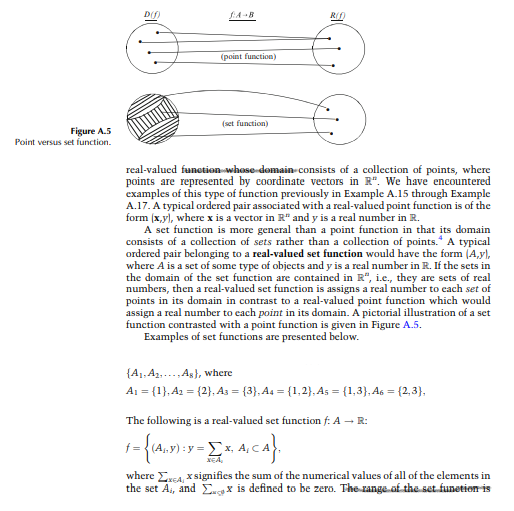
DO 14-8 RD (point function) (set function) Figure 1.5 Point versus set function. real-valued function whose domain-consists of a collection of points, where points are represented by coordinate vectors in E". We have encountered examples of this type of function previously in Example A.15 through Example A.17. A typical ordered pair associated with a real-valued point function is of the form (x,y), where x is a vector in R" and y is a real number in R. A set function is more general than a point function in that its domain consists of a collection of sets rather than a collection of points. A typical ordered pair belonging to a real-valued set function would have the form (Ayl, where A is a set of some type of objects and y is a real number in R. If the sets in the domain of the set function are contained in R", i.e., they are sets of real numbers, then a real-valued set function is assigns a real number to each set of points in its domain in contrast to a real-valued point function which would assign a real number to each point in its domain. A pictorial illustration of a set function contrasted with a point function is given in Figure A.5. Examples of set functions are presented below. {A1, A2,..., As), where A1 = {1},A2 = {2},A3 = {3}, A4 = {1,2},A5 = {1,3), A6 = {2,3), The following is a real-valued set function f: A-R: = {(2,3):= {x, ACA} where x x signifies the sum of the numerical values of all of the elements in the set As, and cox is defined to be zero. The range of the set funetion is
Step by Step Solution
There are 3 Steps involved in it

Get step-by-step solutions from verified subject matter experts
 Study Help