







Question: economics subject ;: Question 2 Consider a representative agent, optimal growth model with no population growth in which agents have logarithmic preferences and assume that
economics subject ;:
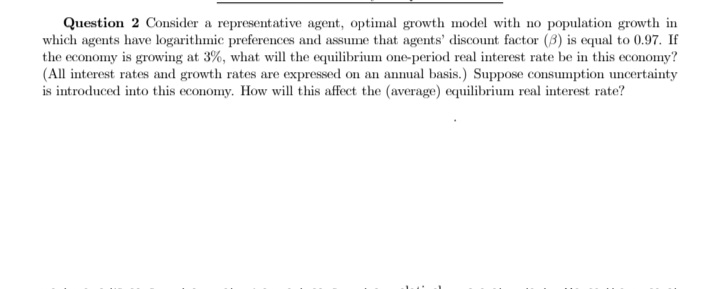
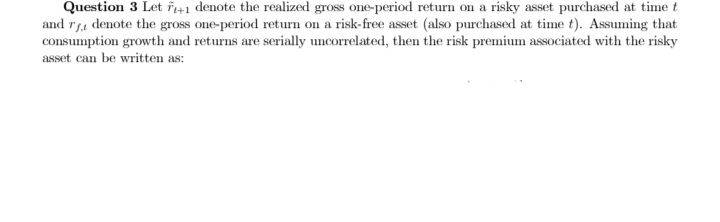
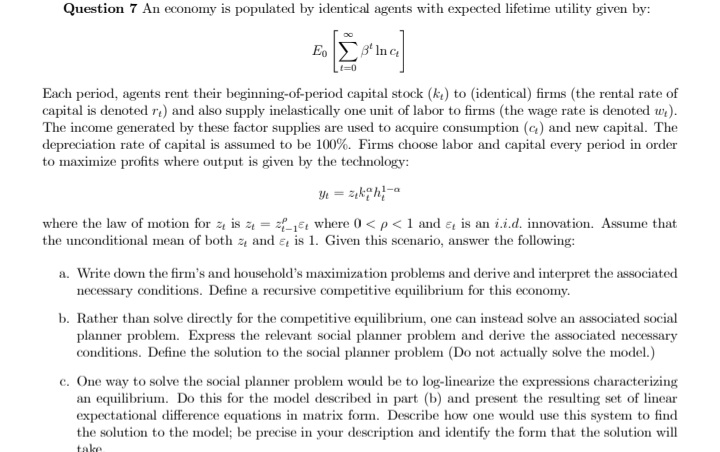
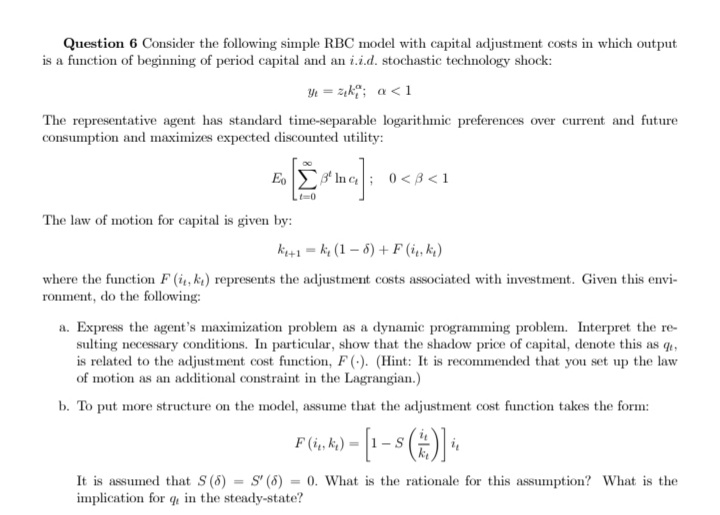
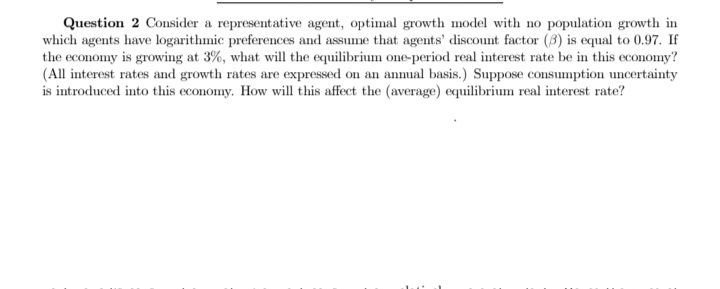
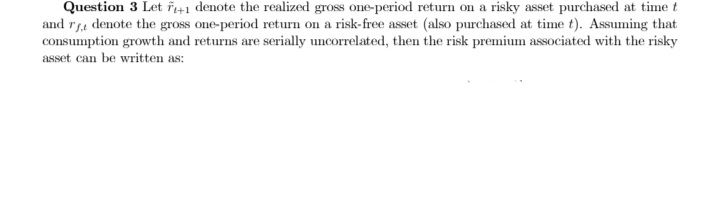
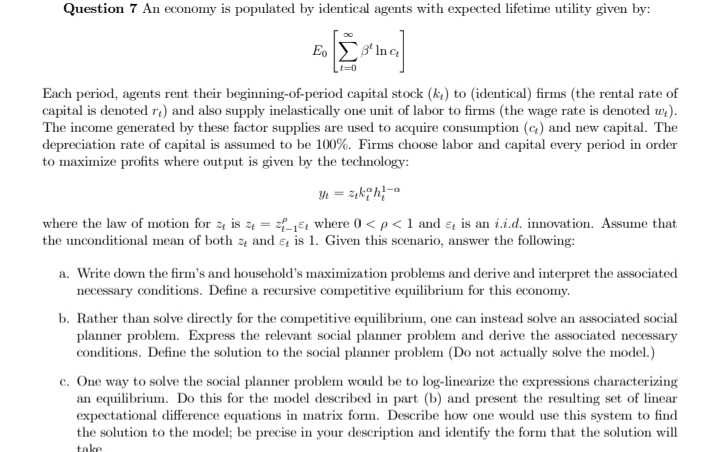
Question 2 Consider a representative agent, optimal growth model with no population growth in which agents have logarithmic preferences and assume that agents' discount factor (8) is equal to 0.97. If the economy is growing at 3%, what will the equilibrium one-period real interest rate be in this economy? (All interest rates and growth rates are expressed on an annual basis.) Suppose consumption uncertainty is introduced into this economy. How will this affect the (average) equilibrium real interest rate?Question 3 Let it denote the realized gross one-period return on a risky asset purchased at time t and rye denote the gross one-period return on a risk-free asset (also purchased at time (). Assuming that consumption growth and returns are serially uncorrelated, then the risk premium associated with the risky asset can be written as:Question 7 An economy is populated by identical agents with expected lifetime utility given by: Each period, agents rent their beginning-of-period capital stock (k) to (identical) firms (the rental rate of capital is denoted r) and also supply inelastically one unit of labor to firms (the wage rate is denoted w,). The income generated by these factor supplies are used to acquire consumption (c ) and new capital. The depreciation rate of capital is assumed to be 100%. Firms choose labor and capital every period in order to maximize profits where output is given by the technology: 1 = qkahl- where the law of motion for & is = = _16, where 0
Step by Step Solution
There are 3 Steps involved in it

Get step-by-step solutions from verified subject matter experts
 Study Help