







Question: Edit: This is a complete question that does not require any editing. If you do not remember the concept of Turing machines then you are
Edit: This is a complete question that does not require any editing. If you do not remember the concept of Turing machines then you are not required to answer. Thank you.
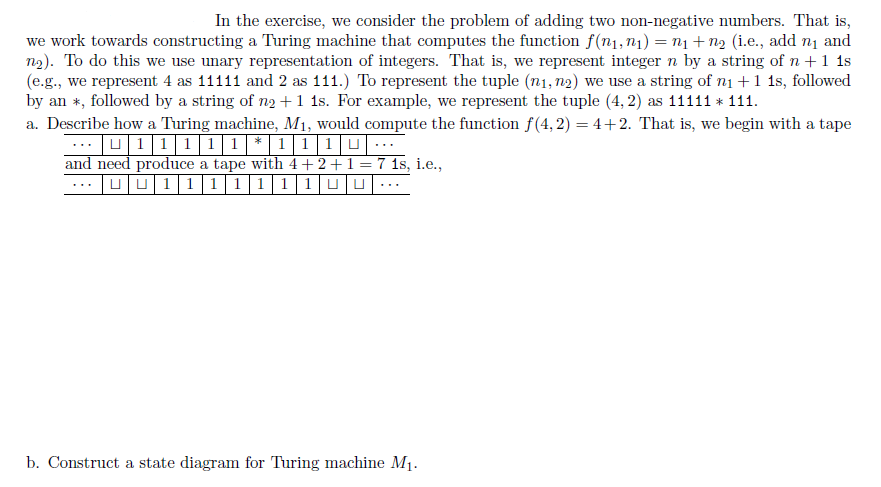
In the exercise, we consider the problem of adding two non-negative numbers. That is, we work towards constructing a Turing machine that computes the function f(n1,11) = n1 +n2 (i.e., add ny and mo). To do this we use unary representation of integers. That is, we represent integer n by a string of n +1 1s (e.g., we represent 4 as 11111 and 2 as 111.) To represent the tuple (n1, n2) we use a string of ni+1 1s, followed by an *, followed by a string of n2 +1 1s. For example, we represent the tuple (4,2) as 11111 * 111. a. Describe how a Turing machine, M1, would compute the function f(4,2) = 4+2. That is, we begin with a tape ... U11|11|1 * 111u... and need produce a tape with 4+2+1 = 7 1s, i.e.. ...DD1|11|11|11 UU... b. Construct a state diagram for Turing machine M1. In the exercise, we consider the problem of adding two non-negative numbers. That is, we work towards constructing a Turing machine that computes the function f(n1,11) = n1 +n2 (i.e., add ny and mo). To do this we use unary representation of integers. That is, we represent integer n by a string of n +1 1s (e.g., we represent 4 as 11111 and 2 as 111.) To represent the tuple (n1, n2) we use a string of ni+1 1s, followed by an *, followed by a string of n2 +1 1s. For example, we represent the tuple (4,2) as 11111 * 111. a. Describe how a Turing machine, M1, would compute the function f(4,2) = 4+2. That is, we begin with a tape ... U11|11|1 * 111u... and need produce a tape with 4+2+1 = 7 1s, i.e.. ...DD1|11|11|11 UU... b. Construct a state diagram for Turing machine M1
Step by Step Solution
There are 3 Steps involved in it

Get step-by-step solutions from verified subject matter experts
 Study Help