







Question: EEGR 409: C Programming Applications Assignment 4 Pulse Width Modulation (PWM) is a type of digital signal used in a variety of applications, such as
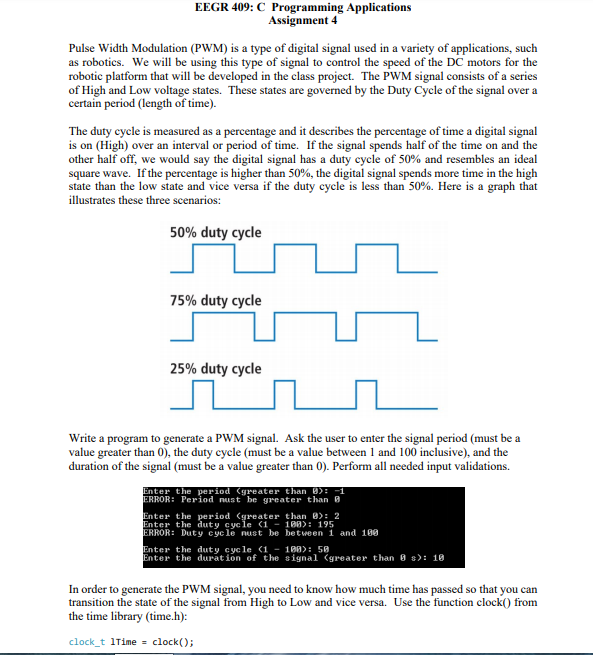
EEGR 409: C Programming Applications Assignment 4 Pulse Width Modulation (PWM) is a type of digital signal used in a variety of applications, such as robotics. We will be using this type of signal to control the speed of the DC motors for the robotic platform that will be developed in the class project. The PWM signal consists of a series of High and Low voltage states. These states are governed by the Duty Cycle of the signal over a certain period (length of time). The duty cycle is measured as a percentage and it describes the percentage of time a digital signal is on (High) over an interval or period of time. If the signal spends half of the time on and the other half off, we would say the digital signal has a duty cycle of 50% and resembles an ideal square wave. If the percentage is higher than 50%, the digital signal spends more time in the high state than the low state and vice versa if the duty cycle is less than 50%. Here is a graph that llustrates these three scenarios: 50% duty cycle 75% duty cycle 25% duty cycle Write a program to generate a PWM signal. Ask the user to enter the signal period (must be a value greater than 0), the duty cycle (must be a value between 1 and 100 inclusive), and the duration of the signal (must be a value greater than 0). Perform all needed input validations. RRO: eiod nust be greater than nter the period greater than 2 nter the duty cycle 1108 195 RROR: Duty cycle nust be between 1 and 100 nter the duty cycle 1 100 58 nter the duration of the signal
Step by Step Solution
There are 3 Steps involved in it

Get step-by-step solutions from verified subject matter experts
 Study Help