







Question: Efficiency of solid - phase microextraction. Equation 2 4 - 9 gives the mass of analyte extracted into a solid - phase microextraction fiber as
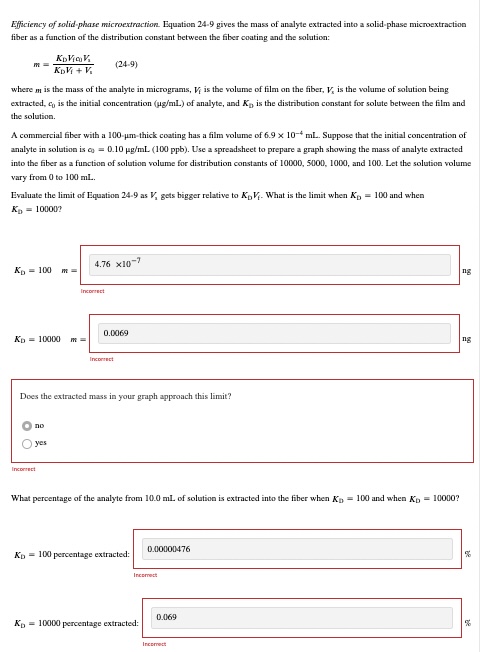
Efficiency of solidphase microextraction. Equation gives the mass of analyte extracted into a solidphase microextraction
fiber as a function of the distribution constant between the fiber coating and the solution:
where is the mass of the analyte in micrograms, is the volume of film on the fiber, is the volume of solution being
extracted, is the initial concentration of analyte, and is the distribution constant for solute between the film and
the solution.
A commercial fiber with a thick coating has a film volume of Suppose that the initial concentration of
analyte in solution is Use a spreadsheet to prepare a graph showing the mass of analyte extracted
into the fiber as a function of solution volume for distribution constants of and Let the solution volume
vary from to
Evaluate the limit of Equation as gets bigger relative to What is the limit when and when
Doe
I
Incornect
What percentage of the analyte from of solution is extracted into the fiber when and when
percentage extracted:
percentage extracted
Step by Step Solution
There are 3 Steps involved in it
1 Expert Approved Answer
Step: 1 Unlock

Question Has Been Solved by an Expert!
Get step-by-step solutions from verified subject matter experts
Step: 2 Unlock
Step: 3 Unlock
 Study Help