







Question: [ egin{array}{c} dot{x}(t)=A oldsymbol{x}(t)+oldsymbol{B} oldsymbol{u}(t)=left[egin{array}{ll} a & c b & d end{array} ight] oldsymbol{x}(t)+left[egin{array}{l} e f end{array} ight] oldsymbol{u}(t) oldsymbol{y}(t)=oldsymbol{C} oldsymbol{x}(t)=left[egin{array}{ll} g
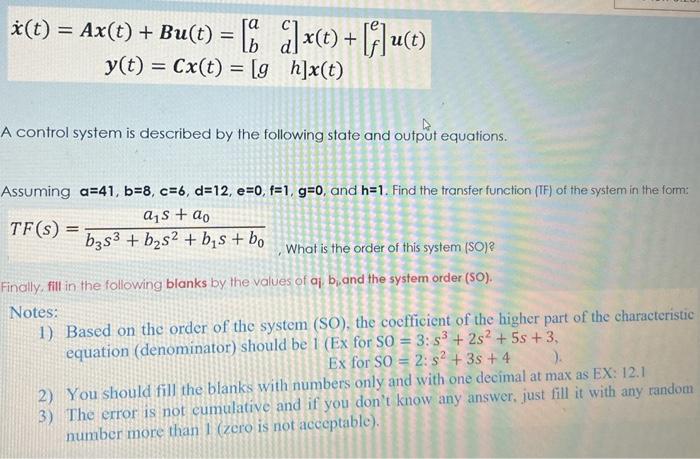
x(t)=Ax(t)+Bu(t)=[abcd]x(t)+[ef]u(t)y(t)=Cx(t)=[gh]x(t) A control system is described by the following state and output equations. Assuming a=41,b=8,c=6,d=12,e=0,f=1,g=0, and h=1. Find the transfer function (IF) of the system in the form: TF(s)=b3s3+b2s2+b1s+b0a1s+a0 What is the order of this system (SO)? Finally, fill in the following blanks by the values of a bi and the system order (SO). Notes: 1) Based on the order of the system (SO), the coefficient of the higher part of the characteristic equation (denominator) should be 1 (Ex for SO=3:s3+2s2+5s+3, ExforSO=2:s2+3s+4). 2) You should fill the blanks with numbers only and with one decimal at max as EX: 12.1 3) The error is not cumulative and if you don't know any answer, just fill it with any random number more than 1 (zero is not acceptable)
Step by Step Solution
There are 3 Steps involved in it

Get step-by-step solutions from verified subject matter experts
 Study Help