Question: Eigenvalue/Eigenvector Part IV: Suppose A is an n x n matrix. a. What does it mean to say that a vector x E Rn is
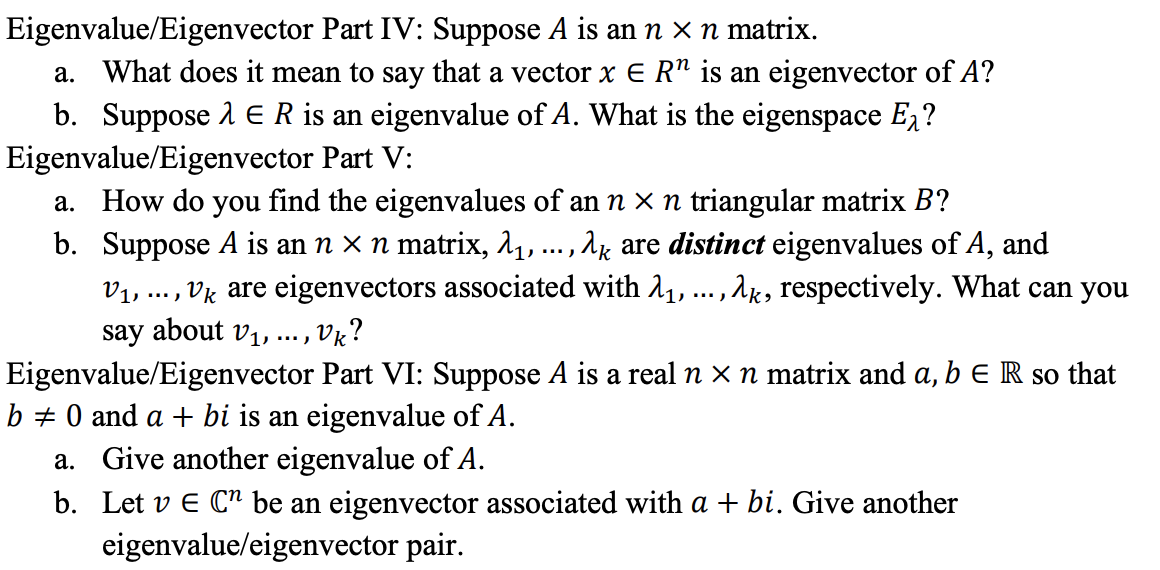
Eigenvalue/Eigenvector Part IV: Suppose A is an n x n matrix. a. What does it mean to say that a vector x E Rn is an eigenvector of A? b. Suppose A E R is an eigenvalue of A. What is the eigenspace Ea? Eigenvalue/Eigenvector Part V: a. How do you find the eigenvalues of an n x n triangular matrix B? b. Suppose A is an n x n matrix, A1, , Ak are distinct eigenvalues of A, and v1, ..., vk are eigenvectors associated with A1, Ak, respectively. What can you say about vk?
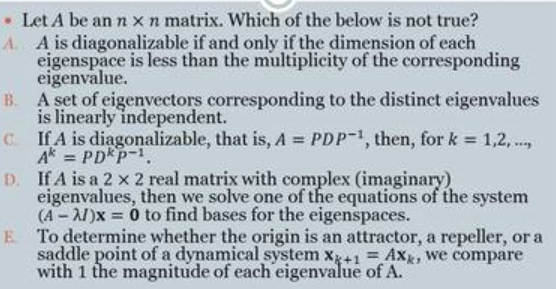
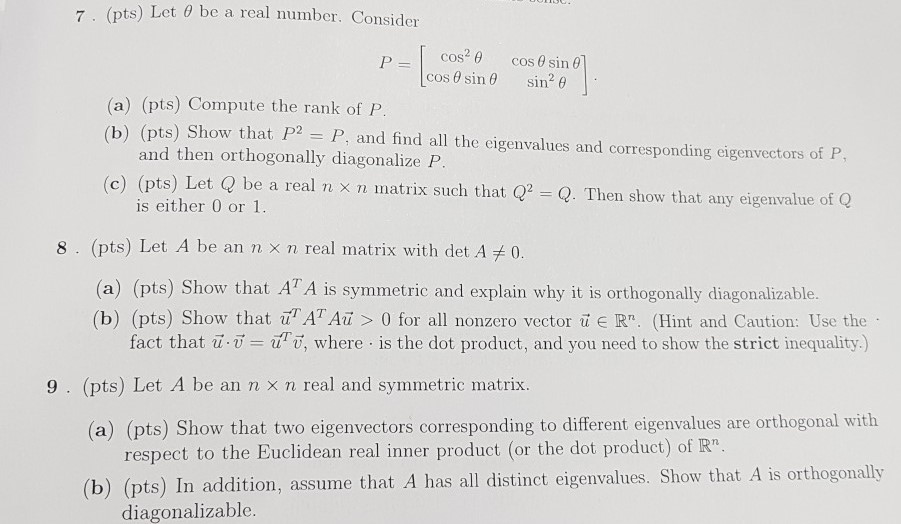
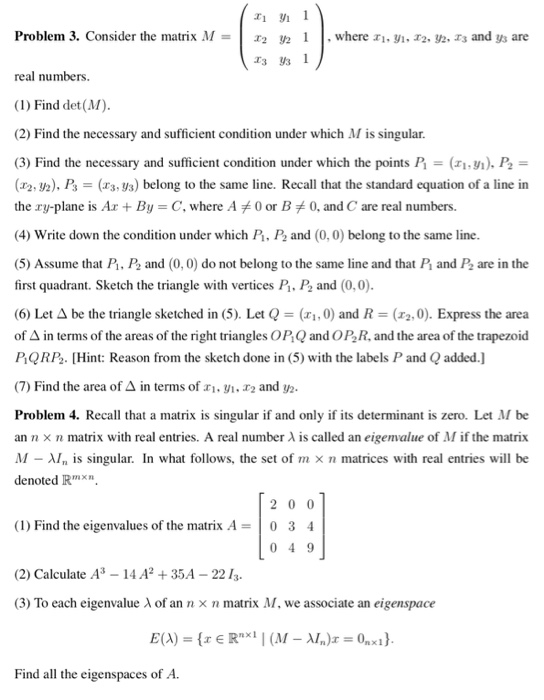
Eigenvalue/Eigenvector Part IV: Suppose A is an n X in matrix. a. What does it mean to say that a vector x E R" is an eigenvector of A? b. Suppose it E R is an eigenvalue of A. What is the eigenspace EA? Eigenvalue/Eigenvector Part V: a. How do you nd the eigenvalues of an n X n triangular matrix B? b. Suppose A is an n x n matrix, 11, , ll}: are distinct eigenvalues of A, and v1, , vk are eigenvectors associated with 11, , 2k, respectively. What can you say about 191, , vk? Eigenvalue/Eigenvector Part VI: Suppose A is a real n X in matrix and a, b E R so that b at 0 and a + bi is an eigenvalue of A. a. Give another eigenvalue of A. b. Let v E C\" be an eigenvector associated with a + bi. Give another eigenvalue/eigenvector pair. Let A be an n x n matrix. Which of the below is not true? A. A is diagonalizable if and only if the dimension of each eigenspace is less than the multiplicity of the corresponding eigenvalue. B. A set of eigenvectors corresponding to the distinct eigenvalues is linearly independent. C If A is diagonalizable, that is, A = PDP-1, then, for k = 1,2, ..., Ak = PD*P-1. D. If A is a 2 x 2 real matrix with complex (imaginary) eigenvalues, then we solve one of the equations of the system (4 - W/)x = 0 to find bases for the eigenspaces. E To determine whether the origin is an attractor, a repeller, or a saddle point of a dynamical system X*+1 = AXK, we compare with 1 the magnitude of each eigenvalue of A.7 . (pts) Let 0 be a real number. Consider P = cos20 cos 0 sin 0 cos 0 sin 0 sin 0 (a) (pts) Compute the rank of P. (b) (pts) Show that P? = P, and find all the eigenvalues and corresponding eigenvectors of P, and then orthogonally diagonalize P. (c) (pts) Let Q be a real n x n matrix such that Q2 = Q. Then show that any eigenvalue of Q is either 0 or 1. 8 . (pts) Let A be an n x n real matrix with det A # 0. (a) (pts) Show that A"A is symmetric and explain why it is orthogonally diagonalizable. (b) (pts) Show that u" A" Au > 0 for all nonzero vector u e R". (Hint and Caution: Use the fact that u . v = u v, where . is the dot product, and you need to show the strict inequality.) 9 . (pts) Let A be an n x n real and symmetric matrix. (a) (pts) Show that two eigenvectors corresponding to different eigenvalues are orthogonal with respect to the Euclidean real inner product (or the dot product) of En. (b) (pts) In addition, assume that A has all distinct eigenvalues. Show that A is orthogonally diagonalizable.1 Problem 3. Consider the matrix M = T2 1/2 1 , where $1. y1. 12. 92. I3 and ys are 13 y3 real numbers. (1) Find det (M). (2) Find the necessary and sufficient condition under which M is singular. (3) Find the necessary and sufficient condition under which the points P = (21, y1). P2 = (12, 12), P3 = (13, 93) belong to the same line. Recall that the standard equation of a line in the ry-plane is Ar + By = C, where A * 0 or B # 0, and C are real numbers. (4) Write down the condition under which Pi. P, and (0, 0) belong to the same line. (5) Assume that Pi, P2 and (0, 0) do not belong to the same line and that Pi and P2 are in the first quadrant. Sketch the triangle with vertices Pi. P2 and (0, 0). (6) Let A be the triangle sketched in (5). Let Q = (x1, 0) and R = (12, 0). Express the area of A in terms of the areas of the right triangles OP, Q and OP2 R, and the area of the trapezoid PIQRP2. [Hint: Reason from the sketch done in (5) with the labels P and Q added.] (7) Find the area of A in terms of 21. y1. 12 and yz. Problem 4. Recall that a matrix is singular if and only if its determinant is zero. Let M be an n x n matrix with real entries. A real number A is called an eigenvalue of M if the matrix M - Al,, is singular. In what follows, the set of m x n matrices with real entries will be denoted Rmxa 0 (1) Find the eigenvalues of the matrix A = 0 3 0 9 (2) Calculate A3 - 14 A3 + 35A - 22 13. (3) To each eigenvalue A of an n x n matrix M, we associate an eigenspace E(X) = {x E Rox) | (M - Al,)x = 0nx1) Find all the eigenspaces of A
Step by Step Solution
There are 3 Steps involved in it
1 Expert Approved Answer
Step: 1 Unlock
Question Has Been Solved by an Expert!
Get step-by-step solutions from verified subject matter experts
Step: 2 Unlock
Step: 3 Unlock
Students Have Also Explored These Related Mathematics Questions!









 Study Help