







Question: Elaborate Relationship Between Heat and Work Lab An object does work when it exerts a force over a distance. For example, you do work to
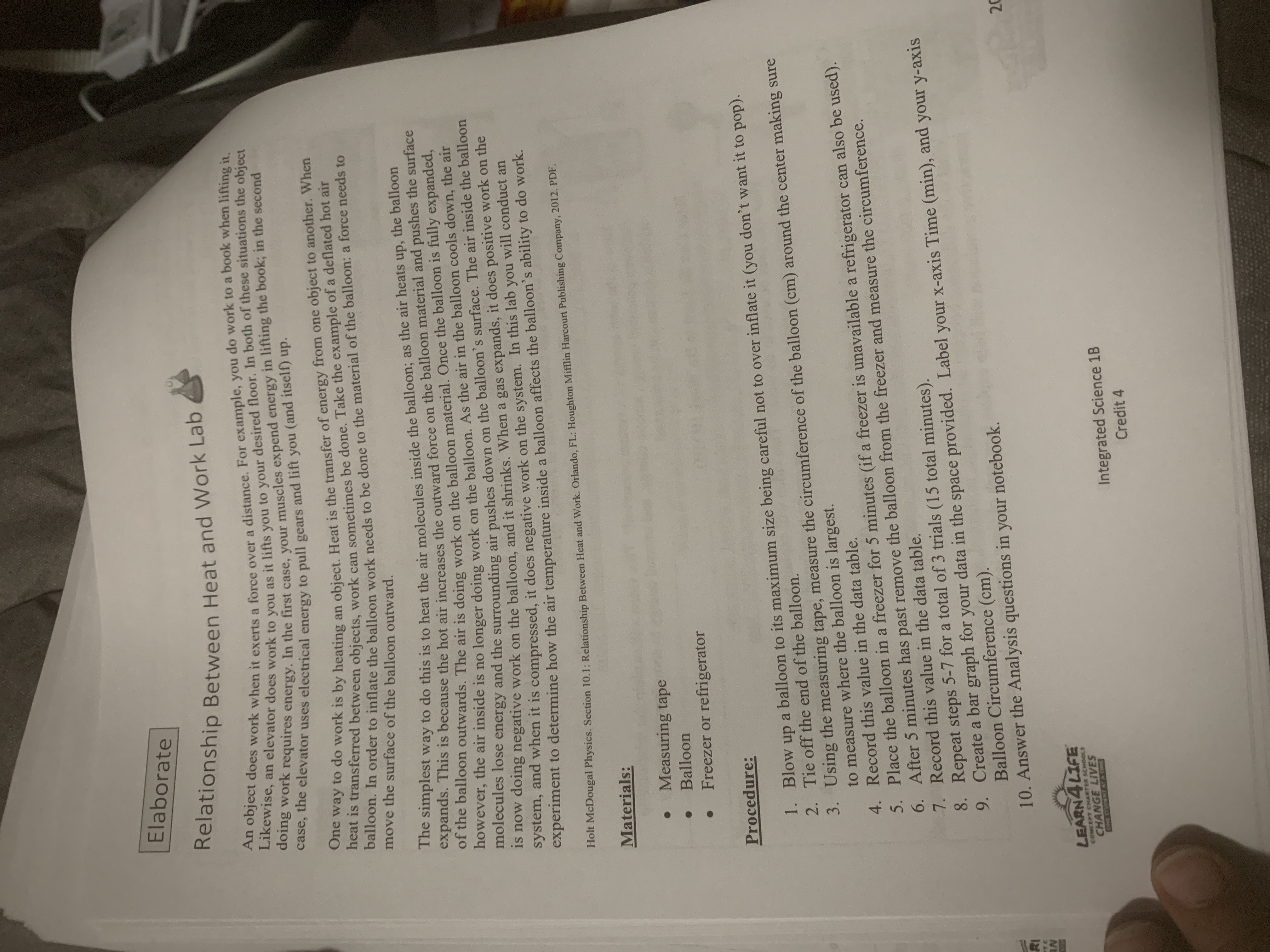
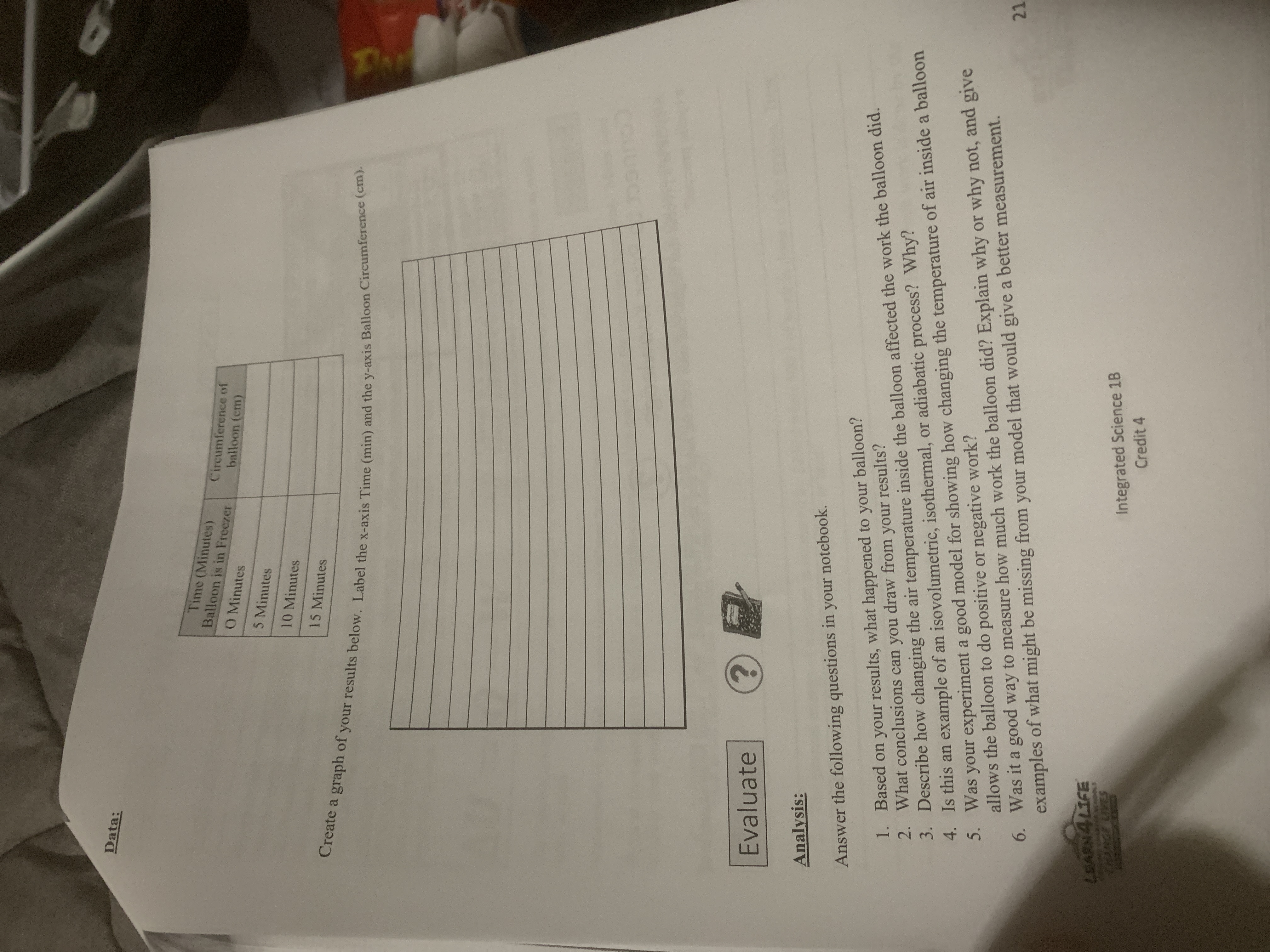
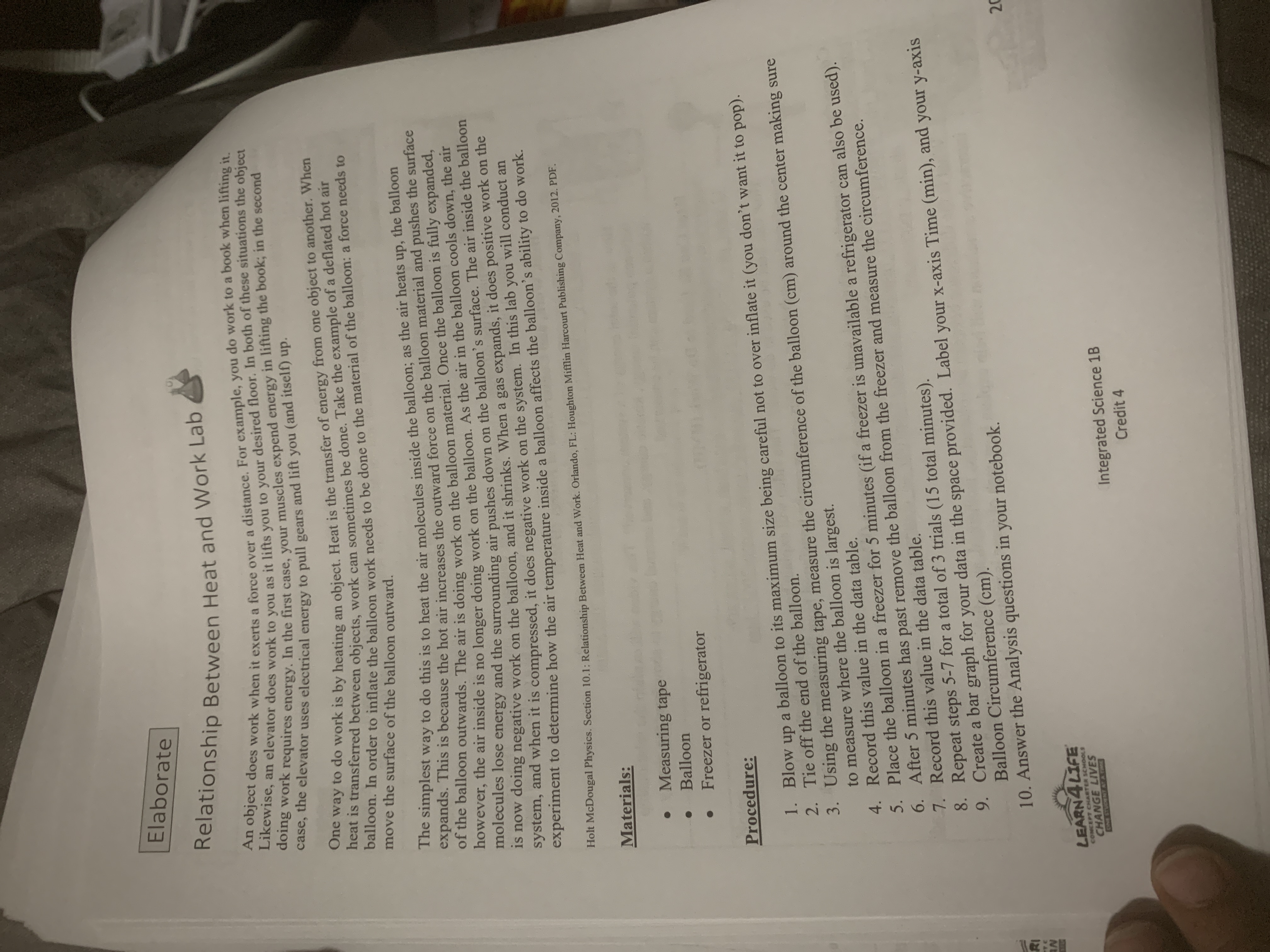
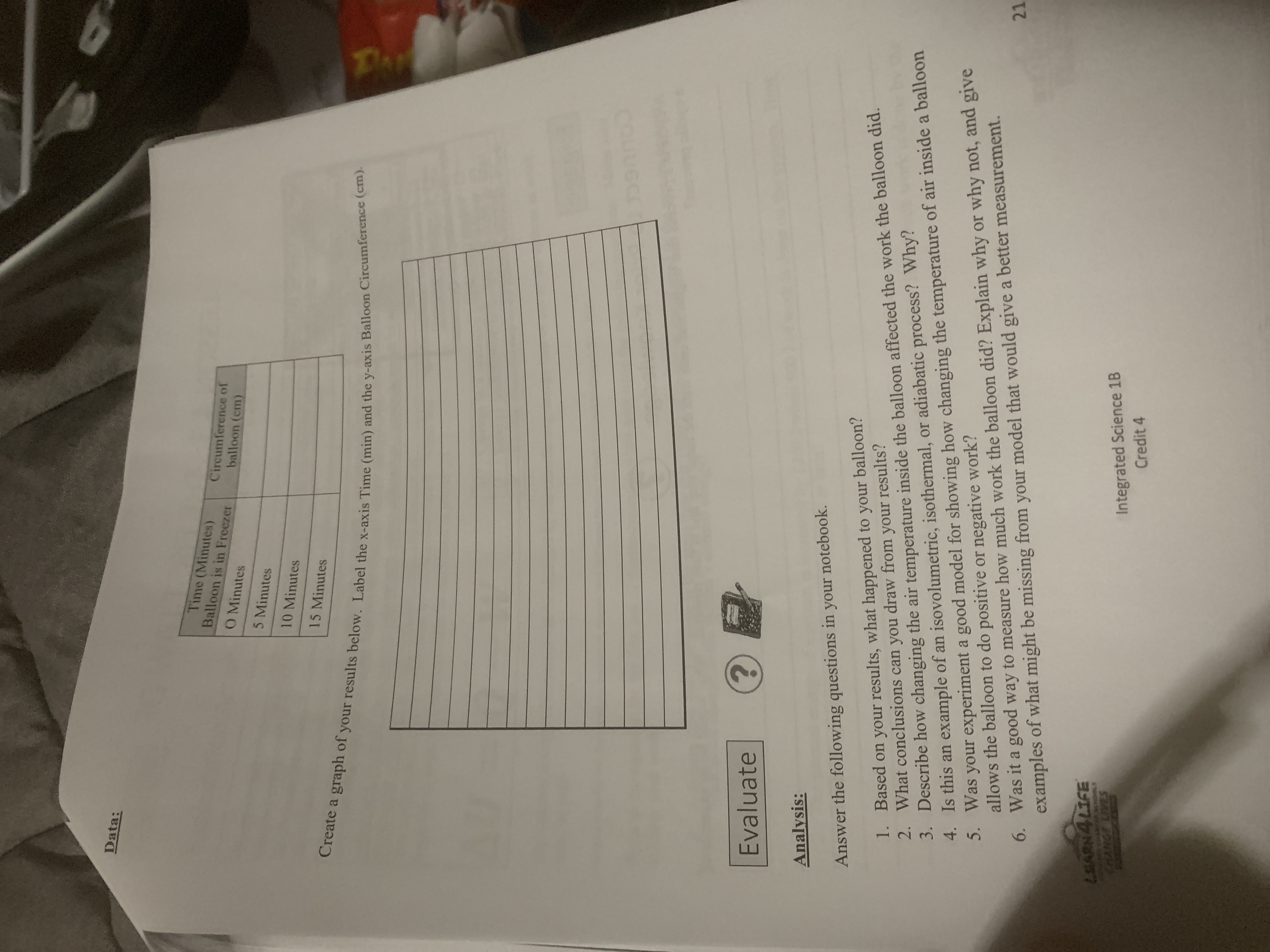
Elaborate Relationship Between Heat and Work Lab An object does work when it exerts a force over a distance. For example, you do work to a book when lifting it Likewise, an elevator does work to you as it lifts you to your desired floor. In both of these situations the object doing work requires energy. In the first case, your muscles expend energy in lifting the book; in the second case, the elevator uses electrical energy to pull gears and lift you (and itself) up. One way to do work is by heating an object. Heat is the transfer of energy from one object to another. When heat is transferred between objects, work , work can sometimes be done. Take the example of a deflated hot air balloon. In order to inflate the balloon work needs to be done to the material of the balloon: a force needs to move the surface of the balloon outward. The simplest way to do this is to heat the air molecules inside the balloon; as the air heats up, the balloon expands. This is because the hot air increases the outward force on the balloon material and pushes the surface of the balloon outwards. The air is doing work on the balloon material. Once the balloon is fully expanded, however, the air inside is no longer doing work on the balloon. As the air in the balloon cools down, the air molecules lose energy and the surrounding air pushes down on the balloon's surface. The air inside the balloon is now doing negative work on the balloon, and it shrinks. When a gas expands, it does positive work on the system, and when it is compressed, it does negative work on the system. In this lab you will conduct an experiment to determine how the air temperature inside a balloon affects the balloon's ability to do work. Holt Mcdougal Physics. Section 10.1: Relationship Between Heat and Work. Orlando, FL: Houghton Mifflin Harcourt Publishing Company, 2012. PDF. Materials: Measuring tape Balloon Freezer or refrigerator Procedure: 1. Blow up a balloon to its maximum size being careful not to over inflate it (you don't want it to pop). 2. Tie off the end of the balloon. 3. Using the measuring tape, measure the circumference of the balloon (cm) around the center making sure to measure where the balloon is largest. 4. Record this value in the data table. 5. Place the balloon in a freezer for 5 minutes (if a freezer is unavailable a refrigerator can also be used). 6. After 5 minutes has past remove the balloon from the freezer and measure the circumference. 7. Record this value in the data table. 8. Repeat steps 5-7 for a total of 3 trials (15 total minutes). 9. Create a bar graph for your data in the space provided. Label your x-axis Time (min), and your y-axis Balloon Circumference (cm). 10. Answer the Analysis questions in your notebook. LEARN 4LIFE CHANGE LIVES Integrated Science 1B Credit 4Data: Time (Minutes) Balloon is in Freezer O Minutes Circumference of balloon (em) 5 Minutes 10 Minutes 15 Minutes Create a graph of your results below. Label the x-axis Time (min) and the y-axis Balloon Circumference (cm). Evaluate ? Analysis: Answer the following questions in your notebook. 1. Based on your results, what happened to your balloon? 2. What conclusions can you draw from your results? 3. Describe how changing the air temperature inside the balloon affected the work the balloon did. 4. Is this an example of an isovolumetric, isothermal, or adiabatic process? Why? 5. Was your experiment a good model for showing how changing the temperature of air inside a balloon allows the balloon to do positive or negative work? 6. Was it a good way to measure how much work the balloon did? Explain why or why not, and give examples of what might be missing from your model that would give a better measurement. 21 LEARN A LIFE CHANGE LIVES Integrated Science 1B Credit 4
Step by Step Solution
There are 3 Steps involved in it

Get step-by-step solutions from verified subject matter experts
 Study Help