







Question: Electropolishing is a well - known method for improving the surface finish of a metallic component. Through detailed electrochemical studies, it has been found that
Electropolishing is a wellknown method for improving the surface finish of a metallic component.
Through detailed electrochemical studies, it has been found that during electropolishing of
copper parts in a phosphoric acidbased solution, the diffusion of copper phosphate species
determines the rate of electropolishing.
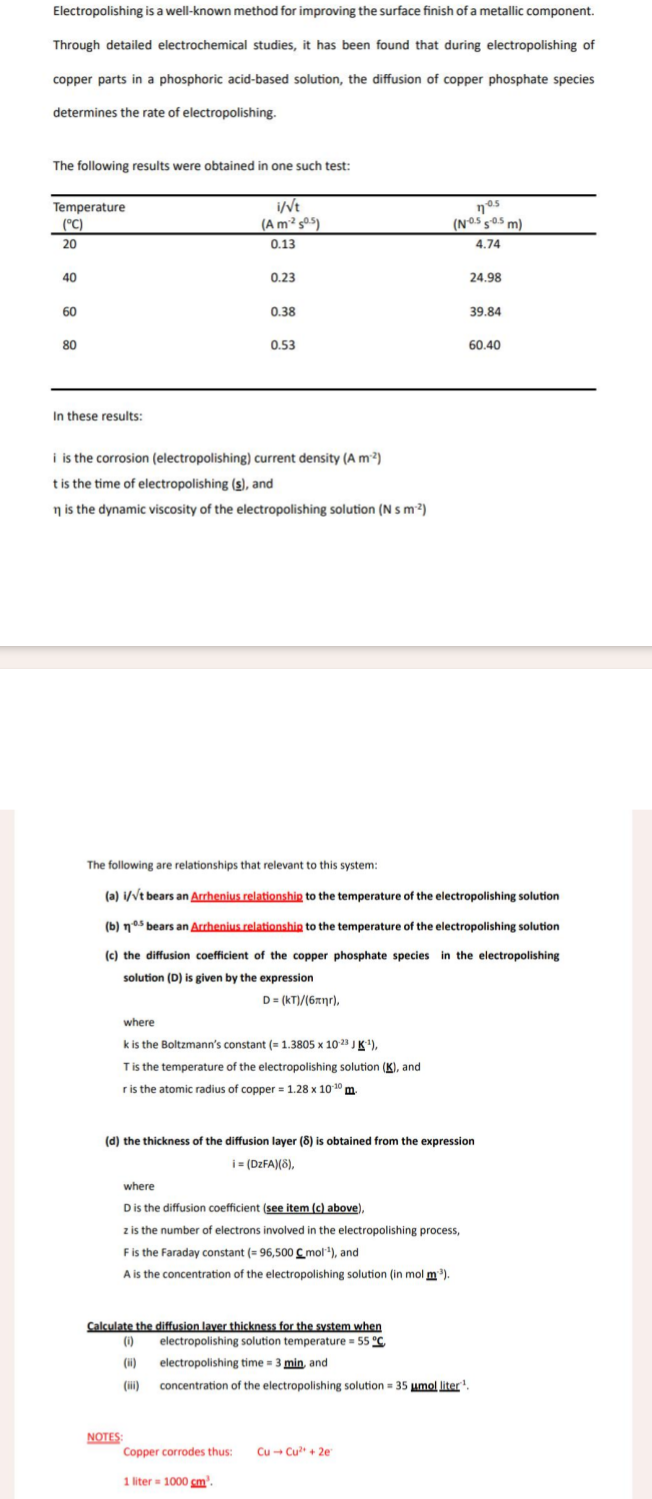
The following results were obtained in one such test:
In these results:
i is the corrosion electropolishing current density
is the time of electropolishing s and
is the dynamic viscosity of the electropolishing solution
The following are relationships that relevant to this system:
a t bears an Arrhenius relationship to the temperature of the electropolishing solution
b bears an Arrhenius relationshig to the temperature of the electropolishing solution
c the diffusion coefficient of the copper phosphate species in the electropolishing
solution D is given by the expression
where
k is the Boltzmann's constant
is the temperature of the electropolishing solution and
r is the atomic radius of copper
d the thickness of the diffusion layer is obtained from the expression
where
D is the diffusion coefficient see item c above
is the number of electrons involved in the electropolishing process,
is the concentration of the electropolishing solution in
Calculate the diffusion laver thickness for the system when
i electropolishing solution temperature
ii electropolishing time min, and
iii concentration of the electropolishing solution umol liter
NOTES:
Copper corrodes thus:
liter
Step by Step Solution
There are 3 Steps involved in it
1 Expert Approved Answer
Step: 1 Unlock

Question Has Been Solved by an Expert!
Get step-by-step solutions from verified subject matter experts
Step: 2 Unlock
Step: 3 Unlock
 Study Help