



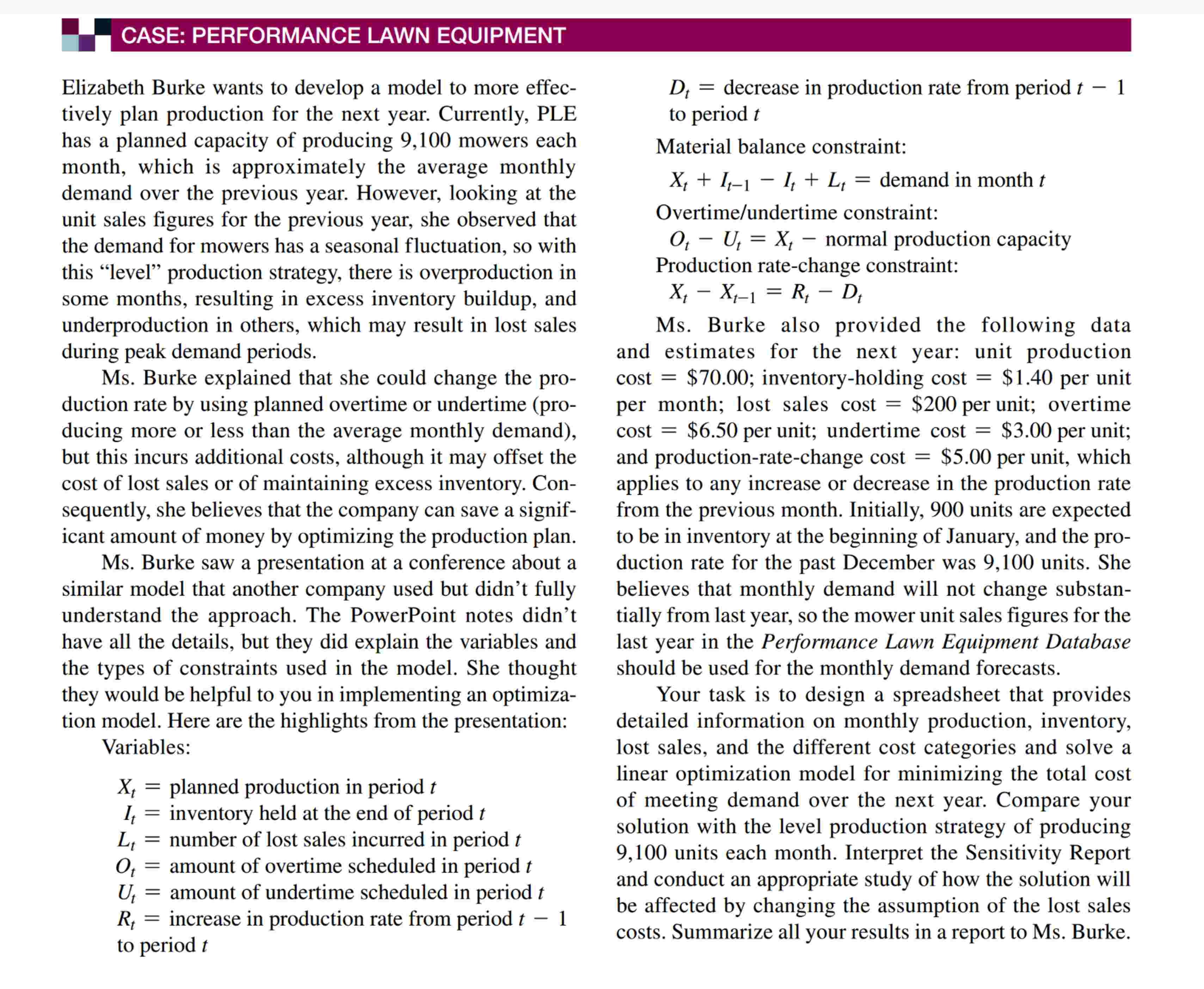
Question: Elizabeth Burke wants to develop a model to more effec - tively plan production for the next year. Currently, PLE has a planned capacity of
Elizabeth Burke wants to develop a model to more effec
tively plan production for the next year. Currently, PLE
has a planned capacity of producing mowers each
month, which is approximately the average monthly
demand over the previous year. However, looking at the
unit sales figures for the previous year, she observed that
the demand for mowers has a seasonal fluctuation, so with
this "level" production strategy, there is overproduction in
some months, resulting in excess inventory buildup, and
underproduction in others, which may result in lost sales
during peak demand periods.
Ms Burke explained that she could change the pro
duction rate by using planned overtime or undertime pro
ducing more or less than the average monthly demand
but this incurs additional costs, although it may offset the
cost of lost sales or of maintaining excess inventory. Con
sequently, she believes that the company can save a signif
icant amount of money by optimizing the production plan.
Ms Burke saw a presentation at a conference about a
similar model that another company used but didn't fully
understand the approach. The PowerPoint notes didn't
have all the details, but they did explain the variables and
the types of constraints used in the model. She thought
they would be helpful to you in implementing an optimiza
tion model. Here are the highlights from the presentation:
Variables:
Xt planned production in period t
It inventory held at the end of period t
Lt number of lost sales incurred in period t
Ot amount of overtime scheduled in period t
Ut amount of undertime scheduled in period t
Rt increase in production rate from period t
to period t
Dt decrease in production rate from period t
to period t
Material balance constraint:
XtItItLt demand in month t
Overtimeundertime constraint:
OtUtXt normal production capacity
Production ratechange constraint:
XtXtRtDt
Ms Burke also provided the following data
and estimates for the next year: unit production
cost $; inventoryholding cost $ per unit
per month; lost sales cost $ per unit; overtime
cost $ per unit; undertime cost $ per unit;
and productionratechange cost $ per unit, which
applies to any increase or decrease in the production rate
from the previous month. Initially, units are expected
to be in inventory at the beginning of January, and the pro
duction rate for the past December was units. She
believes that monthly demand will not change substan
tially from last year, so the mower unit sales figures for the
last year in the Performance Lawn Equipment Database
should be used for the monthly demand forecasts.
Your task is to design a spreadsheet that provides
detailed information on monthly production, inventory,
lost sales, and the different cost categories and solve a
linear optimization model for minimizing the total cost
of meeting demand over the next year. Compare your
solution with the level production strategy of producing
units each month. Interpret the Sensitivity Report
and conduct an appropriate study of how the solution will
be affected by changing the assumption of the lost sales
costs. Summarize all your results in a report to Ms Burke. The demand of each month are January; February;March;April; May; June; July August;September;October; November;December
Step by Step Solution
There are 3 Steps involved in it
1 Expert Approved Answer
Step: 1 Unlock

Question Has Been Solved by an Expert!
Get step-by-step solutions from verified subject matter experts
Step: 2 Unlock
Step: 3 Unlock