







Question: em 3 - Linking (10 points) (6 points) In the problem, let REF(x. I) >DEF(x. k) denote that the linker will associate an reference to
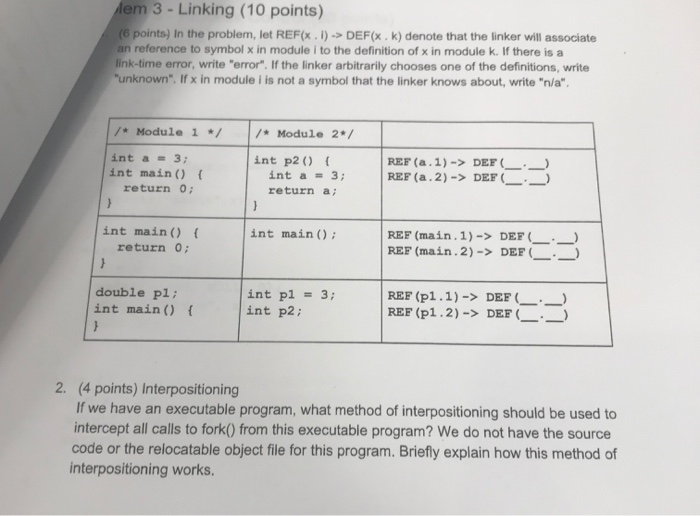
em 3 - Linking (10 points) (6 points) In the problem, let REF(x. I) >DEF(x. k) denote that the linker will associate an reference to symbol x in module i to the definition of x in module k. If there is a link-time error, write "error. If the linker arbitrarily chooses one of the definitions, write "unknown". If x in module i is not a symbol that the linker knows about, write "n/a" /* Module 1 Module 2* int p2 int a 3: int main) ( return 0 REF (a . 1 )-> | REF (a.2)-> DEF ( DEF (-_-) ) -- int a = 3; return a; int main) ( return 0; int main) REF (main.1)- DEF. REF (main.2)-DEF double pl; int main() f int pl3; int p2; REF (pl . 1 )-> DEF (---) REF (p1.2)-DEFC_._) 2. (4 points) Interpositioning If we have an executable program, what method of interpositioning should be used to intercept all calls to fork) from this executable program? We do not have the source code or the relocatable object file for this program. Briefly explain how this method of interpositioning works. em 3 - Linking (10 points) (6 points) In the problem, let REF(x. I) >DEF(x. k) denote that the linker will associate an reference to symbol x in module i to the definition of x in module k. If there is a link-time error, write "error. If the linker arbitrarily chooses one of the definitions, write "unknown". If x in module i is not a symbol that the linker knows about, write "n/a" /* Module 1 Module 2* int p2 int a 3: int main) ( return 0 REF (a . 1 )-> | REF (a.2)-> DEF ( DEF (-_-) ) -- int a = 3; return a; int main) ( return 0; int main) REF (main.1)- DEF. REF (main.2)-DEF double pl; int main() f int pl3; int p2; REF (pl . 1 )-> DEF (---) REF (p1.2)-DEFC_._) 2. (4 points) Interpositioning If we have an executable program, what method of interpositioning should be used to intercept all calls to fork) from this executable program? We do not have the source code or the relocatable object file for this program. Briefly explain how this method of interpositioning works
Step by Step Solution
There are 3 Steps involved in it

Get step-by-step solutions from verified subject matter experts
 Study Help