







Question: Energy Function (3 marks) Consider the image de-noising example in the lecture. Let the observed noisy image be described by an array of binary pixel
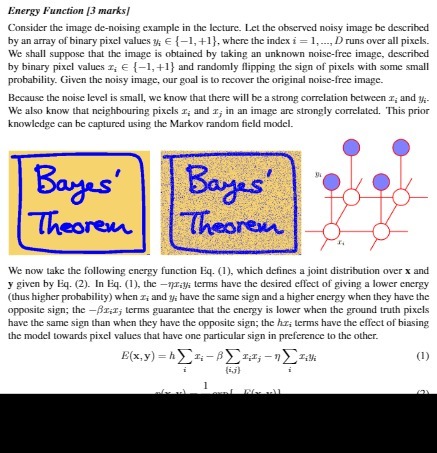
Energy Function (3 marks) Consider the image de-noising example in the lecture. Let the observed noisy image be described by an array of binary pixel values y, 6 {-1, +1}, where the index i = 1, ..., D runs over all pixels. We shall suppose that the image is obtained by taking an unknown noise-free image, described by binary pixel values z, 6 {-1, +1} and randomly flipping the sign of pixels with some small probability. Given the noisy image, our goal is to recover the original noise-free image. Because the noise level is small, we know that there will be a strong correlation between r; and y;- We also know that neighbouring pixels I, and I, in an image are strongly correlated. This prior knowledge can be captured using the Markov random field model. Bayes' Bayes' Theorem Theorem We now take the following energy function Bq. (1), which defines a joint distribution over x and y given by Biq. (2). In Bq. (1), the - meigs terms have the desired effect of giving a lower energy (thus higher probability) when Is and y: have the same sign and a higher energy when they have the opposite sign; the -BI;I; terms guarantee that the energy is lower when the ground truth pixels have the same sign than when they have the opposite sign; the he; terms have the effect of biasing the model towards pixel values that have one particular sign in preference to the other. E(x, y) = hEn-BY; - 1) (1) (ijl
Step by Step Solution
There are 3 Steps involved in it

Get step-by-step solutions from verified subject matter experts
 Study Help