







Question: Enginnering Optimization using Decision Tree An engineer must decide between spread footings or piles for the foundation to support each column of a building. The
Enginnering Optimization using Decision Tree
An engineer must decide between spread footings or piles for the foundation to support each column of a
building. The soil strength is not known for certain, but could be low, medium, or high. Spread footings
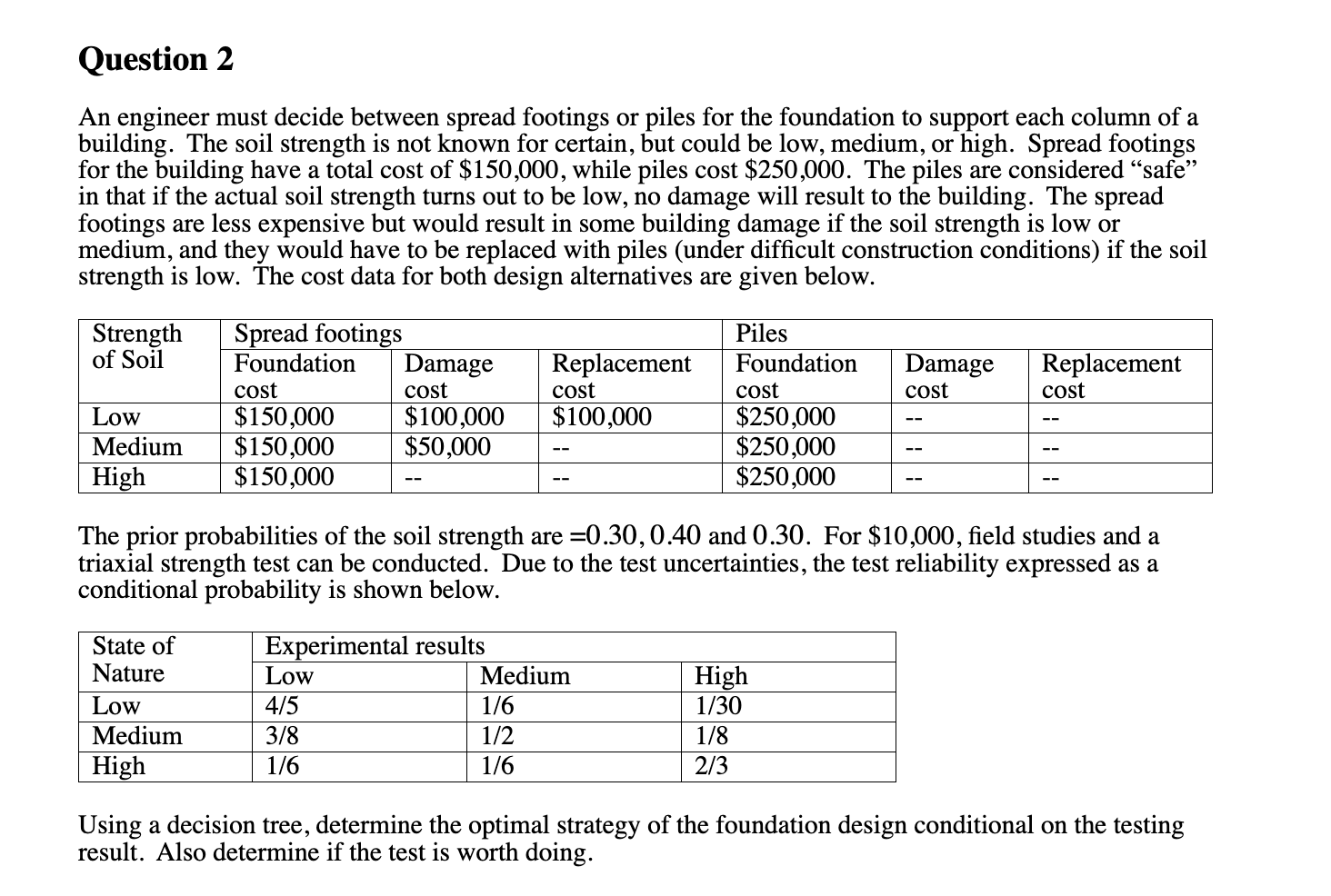
for the building have a total cost of $ while piles cost $ The piles are considered "safe"
in that if the actual soil strength turns out to be low, no damage will result to the building. The spread
footings are less expensive but would result in some building damage if the soil strength is low or
medium, and they would have to be replaced with piles under difficult construction conditions if the soil
strength is low. The cost data for both design alternatives are given below.
The prior probabilities of the soil strength are and For $ field studies and a
triaxial strength test can be conducted. Due to the test uncertainties, the test reliability expressed as a
conditional probability is shown below.
Using a decision tree, determine the optimal strategy of the foundation design conditional on the testing
result. Also determine if the test is worth doing.
Step by Step Solution
There are 3 Steps involved in it
1 Expert Approved Answer
Step: 1 Unlock

Question Has Been Solved by an Expert!
Get step-by-step solutions from verified subject matter experts
Step: 2 Unlock
Step: 3 Unlock
 Study Help