







Question: ENGR 2 1 3 Fall 2 0 2 4 This project will be online on Monday October 2 1 at 1 0 am . Marked
ENGR Fall
This project will be online on Monday October at am Marked on
Due date and time: November AM
Project to be done in teams of maximum students, minimum
Submit the solution online via the Moodle website of the course.
Accepted format: pdf jpeg, jpg
You are required to submit the complete solution of your project with explanation when needed. No need for a cover page, but make sure your name and your partner's names are clearly indicated on the first page.
No question will be answered on the project. It is your responsibility to seek the information based on what is given.
Context:
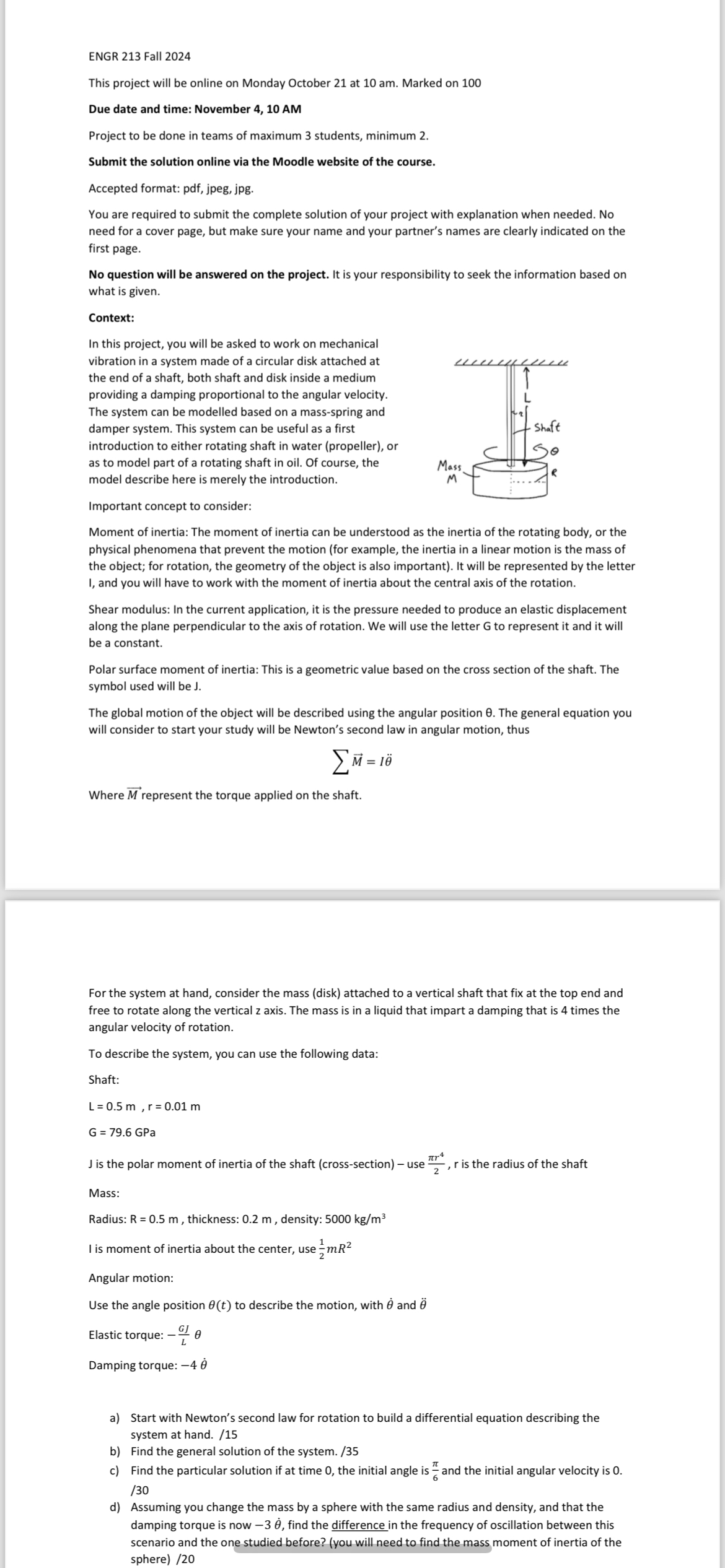
In this project, you will be asked to work on mechanical vibration in a system made of a circular disk attached at the end of a shaft, both shaft and disk inside a medium providing a damping proportional to the angular velocity. The system can be modelled based on a massspring and damper system. This system can be useful as a first introduction to either rotating shaft in water propeller or as to model part of a rotating shaft in oil. Of course, the model describe here is merely the introduction.
Important concept to consider:
Moment of inertia: The moment of inertia can be understood as the inertia of the rotating body, or the physical phenomena that prevent the motion for example, the inertia in a linear motion is the mass of the object; for rotation, the geometry of the object is also important It will be represented by the letter I and you will have to work with the moment of inertia about the central axis of the rotation.
Shear modulus: In the current application, it is the pressure needed to produce an elastic displacement along the plane perpendicular to the axis of rotation. We will use the letter G to represent it and it will be a constant.
Polar surface moment of inertia: This is a geometric value based on the cross section of the shaft. The symbol used will be J
The global motion of the object will be described using the angular position The general equation you will consider to start your study will be Newton's second law in angular motion, thus
vec
Where vec represent the torque applied on the shaft.
For the system at hand, consider the mass disk attached to a vertical shaft that fix at the top end and free to rotate along the vertical axis. The mass is in a liquid that impart a damping that is times the angular velocity of rotation.
To describe the system, you can use the following data:
Shaft:
GPa
is the polar moment of inertia of the shaft crosssection use is the radius of the shaft
Mass:
Radius: thickness: m density:
I is moment of inertia about the center, use
Angular motion:
Use the angle position to describe the motion, with and
Elastic torque:
Damping torque:
a Start with Newton's second law for rotation to build a differential equation describing the system at hand.
b Find the general solution of the system.
c Find the particular solution if at time the initial angle is and the initial angular velocity is
d Assuming you change the mass by a sphere with the same radius and density, and that the damping torque is now find the difference in the frequency of oscillation between this scenario and the one studied before? you will need to find the mass moment of inertia of the sphere
Step by Step Solution
There are 3 Steps involved in it
1 Expert Approved Answer
Step: 1 Unlock

Question Has Been Solved by an Expert!
Get step-by-step solutions from verified subject matter experts
Step: 2 Unlock
Step: 3 Unlock
 Study Help