







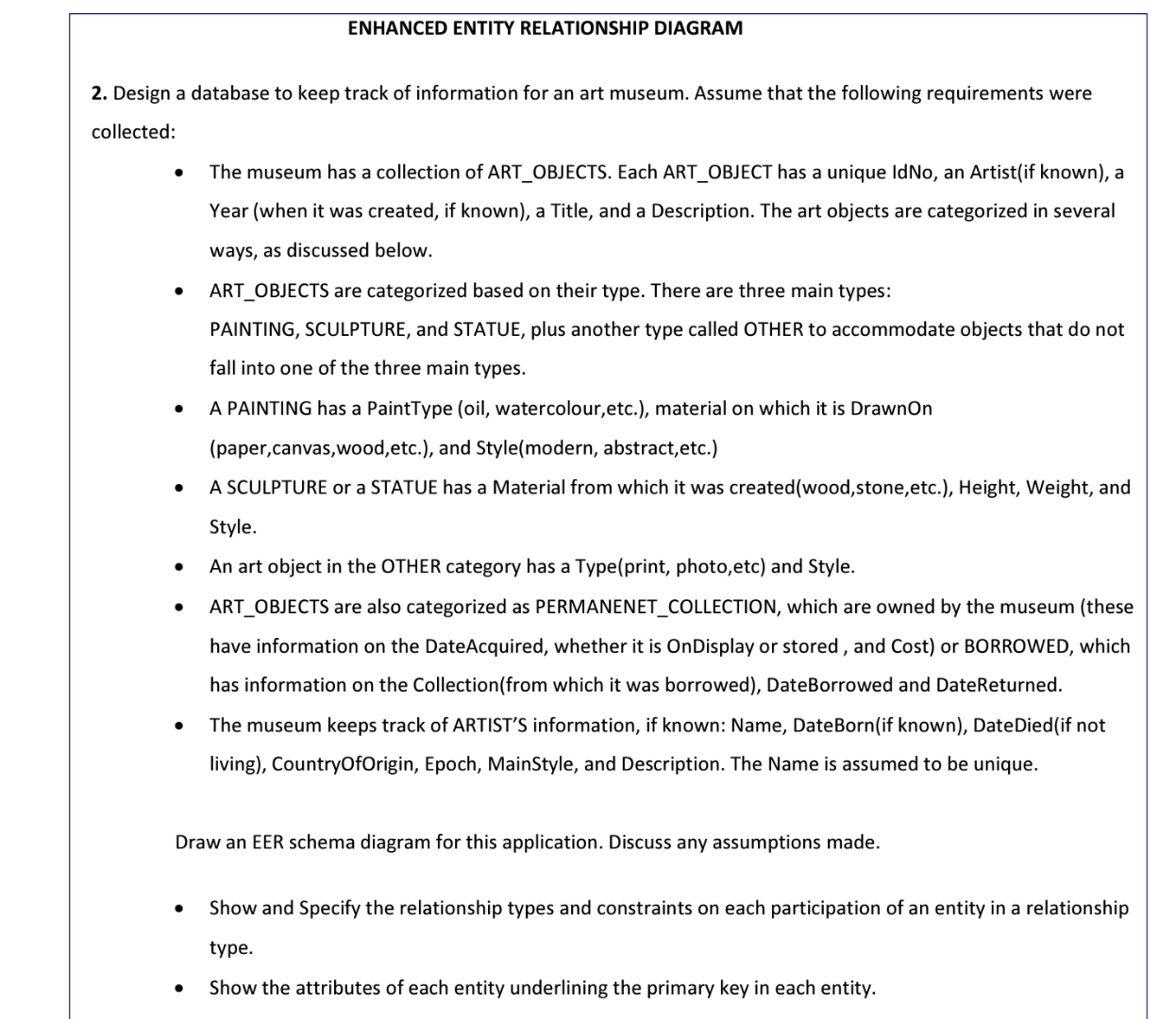
Question: ENHANCED ENTITY RELATIONSHIP DIAGRAM Design a database to keep track of information for an art museum. Assume that the following requirements were collected: The museum
ENHANCED ENTITY RELATIONSHIP DIAGRAM
Design a database to keep track of information for an art museum. Assume that the following requirements were
collected:
The museum has a collection of ARTOBJECTS. Each ARTOBJECT has a unique IdNo, an Artistif known a
Year when it was created, if known a Title, and a Description. The art objects are categorized in several
ways, as discussed below.
ARTOBJECTS are categorized based on their type. There are three main types:
PAINTING, SCULPTURE, and STATUE, plus another type called OTHER to accommodate objects that do not
fall into one of the three main types.
A PAINTING has a PaintType oil watercolour,etc. material on which it is DrawnOn
papercanvas, wood,etc. and Stylemodern abstractetc.
A SCULPTURE or a STATUE has a Material from which it was createdwoodstone,etc. Height, Weight, and
Style.
An art object in the OTHER category has a Typeprint photo,etc and Style.
ARTOBJECTS are also categorized as PERMANENETCOLLECTION, which are owned by the museum these
have information on the DateAcquired, whether it is OnDisplay or stored, and Cost or BORROWED, which
has information on the Collectionfrom which it was borrowed DateBorrowed and DateReturned.
The museum keeps track of ARTIST'S information, if known: Name, DateBornif known DateDiedif not
living CountryOfOrigin, Epoch, MainStyle, and Description. The Name is assumed to be unique.
Draw an EER schema diagram for this application. Discuss any assumptions made.
Show and Specify the relationship types and constraints on each participation of an entity in a relationship
type.
Show the attributes of each entity underlining the primary key in each entity.
Step by Step Solution
There are 3 Steps involved in it
1 Expert Approved Answer
Step: 1 Unlock

Question Has Been Solved by an Expert!
Get step-by-step solutions from verified subject matter experts
Step: 2 Unlock
Step: 3 Unlock
 Study Help