







Question: Enter formulas in cells that contain question marks (only use formulas). After entering formulas in all of the cells that contain question marks, verify that
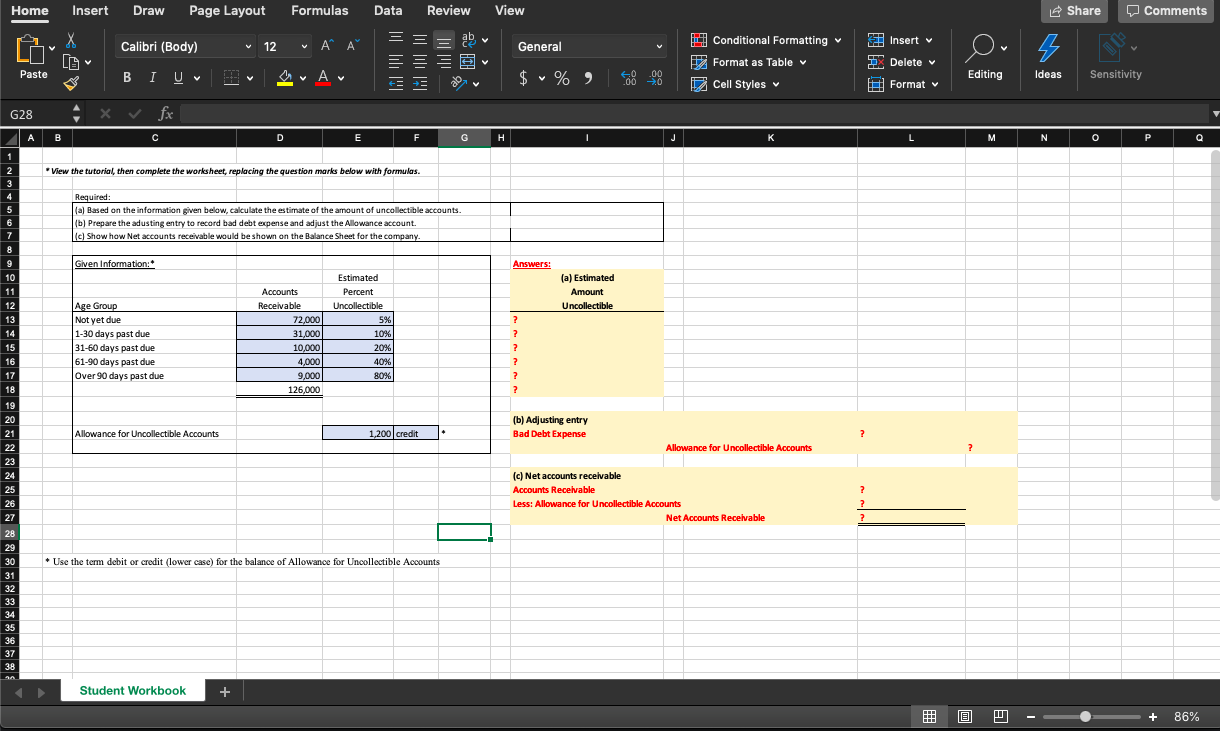
Enter formulas in cells that contain question marks (only use formulas). After entering formulas in all of the cells that contain question marks, verify that the amounts match the example below.
(a) Estimated Amount Uncollectible
$ 3,600 3,100 2,000 1,600 7,200 $ 17,500
(b) Adjusting entry Bad Debt Expense 16,300 Allowance for Uncollectible Accounts 16,300
(c) Net accounts receivable Accounts Receivable $ 126,000 Less: Allowance for Uncollectible Accounts (17,500 ) Net Accounts Receivable $ 108,500 Check your worksheet setup and formulas by changing the 'Over 90 days past due' amount to $19,000, and the Allowance for Uncollectible Accounts balance at the end of the period to $1,500 (credit). You should now have an estimated uncollectible amount of $25,500 and an adjustment amount of $24,000. If you do not get this answer, review your worksheet and the formulas you used.
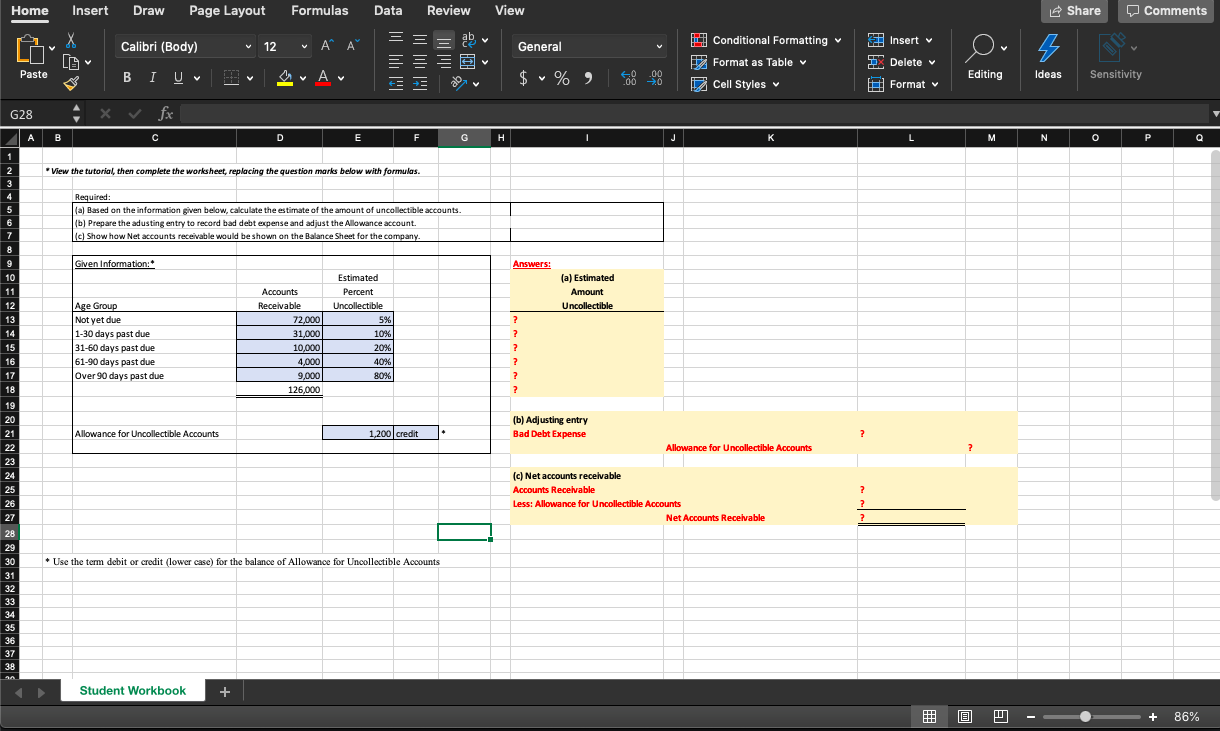
Revise your worksheet to reflect these updated assumptions then answer the questions that follow. You have been provided with the following Aging Report to use to adjust the Allowance for Uncollectible Accounts for a company at year-end.
| Age Group | Accounts Receivable | Estimated Percent Uncollectible | ||||||
| Not yet due | $ | 90,000 | 5 | % | ||||
| 1-30 days past due | 40,000 | 10 | % | |||||
| 31-60 days past due | 28,000 | 20 | % | |||||
| 61-90 days past due | 22,000 | 40 | % | |||||
| Over 90 days past due | 18,000 | 80 | % | |||||
| $ | 198,000 | |||||||
| Allowance for Uncollectible Accounts | 2,100 | Credit |
After reviewing the data, you note the "not yet due" category is overstated and needs to decrease by 20%. Also, the "Over 90 days" category is understated and needs to increase by 20%. Also, you note the balance in the Allowance account is actually a debit, rather than a credit. Being that the normal balance for this account is a credit, the accountant hadn't noticed the issue. Required: 1. Use your spreadsheet to recalculate the needed adjustment and account balances. What will be the balance in Accounts Receivable and the Allowance for Uncollectible Accounts based on the above information? 2. Prepare the journal entry to adjust the Allowance for Uncollectible Accounts, using your corrected data. (If no entry is required for a particular transaction/event, select "No Journal Entry Required" in the first account field.) 3. Which statement is true regarding the effect of the Allowance account being shown incorrectly as a credit rather than as a debit balance in the original account analysis?
A.) The error caused the journal entry to require a credit to Bad Debts Expense rather than a debit.
B.) Correcting the error increased the amount of Bad Debt Expense recorded for the period.
C.) Correcting the error decreased the amount of Bad Debt Expense recorded for the period.
D.) The Allowance account and the adjustment were not affected by the original misstatement, as it was only an estimate.
= =
Step by Step Solution
There are 3 Steps involved in it

Get step-by-step solutions from verified subject matter experts
 Study Help