Question: Entity-Relationship Modelling (22 marks) Use the following case study description to answer questions 4 and 5. Smiggle Corporation (SC) has a department store with average
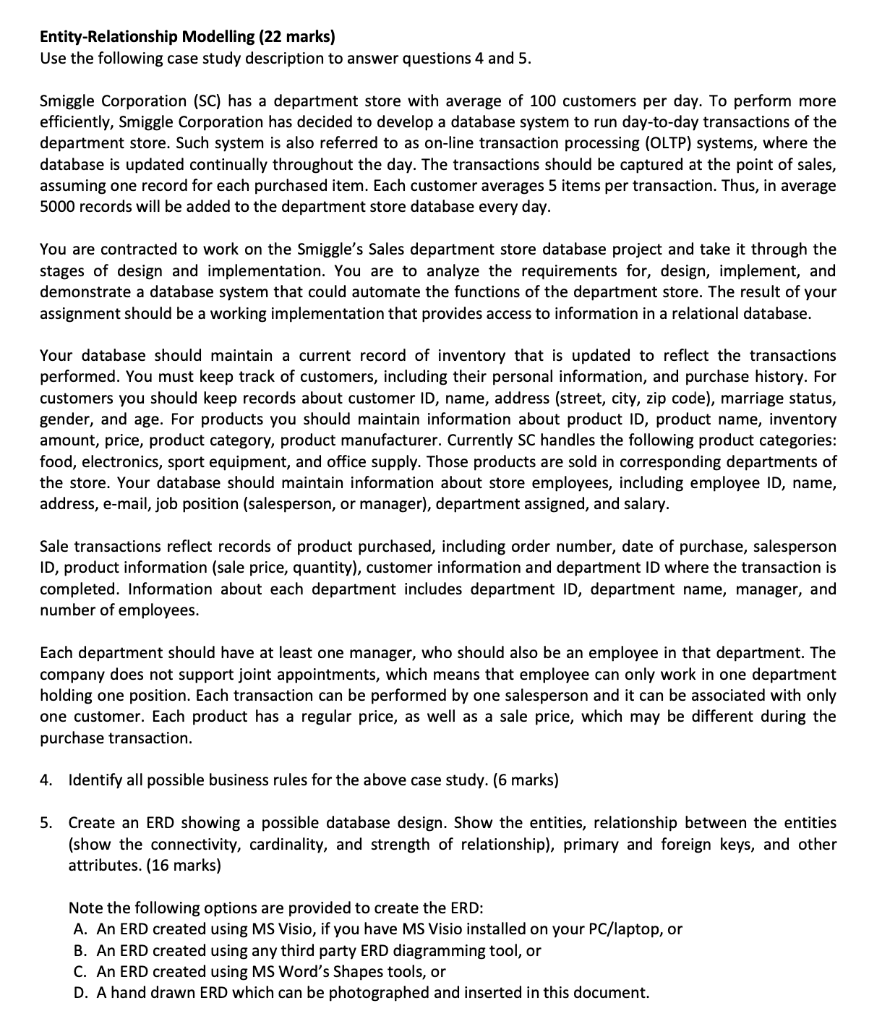
Entity-Relationship Modelling (22 marks) Use the following case study description to answer questions 4 and 5. Smiggle Corporation (SC) has a department store with average of 100 customers per day. To perform more efficiently, Smiggle Corporation has decided to develop a database system to run day-to-day transactions of the department store. Such system is also referred to as on-line transaction processing (OLTP) systems, where the database is updated continually throughout the day. The transactions should be captured at the point of sales, assuming one record for each purchased item. Each customer averages 5 items per transaction. Thus, in average 5000 records will be added to the department store database every day. You are contracted to work on the Smiggle's Sales department store database project and take it through the stages of design and implementation. You are to analyze the requirements for, design, implement, and demonstrate a database system that could automate the functions of the department store. The result of your assignment should be a working implementation that provides access to information in a relational database. Your database should maintain a current record of inventory that is updated to reflect the transactions performed. You must keep track of customers, including their personal information, and purchase history. For customers you should keep records about customer ID, name, address (street, city, zip code), marriage status, gender, and age. For products you should maintain information about product ID, product name, inventory amount, price, product category, product manufacturer. Currently SC handles the following product categories: food, electronics, sport equipment, and office supply. Those products sold in corresponding rtments of the store. Your database should maintain information about store employees, including employee ID, name, address, e-mail, job position (salesperson, or manager), department assigned, and salary. Sale transactions reflect records of product purchased, including order number, date of purchase, salesperson ID, product information (sale price, quantity), customer information and department ID where the transaction is completed. Information about each department includes department ID, department name, manager, and number of employees. Each department should have at least one manager, who should also be an employee in that department. The company does not support joint appointments, which means that employee can only work in one department holding one position. Each transaction can be performed by one salesperson and it can be associated with only one customer. Each product has a regular price, as well as a sale price, which may be different during the purchase transaction. 4. Identify all possible business rules for the above case study. (6 marks) 5. Create an ERD showing a possible database design. Show the entities, relationship between the entities (show the connectivity, cardinality, and strength of relationship), primary and foreign keys, and other attributes. (16 marks) Note the following options are provided to create the ERD: A. An ERD created using MS Visio, if you have MS Visio installed on your PC/laptop, or B. An ERD created using any third party ERD diagramming tool, or C. An ERD created using MS Word's Shapes tools, or D. A hand drawn ERD which can be photographed and inserted in this document









 Study Help