







Question: Entropy - role in describing irreversible processes Consider two regions that are isolated from their surroundings but which share a thermally conducting boundary with each
Entropy - role in describing irreversible processes\ Consider two regions that are isolated from their surroundings but which share a thermally conducting boundary with each other.\ Common sense predicts that if the two regions are at different temperatures, heat will spontaneously flow from the higher temperature region into the lower temperature region. A thermodynamics textbook will also say that this is an irreversible process.\ The former observation indicates that the heat transfer,
q, is non-zero. (Think about how many ways you might define
qfor this problem geometry.) The latter observation indicates that the Gibbs free energy change for the overall system,
dG_(SYS), must be non-zero and negative.\ Construct a brief but rigorous proof of the last assertion.
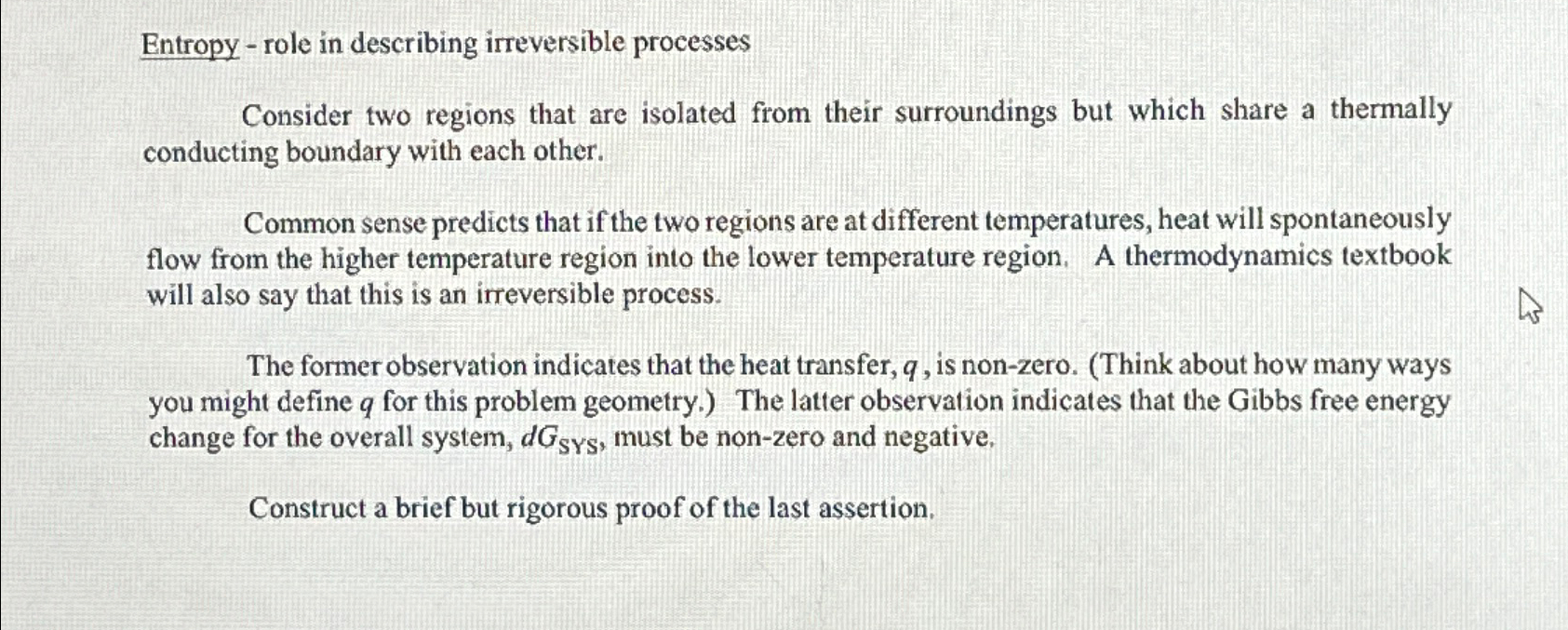
Entropy - role in describing irreversible processes Consider two regions that are isolated from their surroundings but which share a thermally conducting boundary with each other. Common sense predicts that if the two regions are at different temperatures, heat will spontaneously flow from the higher temperature region into the lower temperature region. A thermodynamics textbook will also say that this is an irreversible process. The former observation indicates that the heat transfer, q, is non-zero. (Think about how many ways you might define q for this problem geometry.) The latter observation indicates that the Gibbs free energy change for the overall system, dGSYS, must be non-zero and negative, Construct a brief but rigorous proof of the last assertion
Step by Step Solution
There are 3 Steps involved in it

Get step-by-step solutions from verified subject matter experts
 Study Help