







Question: ENVIRONMENTAL CHEMISTRY 3. 4. PRACTICE EXERCISE 9.4 Identification. Write the answer on the space provided. 1. It refers to the size, number, and arrangement of
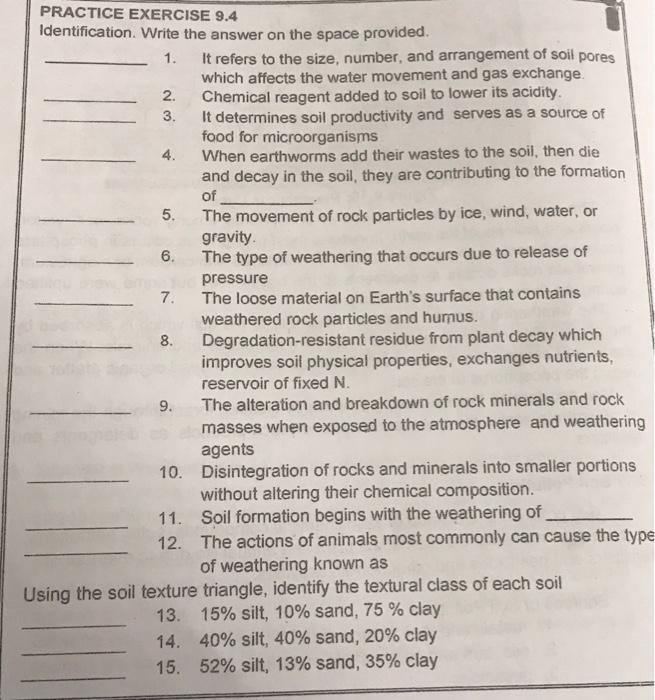
3. 4. PRACTICE EXERCISE 9.4 Identification. Write the answer on the space provided. 1. It refers to the size, number, and arrangement of soil pores which affects the water movement and gas exchange. 2. Chemical reagent added to soil to lower its acidity. It determines soil productivity and serves as a source of food for microorganisms When earthworms add their wastes to the soil, then die and decay in the soil, they are contributing to the formation of 5. The movement of rock particles by ice, wind, water, or gravity 6. The type of weathering that occurs due to release of pressure 7. The loose material on Earth's surface that contains weathered rock particles and humus. 8. Degradation-resistant residue from plant decay which improves soil physical properties, exchanges nutrients, reservoir of fixed N. 9. The alteration and breakdown of rock minerals and rock masses when exposed to the atmosphere and weathering agents 10. Disintegration of rocks and minerals into smaller portions without altering their chemical composition. 11. Soil formation begins with the weathering of 12. The actions of animals most commonly can cause the type of weathering known as Using the soil texture triangle, identify the textural class of each soil 13. 15% silt, 10% sand, 75 % clay 14. 40% silt, 40% sand, 20% clay 15. 52% silt, 13% sand, 35% clay
Step by Step Solution
There are 3 Steps involved in it

Get step-by-step solutions from verified subject matter experts
 Study Help