



Question: Environmental Economics, EEP101 /ECON125 Problem Set 3 James Sallee Spring 2024 Problem set 3 covers core concepts from module 3. You MUST complete and upload
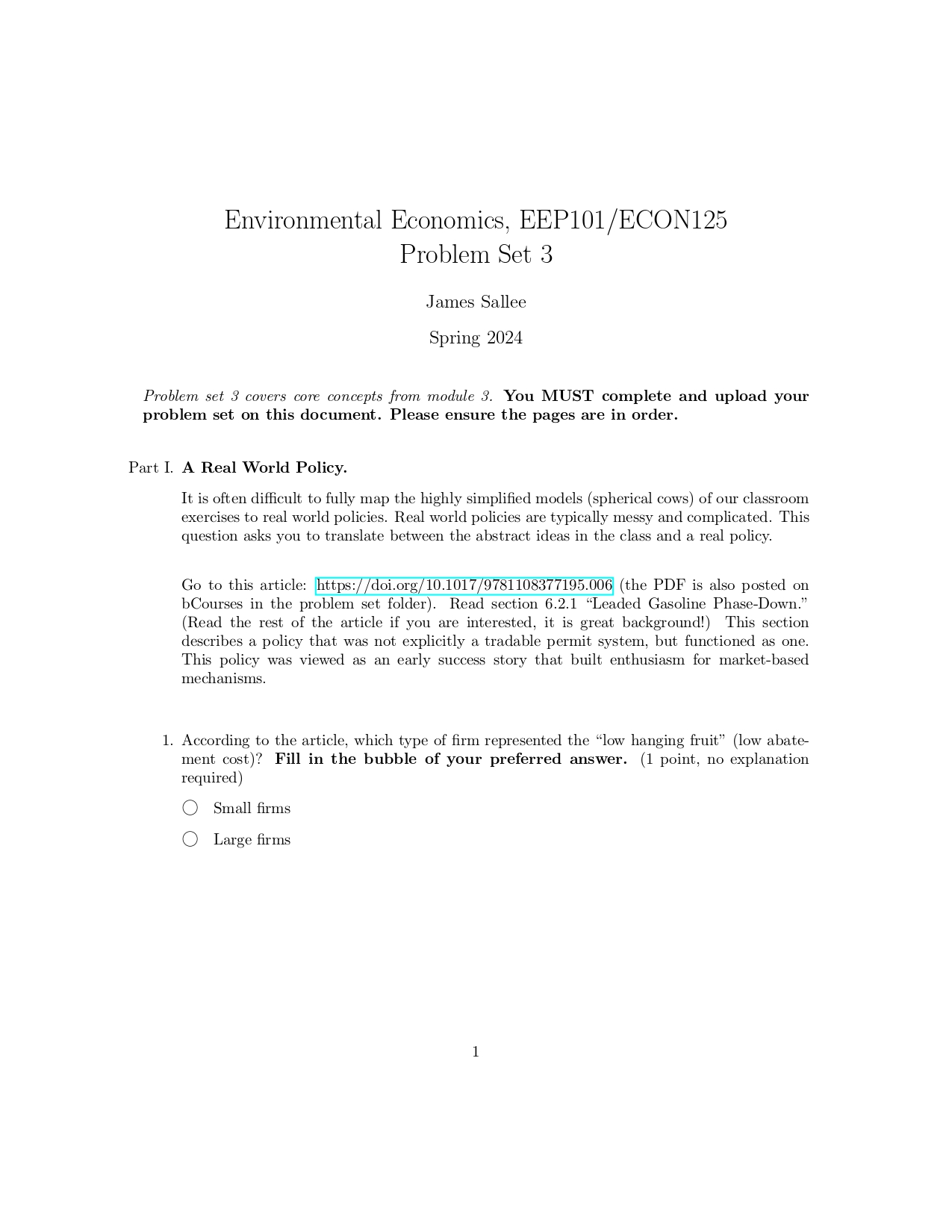
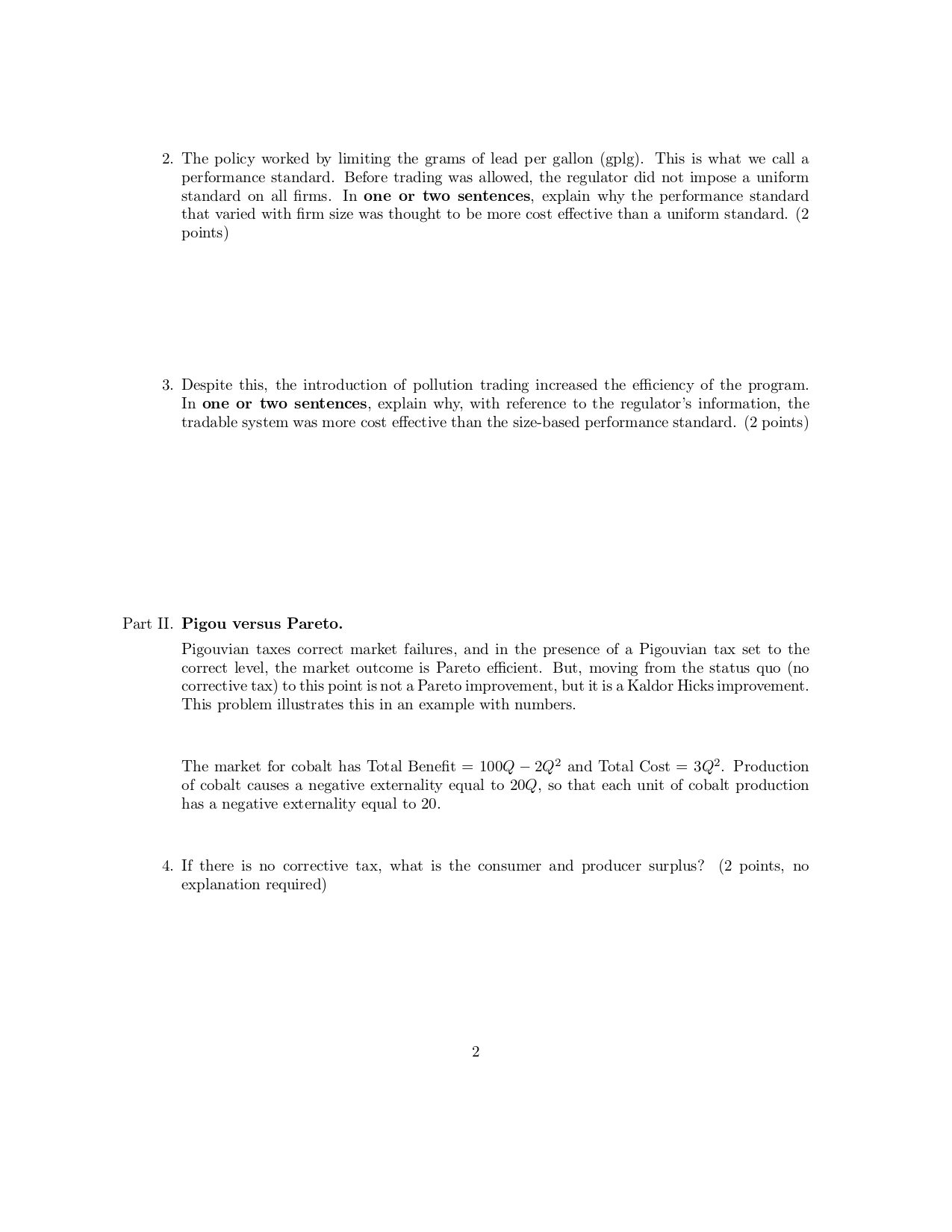
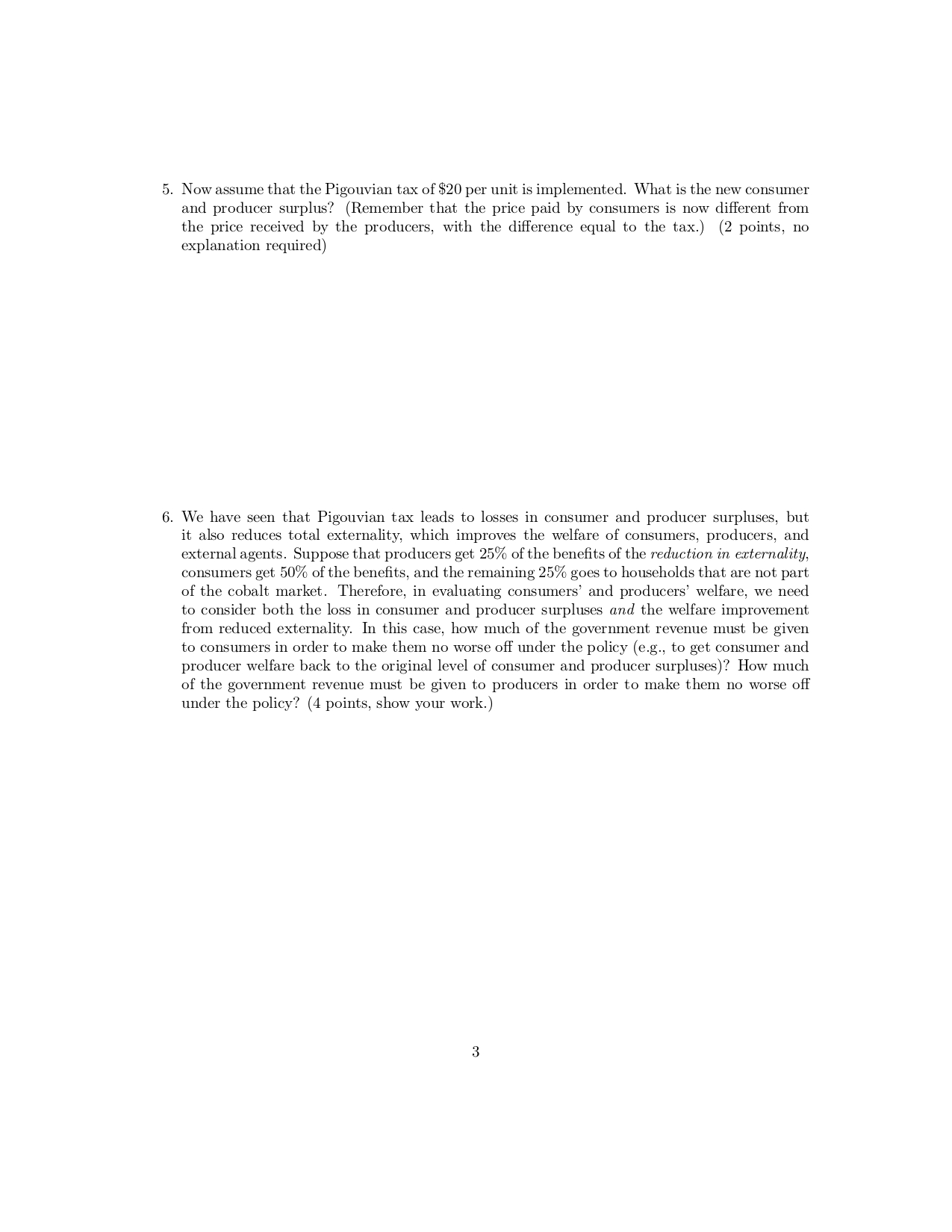
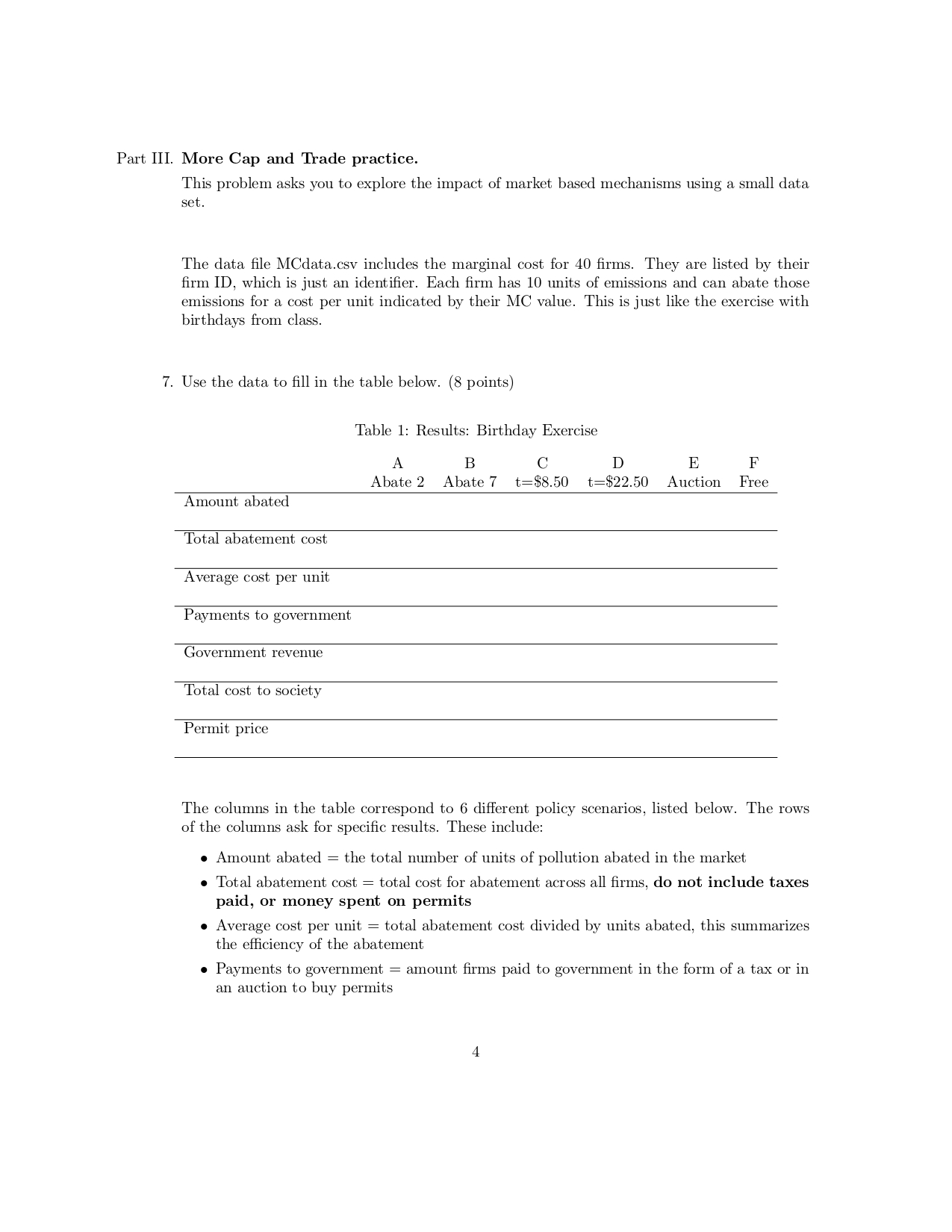
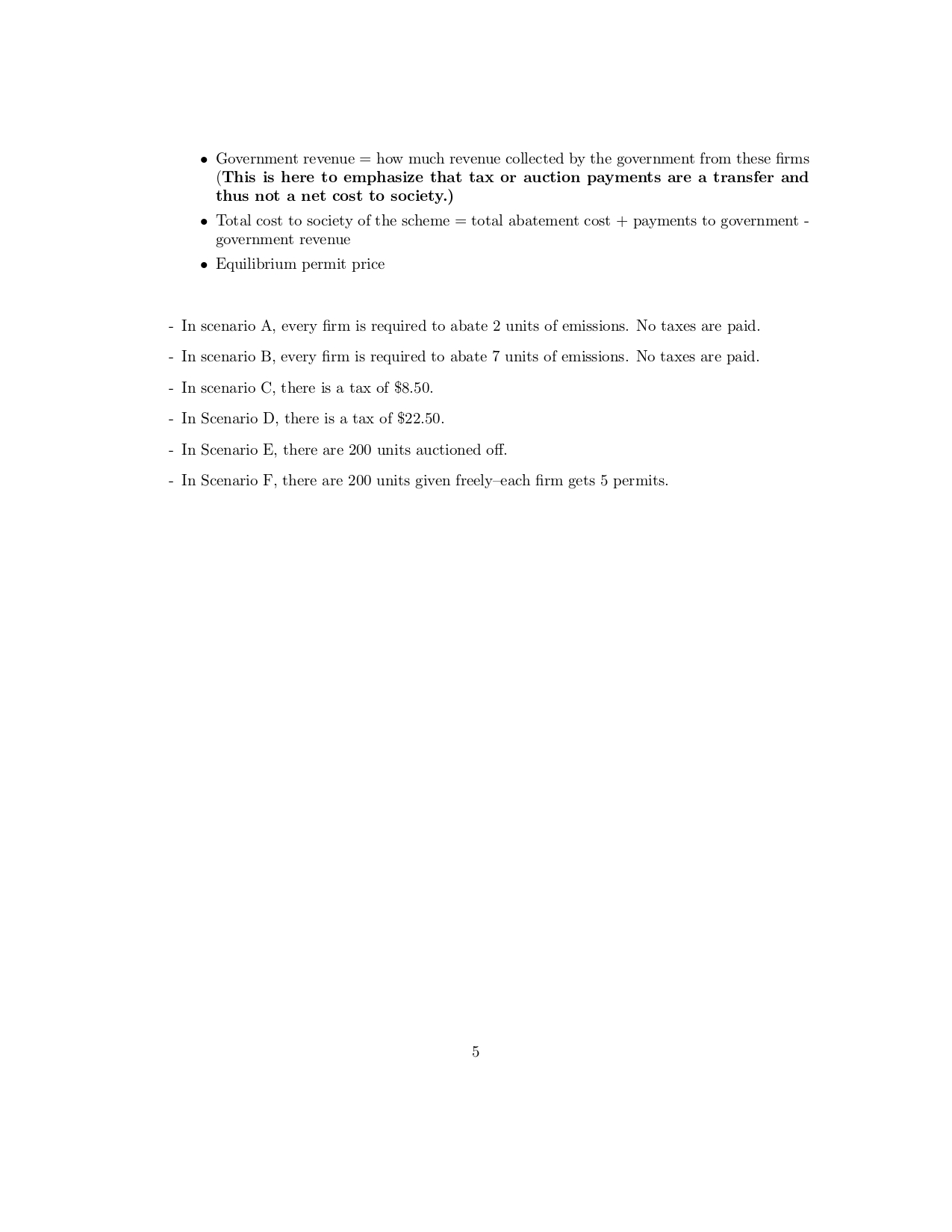
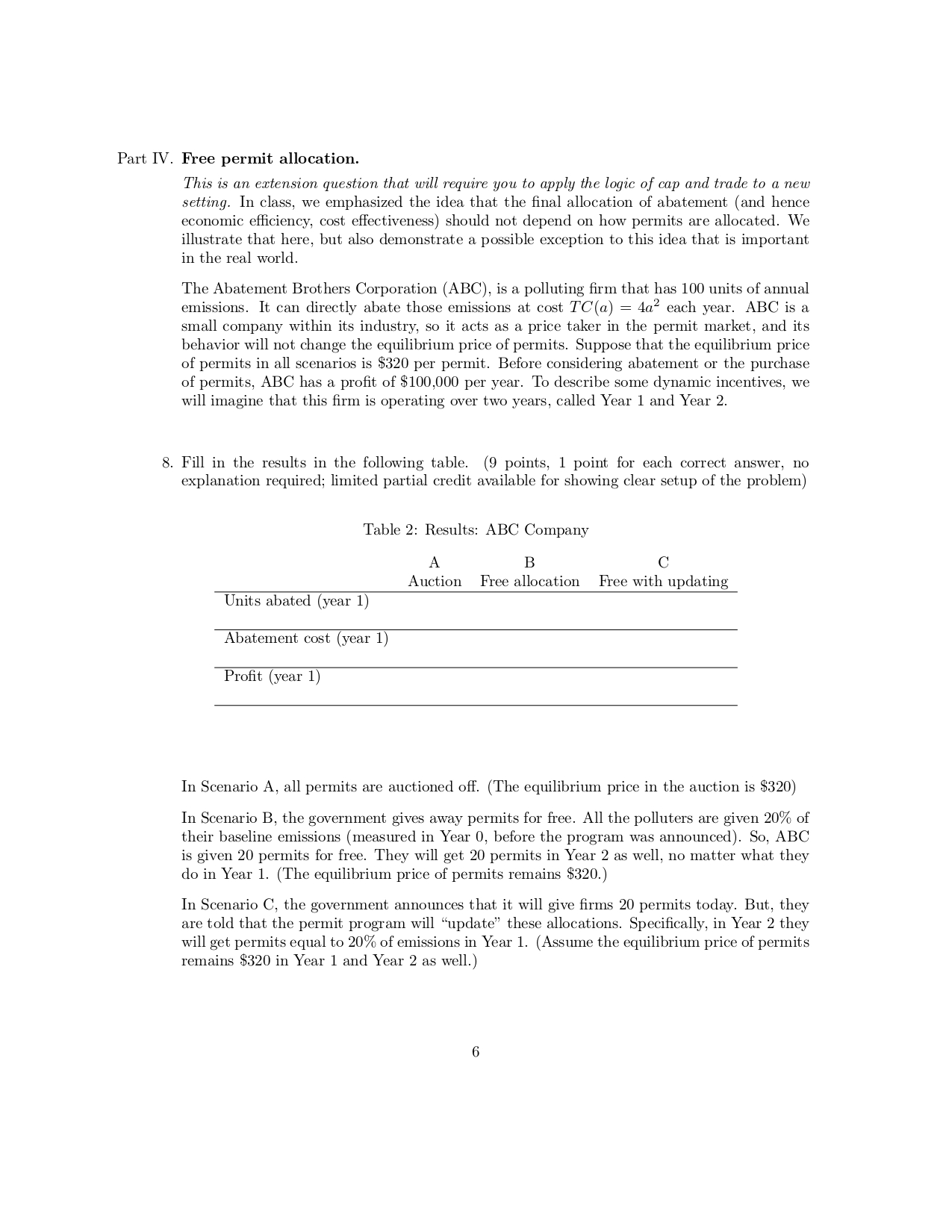

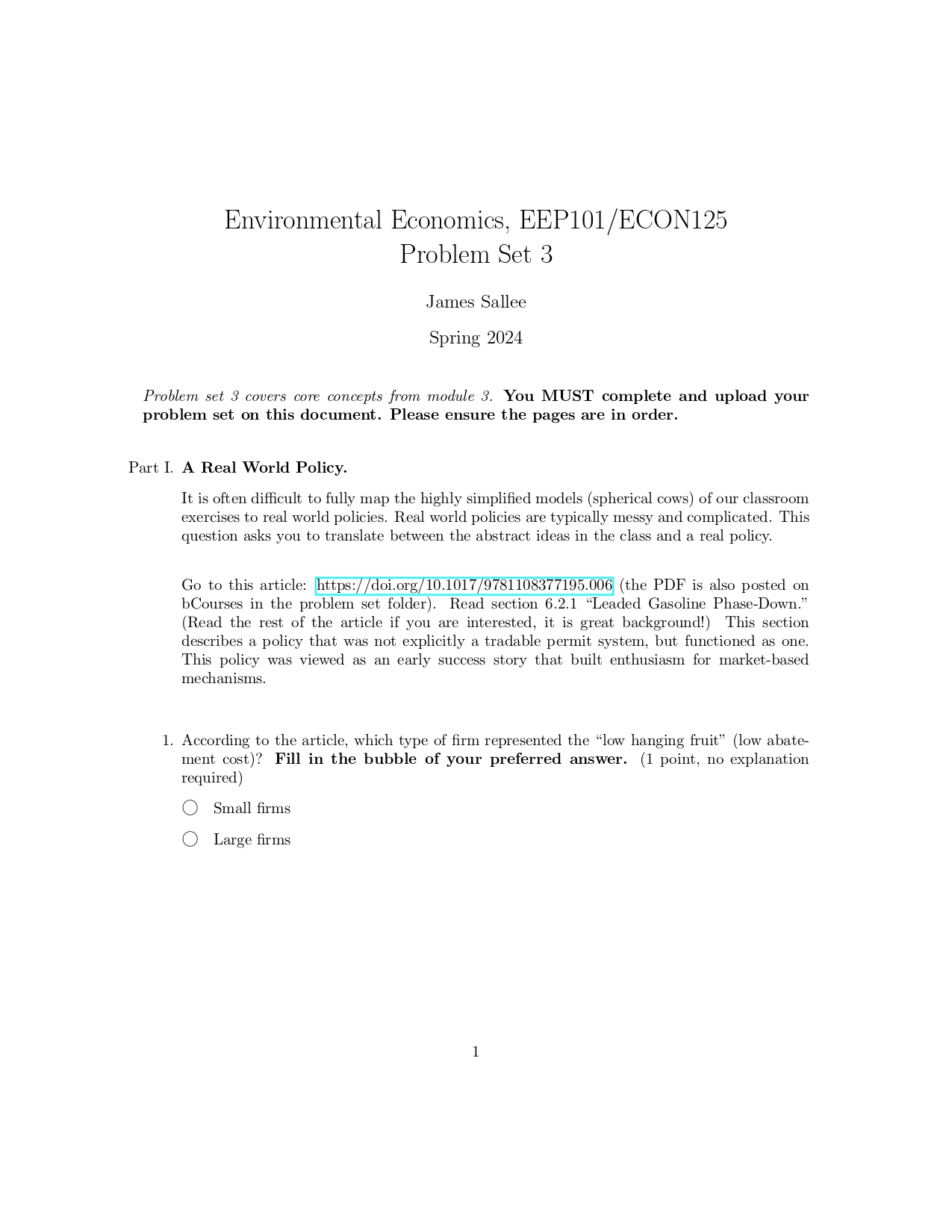
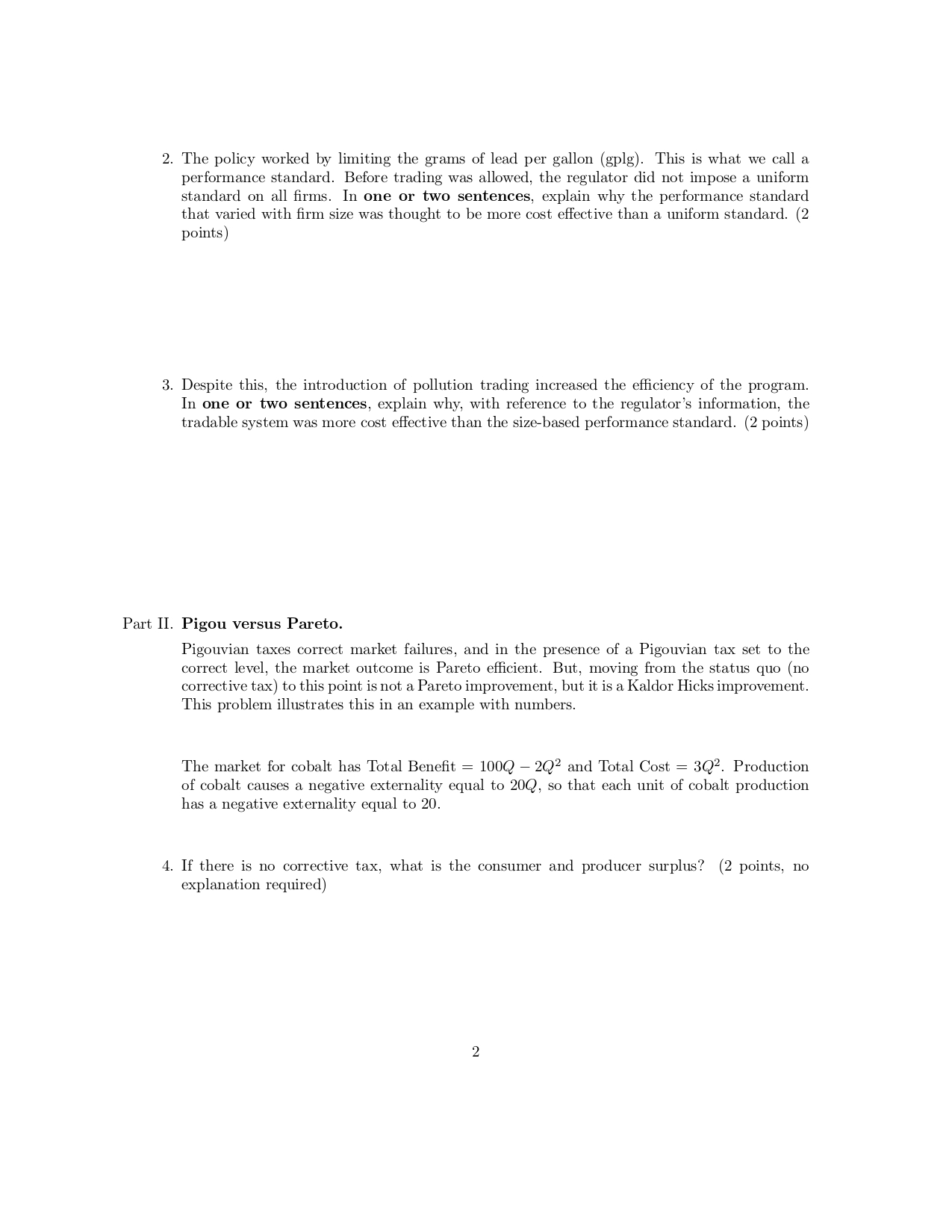
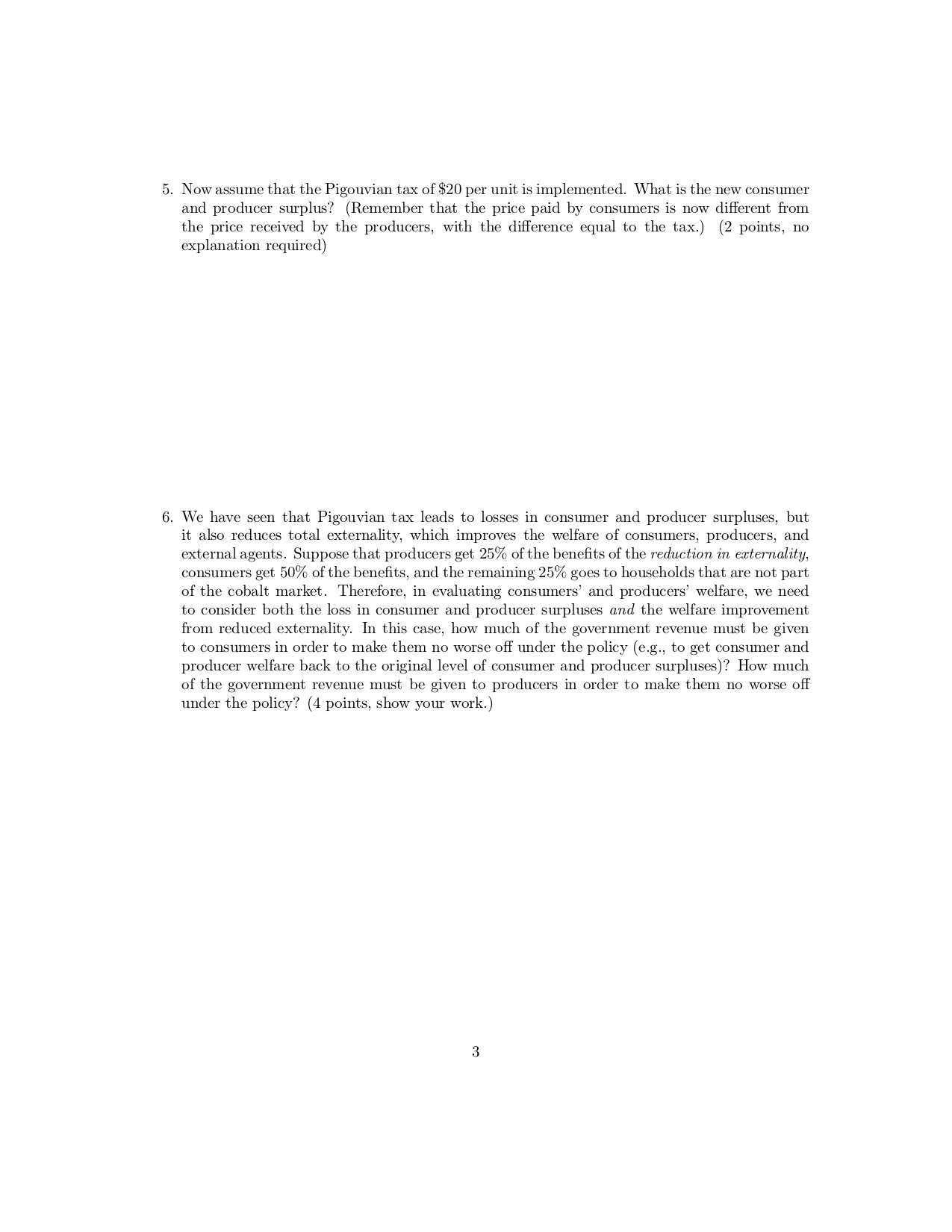
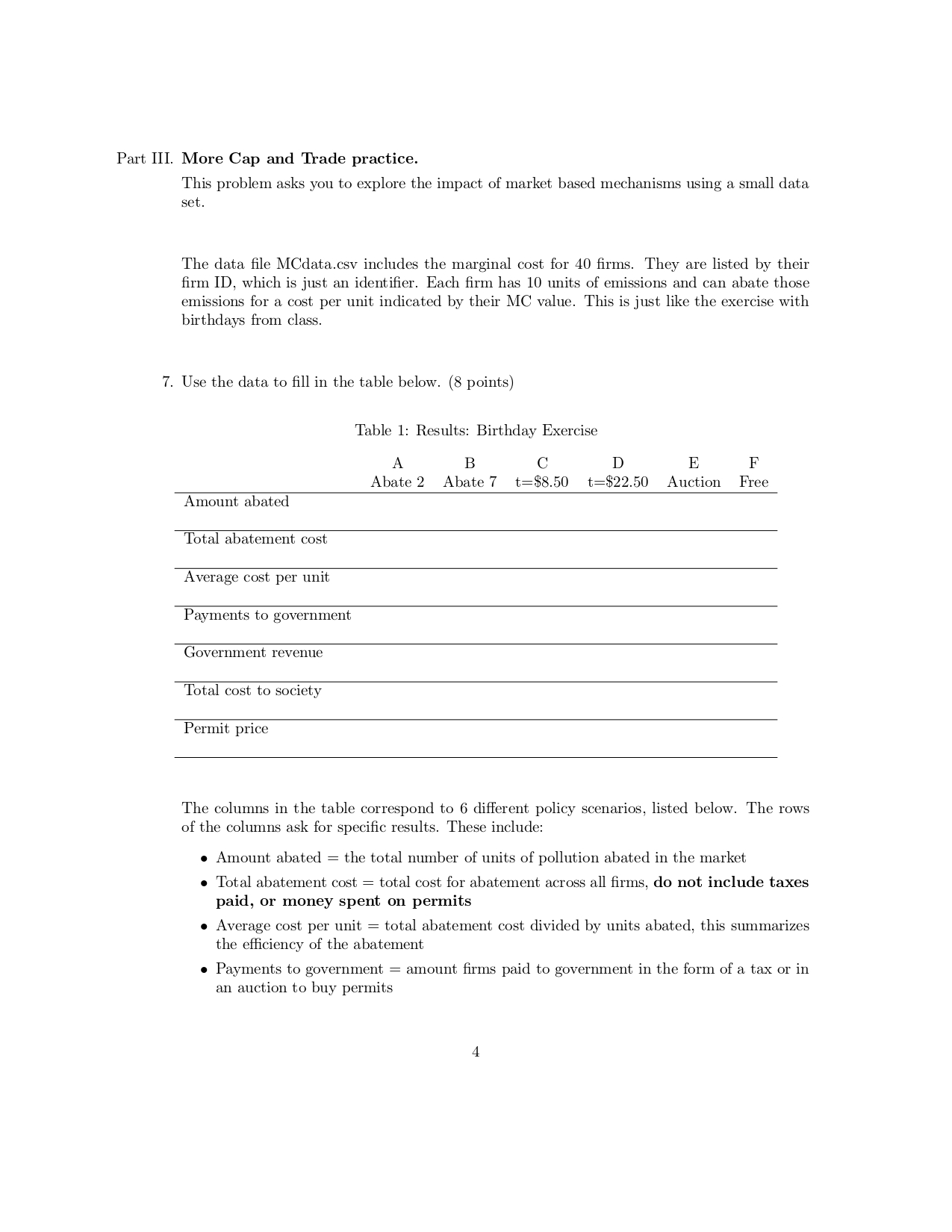
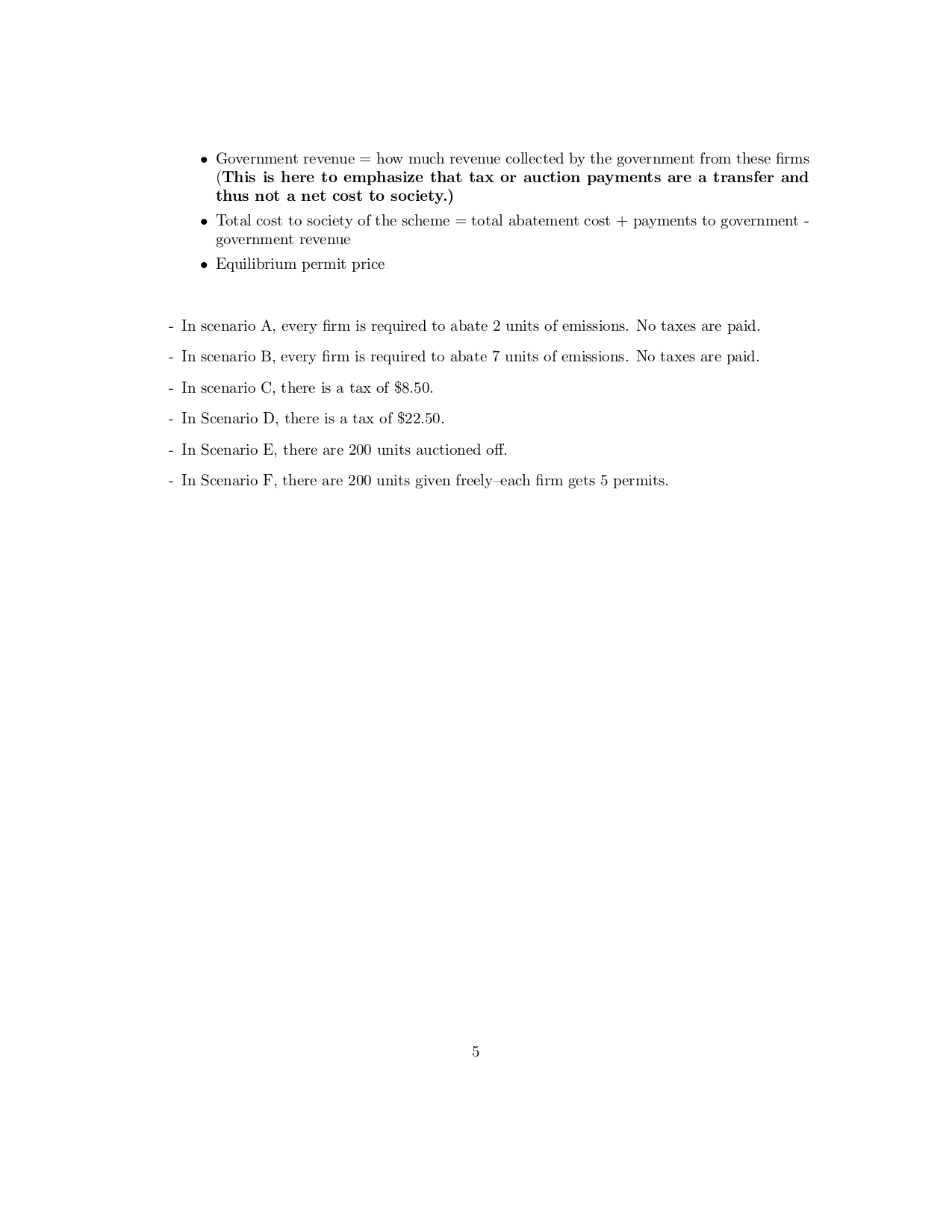
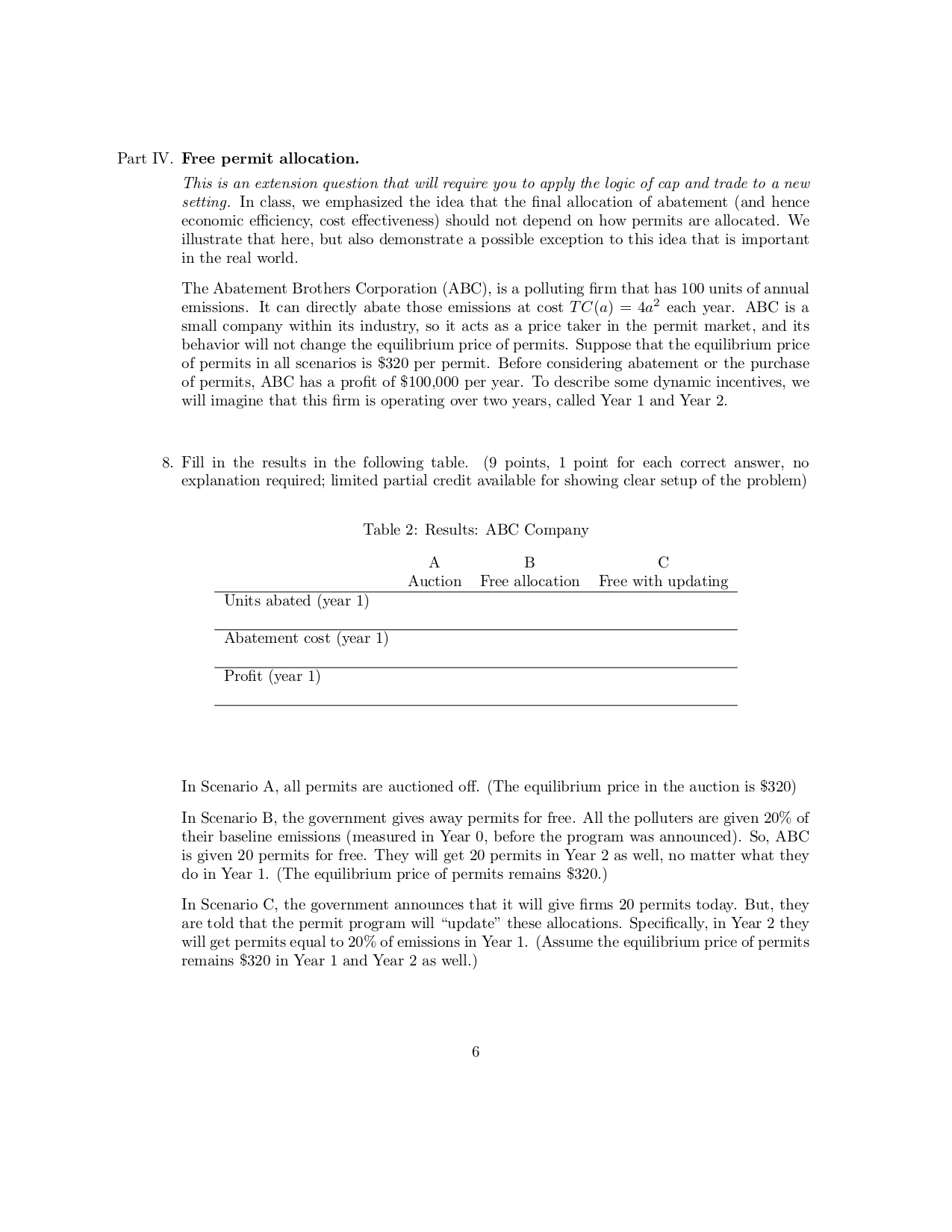

Environmental Economics, EEP101 /ECON125 Problem Set 3 James Sallee Spring 2024 Problem set 3 covers core concepts from module 3. You MUST complete and upload your problem set on this document. Please ensure the pages are in order. Part I. A Real World Policy. It is often difficult to fully map the highly simplified models (spherical cows) of our classroom exercises to real world policies. Real world policies are typically messy and complicated. This question asks you to translate between the abstract ideas in the class and a real policy. Go to this article: https://doi.org/10.1017/9781108377195.006 (the PDF is also posted on bCourses in the problem set folder). Read section 6.2.1 \"Leaded Gasoline Phase-Down.\" (Read the rest of the article if you are interested, it is great background!) This section describes a policy that was not explicitly a tradable permit system, but functioned as one. This policy was viewed as an early success story that built enthusiasm for market-based mechanisms. 1. According to the article, which type of firm represented the \"low hanging fruit\" (low abate- ment cost)? Fill in the bubble of your preferred answer. (1 point, no explanation required) (O Small firms () Large firms 2. The policy worked by limiting the grams of lead per gallon (gplg). This is what we call a performance standard. Before trading was allowed, the regulator did not impose a uniform standard on all firms. In one or two sentences, explain why the performance standard that varied with firm size was thought to be more cost effective than a mniform standard. (2 points) 3. Despite this, the introduction of pollution trading increased the efficiency of the program. In one or two sentences, explain why, with reference to the regulator's information, the tradable system was more cost effective than the size-based performance standard. (2 points) Part II. Pigou versus Pareto. Pigouvian taxes correct market failures, and in the presence of a Pigouvian tax set to the correct level, the market outcome is Pareto efficient. But, moving from the status quo (no corrective tax) to this point is not a Pareto improvement, but it is a Kaldor Hicks improvement. This problem illustrates this in an example with numbers. The market for cobalt has Total Benefit = 100Q 2Q2 and Total Cost = 3Q?. Production of cobalt causes a negative externality equal to 2000, so that each unit of cobalt production has a negative externality equal to 20. 4. If there is no corrective tax, what is the consumer and producer surplus? (2 points, no explanation required) 5. Now assume that the Pigouvian tax of $20 per unit is implemented. What is the new consumer and producer surplus? (Remember that the price paid by consumers is now different from the price received by the producers, with the difference equal to the tax.) (2 points, no explanation required) 6. We have seen that Pigouvian tax leads to losses in consumer and producer surpluses, but it also reduces total externality, which improves the welfare of consumers, producers, and external agents. Suppose that producers get 25% of the benefits of the reduction in externality, consumers get 50% of the benefits, and the remaining 25% goes to households that are not part of the cobalt market. Therefore, in evaluating consumers' and producers' welfare, we need to consider both the loss in consumer and producer surpluses and the welfare improvement from reduced externality. In this case, how much of the government revenue must be given to consumers in order to make them no worse off under the policy (e.g., to get consumer and producer welfare back to the original level of consumer and producer surpluses)? How much of the government revenue must be given to producers in order to make them no worse off under the policy? (4 points, show your work.) Part III. More Cap and Trade practice. This problem asks you to explore the impact of market based mechanisms using a small data set. The data file MCdata.csv includes the marginal cost for 40 firms. They are listed by their firm 1D, which is just an identifier. Fach firm has 10 units of emissions and can abate those emissions for a cost per unit indicated by their MC value. This is just like the exercise with birthdays from class. 7. Use the data to fill in the table below. (8 points) Table 1: Results: Birthday Exercise A B C D E F Abate 2 Abate T t=88.50 t=%$22.50 Auction Free Amount abated Total abatement cost Average cost per unit Payments to government Government revenue Total cost to society Permit price The columns in the table correspond to 6 different policy scenarios, listed below. The rows of the columns ask for specific results. These include: e Amount abated = the total number of units of pollution abated in the market e Total abatement cost = total cost for abatement across all firms, do not include taxes paid, or money spent on permits e Average cost per unit = total abatement cost divided by units abated, this summarizes the efficiency of the abatement e Payments to government = amount firms paid to government in the form of a tax or in an auction to buy permits e Government revenue = how much revenue collected by the government from these firms (This is here to emphasize that tax or auction payments are a transfer and thus not a net cost to society.) e Total cost to society of the scheme = total abatement cost + payments to government - government revenue e Equilibrium permit price In scenario A, every firm is required to abate 2 units of emissions. No taxes are paid. In scenario B, every firm is required to abate 7 units of emissions. No taxes are paid. In scenario C, there is a tax of $8.50. In Scenario D, there is a tax of $22.50. In Scenario E, there are 200 units auctioned off. In Scenario F, there are 200 units given freelycach firm gets 5 permits. Part IV. Free permit allocation. This is an extension guestion that will require you to apply the logic of cap and trade to a new setting. In class, we emphasized the idea that the final allocation of abatement (and hence economic efficiency, cost effectiveness) should not depend on how permits are allocated. We illustrate that here, but also demonstrate a possible exception to this idea that is important in the real world. The Abatement Brothers Corporation (ABC), is a polluting firm that has 100 units of annual emissions. It can directly abate those emissions at cost TC(a) = 4a? each year. ABC is a small company within its industry, so it acts as a price taker in the permit market, and its behavior will not change the equilibrium price of permits. Suppose that the equilibrium price of permits in all scenarios is $320 per permit. Before considering abatement or the purchase of permits, ABC has a profit of $100,000 per year. To describe some dynamic incentives, we will imagine that this firm is operating over two years, called Year 1 and Year 2. 8. Fill in the results in the following table. (9 points, 1 point for each correct answer, no explanation required; limited partial eredit available for showing clear setup of the problem) Table 2: Results: ABC Company A B C Auction Free allocation Free with updating Units abated (year 1) Abatement cost (year 1) Profit (year 1) In Scenario A, all permits are auctioned off. (The equilibrium price in the auction is $320) In Scenario B, the government gives away permits for free. All the polluters are given 20% of their baseline emissions (measured in Year 0, before the program was announced). So, ABC is given 20 permits for free. They will get 20 permits in Year 2 as well, no matter what they do in Year 1. (The equilibrium price of permits remains $320.) In Scenario C, the government announces that it will give firms 20 permits today. But, they are told that the permit program will \"update\" these allocations. Specifically, in Year 2 they will get permits equal to 20% of emissions in Year 1. (Assume the equilibrium price of permits remains $320 in Year 1 and Year 2 as well.) 9. Briefly explain why there is a difference in abatement between Scenarios A and C, and say which one is more efficient. (2 points)
Step by Step Solution
There are 3 Steps involved in it

Get step-by-step solutions from verified subject matter experts