



Question: Environmental Resource Management Motivation The Atlantic cod is a massive fish that can grow up to 2m in length, weigh up to 96 kg, and
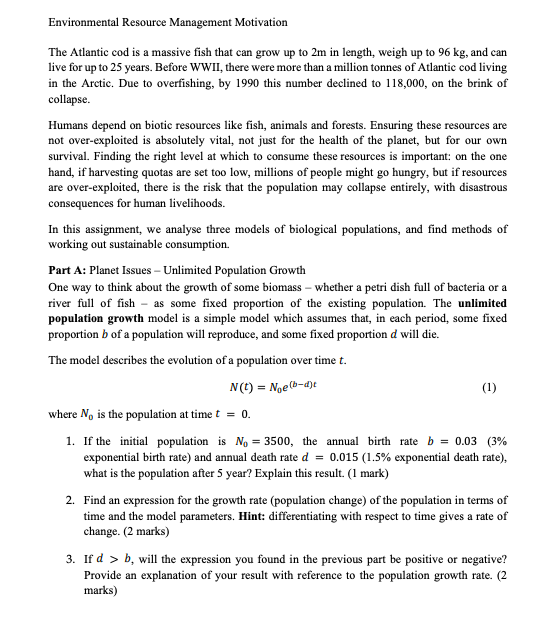
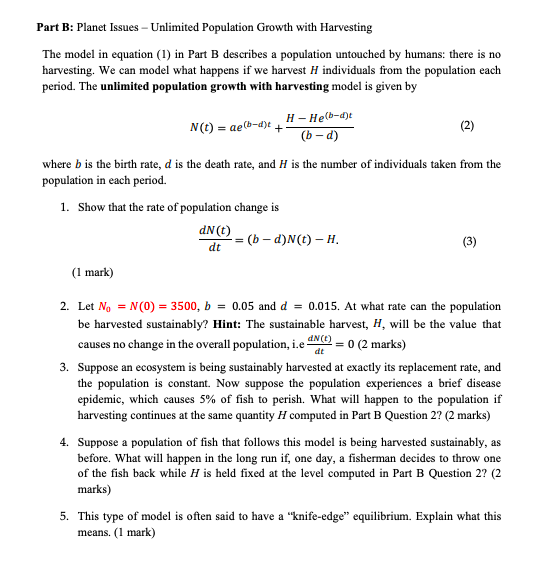
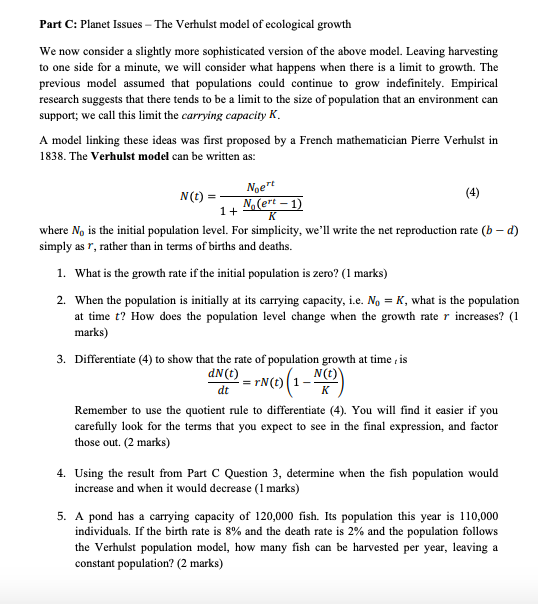
Environmental Resource Management Motivation The Atlantic cod is a massive fish that can grow up to 2m in length, weigh up to 96 kg, and can live for up to 25 years. Before WWII, there were more than a million tonnes of Atlantic cod living in the Arctic. Due to overfishing, by 1990 this number declined to 118,000, on the brink of collapse. Humans depend on biotic resources like fish, animals and forests. Ensuring these resources are not over-exploited is absolutely vital, not just for the health of the planet, but for our own survival. Finding the right level at which to consume these resources is important: on the one hand, if harvesting quotas are set too low, millions of people might go hungry, but if resources are over-exploited, there is the risk that the population may collapse entirely, with disastrous consequences for human livelihoods. In this assignment, we analyse three models of biological populations, and find methods of working out sustainable consumption. Part A: Planet Issues - Unlimited Population Growth One way to think about the growth of some biomass - whether a petri dish full of bacteria or a river full of fish - as some fixed proportion of the existing population. The unlimited population growth model is a simple model which assumes that, in each period, some fixed proportion b of a population will reproduce, and some fixed proportion d will die. The model describes the evolution of a population over time t. N(t) = Noe(b-d)t (1) where No is the population at time & = 0. 1. If the initial population is No = 3500, the annual birth rate b = 0.03 (3% exponential birth rate) and annual death rate d = 0.015 (1.5% exponential death rate), what is the population after 5 year? Explain this result. (1 mark) 2. Find an expression for the growth rate (population change) of the population in terms of time and the model parameters. Hint: differentiating with respect to time gives a rate of change. (2 marks) 3. If d > b, will the expression you found in the previous part be positive or negative? Provide an explanation of your result with reference to the population growth rate. (2 marks)Part B: Planet Issues - Unlimited Population Growth with Harvesting The model in equation (1) in Part B describes a population untouched by humans: there is no harvesting. We can model what happens if we harvest H individuals from the population each period. The unlimited population growth with harvesting model is given by N(t) = ae(b-d)t | H - He(b-d): (b - d) (2) where b is the birth rate, d is the death rate, and H is the number of individuals taken from the population in each period. 1. Show that the rate of population change is dN (t) dt = (b - d)N(t) - H. (3) (1 mark) 2. Let No = N(0) = 3500, b = 0.05 and d = 0.015. At what rate can the population be harvested sustainably? Hint: The sustainable harvest, #, will be the value that causes no change in the overall population, i.e - = de = 0 (2 marks) 3. Suppose an ecosystem is being sustainably harvested at exactly its replacement rate, and the population is constant. Now suppose the population experiences a brief disease epidemic, which causes 5% of fish to perish. What will happen to the population if harvesting continues at the same quantity # computed in Part B Question 2? (2 marks) 4. Suppose a population of fish that follows this model is being harvested sustainably, as before. What will happen in the long run if, one day, a fisherman decides to throw one of the fish back while # is held fixed at the level computed in Part B Question 2? (2 marks) 5. This type of model is often said to have a "knife-edge" equilibrium. Explain what this means. (1 mark)Part C: Planet Issues - The Verhulst model of ecological growth We now consider a slightly more sophisticated version of the above model. Leaving harvesting to one side for a minute, we will consider what happens when there is a limit to growth. The previous model assumed that populations could continue to grow indefinitely. Empirical research suggests that there tends to be a limit to the size of population that an environment can support; we call this limit the carrying capacity K. A model linking these ideas was first proposed by a French mathematician Pierre Verhulst in 1838. The Verhulst model can be written as: N (t) =- Noert 1 + Na(ert - 1) (4) K where No is the initial population level. For simplicity, we'll write the net reproduction rate (b - d) simply as r, rather than in terms of births and deaths. 1. What is the growth rate if the initial population is zero? (1 marks) 2. When the population is initially at its carrying capacity, i.e. No = K, what is the population at time t? How does the population level change when the growth rate r increases? (1 marks) 3. Differentiate (4) to show that the rate of population growth at time , is dN (t) dt = rN(t) 1 N(t) K Remember to use the quotient rule to differentiate (4). You will find it easier if you carefully look for the terms that you expect to see in the final expression, and factor those out. (2 marks) 4. Using the result from Part C Question 3, determine when the fish population would increase and when it would decrease (1 marks) 5. A pond has a carrying capacity of 120,000 fish. Its population this year is 110,000 individuals. If the birth rate is 8% and the death rate is 2% and the population follows the Verhulst population model, how many fish can be harvested per year, leaving a constant population? (2 marks)
Step by Step Solution
There are 3 Steps involved in it

Get step-by-step solutions from verified subject matter experts