







Question: Equation 15.6 attached below 15.6 Factor Analysis We will have a look at another important facet of multivariate statistical analysis: FactorAnaly- sis. The data observations
Equation 15.6 attached below
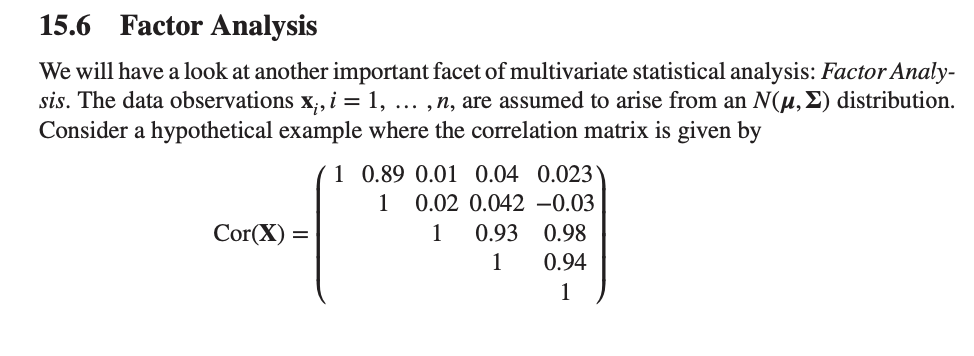
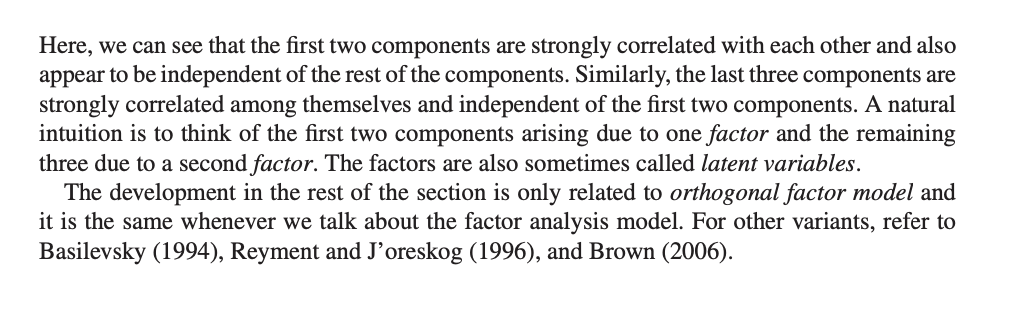
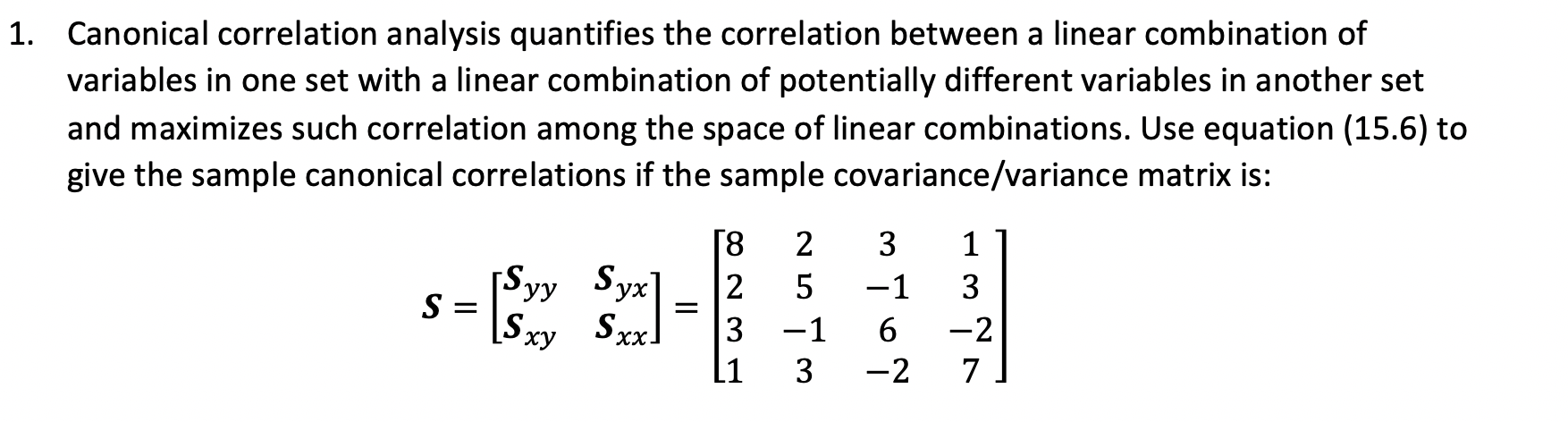
15.6 Factor Analysis We will have a look at another important facet of multivariate statistical analysis: FactorAnaly- sis. The data observations xvi = 1, , n, are assumed to arise from an N01, 2) distribution. Consider a hypothetical example where the correlation matrix is given by 1 0.89 0.01 0.04 0.023 1 0.02 0.042 0.03 Cor(X) = l 0.93 0.98 1 0.94 1 Here, we can see that the first two components are strongly correlated with each other and also appear to be independent of the rest of the components. Similarly, the last three components are strongly correlated among themselves and independent of the first two components. A natural intuition is to think of the first two components arising due to one factor and the remaining three due to a second factor. The factors are also sometimes called latent variables. The development in the rest of the section is only related to orthogonal factor model and it is the same whenever we talk about the factor analysis model. For other variants, refer to Basilevsky (1994), Reyment and J'oreskog (1996), and Brown (2006).1. Canonical correlation analysis quantifies the correlation between a linear combination of variables in one set with a linear combination of potentially different variables in another set and maximizes such correlation among the space of linear combinations. Use equation (15.6) to give the sample canonical correlations if the sample covariance/variance matrix is: 8 1 2 2 3 S = [syy Syx] = [ 5 1 3 sxy Sxx 3 1 6 2 1 3 2 7
Step by Step Solution
There are 3 Steps involved in it

Get step-by-step solutions from verified subject matter experts
 Study Help