







Question: Equipment needed: String (thread or fishing line), Bob, Stand (bob can be suspended with any kind of support), Meter Stick or Tape Measure, Timer (cell
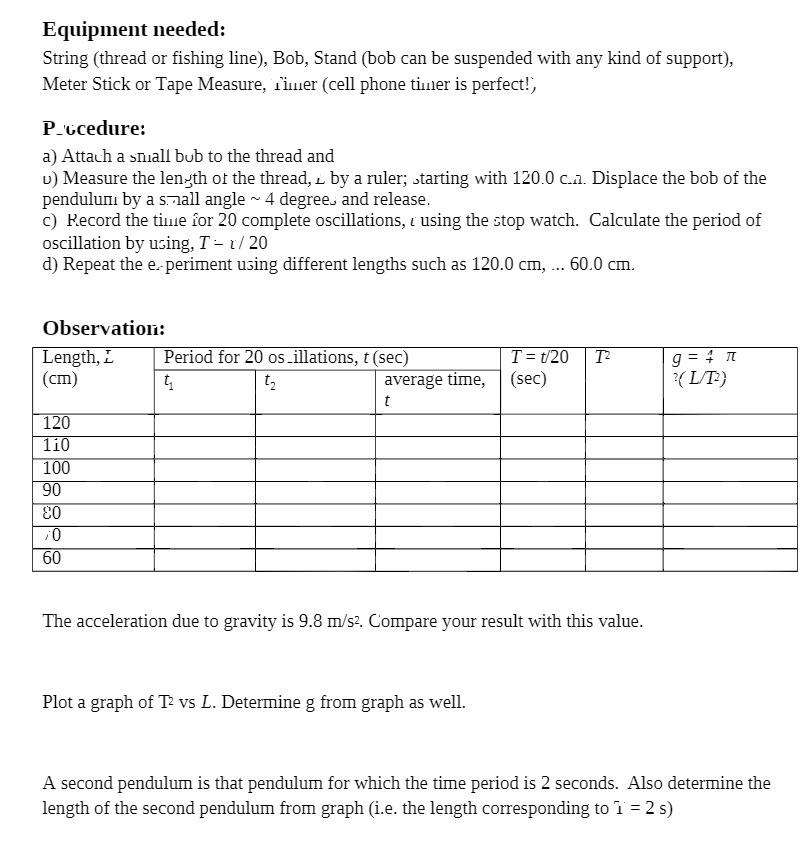
Equipment needed: String (thread or fishing line), Bob, Stand (bob can be suspended with any kind of support), Meter Stick or Tape Measure, Timer (cell phone timer is perfect!; Procedure: a) Attach a small bub to the thread and u) Measure the length of the thread, _ by a ruler; starting with 120.0 c.a. Displace the bob of the pendulum by a small angle ~ 4 degree, and release. c) Record the time for 20 complete oscillations, c using the stop watch. Calculate the period of oscillation by using, T - t/ 20 d) Repeat the experiment using different lengths such as 120.0 cm, ... 60.0 cm. Observation: Length, L Period for 20 oscillations, t (sec T = 1/20 T2 g = 4 n (cm) average time, (sec) ?( L/T2) 120 110 100 90 0 60 The acceleration due to gravity is 9.8 m/s2. Compare your result with this value. Plot a graph of Tz vs L. Determine g from graph as well. A second pendulum is that pendulum for which the time period is 2 seconds. Also determine the length of the second pendulum from graph (i.e. the length corresponding to 1 = 2 s)
Step by Step Solution
There are 3 Steps involved in it

Get step-by-step solutions from verified subject matter experts
 Study Help