







Question: E-R, do not add any entity unless absolutely needed. You may broaden keys as needed to accommodate the necessary design constraints. Do not forget attributes
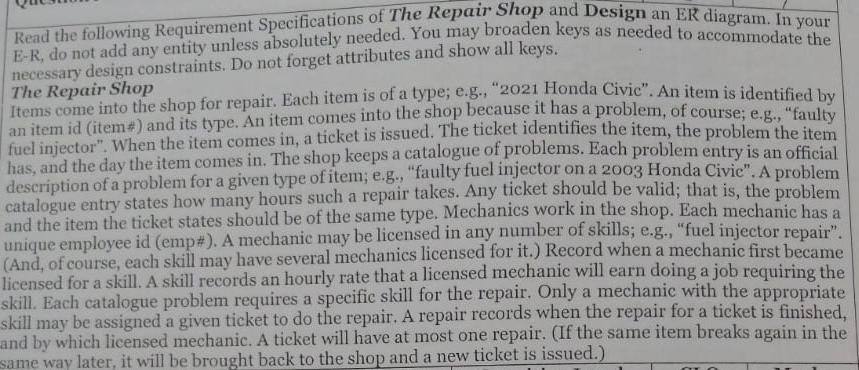
E-R, do not add any entity unless absolutely needed. You may broaden keys as needed to accommodate the necessary design constraints. Do not forget attributes and show all keys. Items come into the shop for repair. Each item is of a typebecause i Honda Civic". An item is identified by an item id (item#) and its type. An item comes into the shop because it has a problem, of course ; e.g., "faulty has, and the day the item comes in. The shop keeps a catalogue of problems. Each problem entry is an official fuel injector". When the item comes in, a ticket is issued. The ticket identifies the item, the problem the item description of a problem for a given type of item; e.g., "faulty fuel injector ona 2003 Honda Civic". A problem catalogue entry states how many hours such a repair takes. Any ticket should be valid; that is, the problem unique employee id (emp#). A mechanic may be licensed in any number of skills; e.g., "fuel injector repair". (And, of course, each skill may have several mechanics licensed for it.) Record when a mechanic first became licensed for a skill . A skill records an hourly rate that a licensed mechanic will earn doing a job requiring the skill. Each catalogue problem requires a specific skill for the repair. Only a mechanic with the appropriate skill may be assigned a given ticket to do the repair. A repair records when the repair for a ticket is finished, and by which licensed mechanic. A ticket will have at most one repair. (If the same item breaks again in the same way later, it will be brought back to the shop and a new ticket is issued.)
Step by Step Solution
There are 3 Steps involved in it
To design the ER diagram for this scenario follow these steps Step 1 Identify Entities Item Attribut... View full answer

Get step-by-step solutions from verified subject matter experts
 Study Help