







Question: ERP stands for A. Enterprise Resource Program B. Enterprise Reporting Program C Enterprise Reprise Platform D. Enterprise Resource Planning E. None of the above. 33.
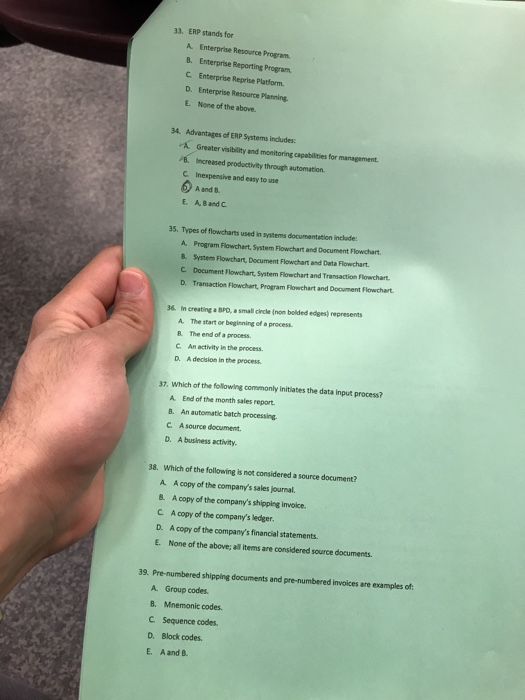
ERP stands for A. Enterprise Resource Program B. Enterprise Reporting Program C Enterprise Reprise Platform D. Enterprise Resource Planning E. None of the above. 33. 34. Advantages of ERP Systems indludes AGreater visibility and monitoring capabilities for management. 8 Increased productivity through automation. C. Inexpensive and easy to use A and B. E. A,Band C 35. Types of flowcharts used in systems documentation inclade A. Program Flowchart, System Flowchart and Document Flowchart &. System Flowchart, Document Flowchart and Data Flowchart C Document Flowchart, System Flowchart and Transaction Flowchart D. Tranmaction Flowchart, Program Flowchart and Document Flowchart In creating a BPO, a small ciecle (non bolded edges) represents A The start or beginning of a process. B. The end of a process C An activity in the process. D. A dedsion in the process 36 37, Which of the following commonly initiates the data input process? A End of the month sales report B. An automatic batch processing. C. A source document. D. A business activity. Which of the following is not considered a source document? A. A copy of the company's sales journal. .A copy of the company's shipping invoice C A copy of the company's ledger. D. A copy of the company's financial statements E. None of the above; all items are considered source documents 38. 39. Pre-numbered shipping documents and pre-numbered invoices are examples of A Group codes. B. Mnemonic codes. C Sequence codes D. Block codes. E. A and B
Step by Step Solution
There are 3 Steps involved in it

Get step-by-step solutions from verified subject matter experts
 Study Help