







Question: Error propagation for a wind turbine efficiency The power P (in W) generated by a wind turbine is P= 1/2 n p At u, where
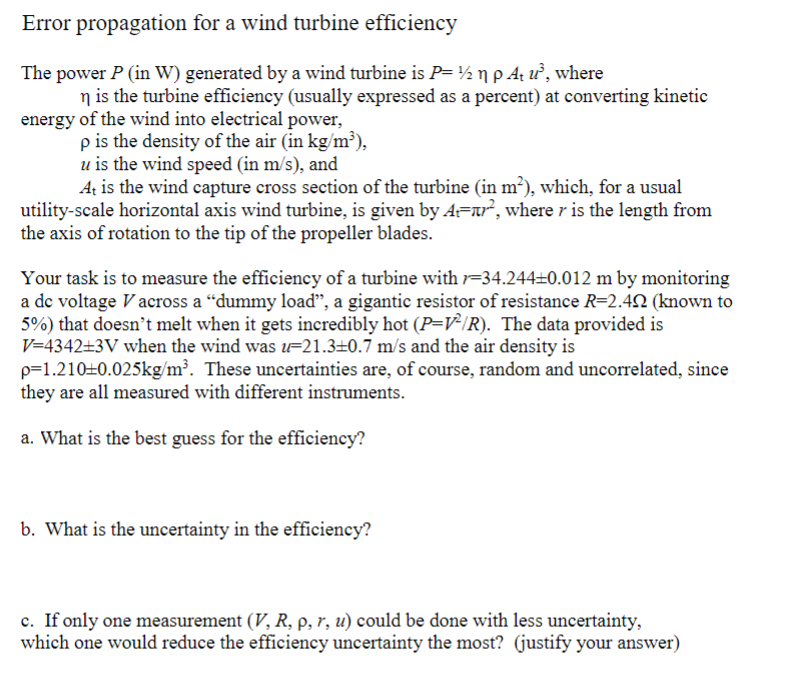
Error propagation for a wind turbine efficiency The power P (in W) generated by a wind turbine is P= 1/2 n p At u, where n is the turbine efficiency (usually expressed as a percent) at converting kinetic energy of the wind into electrical power, p is the density of the air (in kg/m ), u is the wind speed (in m/s), and At is the wind capture cross section of the turbine (in m ), which, for a usual utility-scale horizontal axis wind turbine, is given by Arm, where r is the length from the axis of rotation to the tip of the propeller blades. Your task is to measure the efficiency of a turbine with /=34.24410.012 m by monitoring a dc voltage I across a "dummy load", a gigantic resistor of resistance R=2.40 (known to 5%) that doesn't melt when it gets incredibly hot (P=V-/R). The data provided is V=4342+3V when the wind was u=21.340.7 m/s and the air density is p=1.210+0.025kg/m'. These uncertainties are, of course, random and uncorrelated, since they are all measured with different instruments. a. What is the best guess for the efficiency? b. What is the uncertainty in the efficiency? c. If only one measurement (V, R, p, r, u) could be done with less uncertainty, which one would reduce the efficiency uncertainty the most? (justify your answer)
Step by Step Solution
There are 3 Steps involved in it

Get step-by-step solutions from verified subject matter experts
 Study Help