







Question: es C B D E 1 Question One Decorative Doors, Inc., produces two types of doors, interior and exterior. The company's simple costing system has
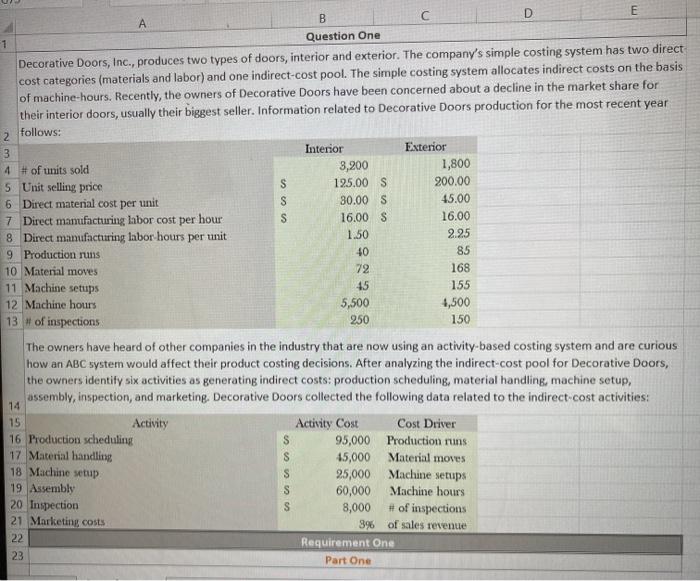
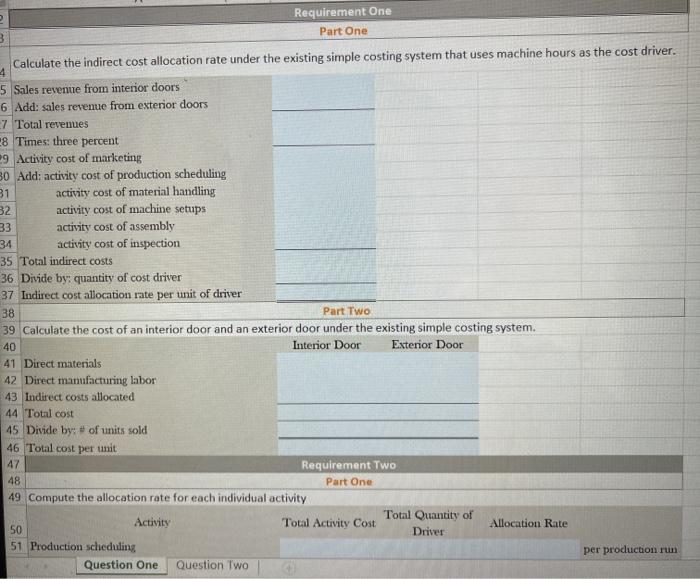
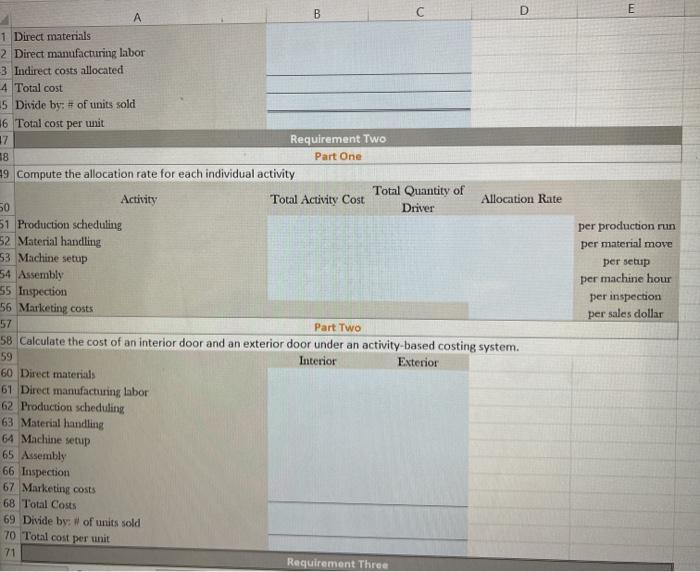
es C B D E 1 Question One Decorative Doors, Inc., produces two types of doors, interior and exterior. The company's simple costing system has two direct cost categories (materials and labor) and one indirect-cost pool. The simple costing system allocates indirect costs on the basis of machine-hours. Recently, the owners of Decorative Doors have been concerned about a decline in the market share for their interior doors, usually their biggest seller. Information related to Decorative Doors production for the most recent year 2 follows: 3 Interior Exterior 4 # of units sold 3,200 1,800 5 Unit selling price S 125.00 S 200.00 6 Direct material cost per unit 80.00 S 45.00 7 Direct manufacturing labor cost per hour 16.00 S 16.00 8 Direct manufacturing labor hours per unit 1.50 2.25 9 Production runs 40 85 10 Material moves 72 168 11 Machine setups 45 155 12 Machine hours 5,500 4,500 13 # of inspections 250 150 The owners have heard of other companies in the industry that are now using an activity-based costing system and are curious how an ABC system would affect their product costing decisions. After analyzing the indirect-cost pool for Decorative Doors, the owners identify six activities as generating indirect costs: production scheduling, material handling, machine setup, assembly, inspection, and marketing. Decorative Doors collected the following data related to the indirect cost activities: 14 15 Activity Activity Cost Cost Driver 16 Production scheduling S 95,000 Production runs 17 Material handling S 45,000 Material moves 18 Machine setup S 25,000 19 Assembly S 60,000 Machine hours 20 Inspection S 8,000 # of inspections 21 Marketing costs 396 of sales revenue 22 Requirement One 23 Part One Machine setups Requirement One 3 Part One Calculate the indirect cost allocation rate under the existing simple costing system that uses machine hours as the cost driver. 4 5 Sales revenue from interior doors 6 Add: sales revenue from exterior doors 7 Total revenues 28 Times: three percent 29 Activity cost of marketing 30 Add: activity cost of production scheduling 31 activity cost of material handling 32 activity cost of machine setups 33 activity cost of assembly 34 activity cost of inspection 35 Total indirect costs 36 Divide by: quantity of cost driver 37 Indirect cost allocation rate per unit of driver 38 Part Two 39 Calculate the cost of an interior door and an exterior door under the existing simple costing system. 40 Interior Door Exterior Door 41 Direct materials 42 Direct manufacturing labor 43 Indirect costs allocated 44 Total cost 45 Divide by: # of units sold 46 Total cost per unit 47 Requirement Two Part One 49 Compute the allocation rate for each individual activity Total Quantity of Activity 50 Total Activity Cost Allocation Rate Driver 51 Production scheduling per production run Question One Question Two 48 E D B A 1 Direct materials 2 Direct manufacturing labor 3 Indirect costs allocated 4 Total cost 5 Divide by: # of units sold 6 Total cost per unit 17 Requirement Two 18 Part One 49 Compute the allocation rate for each individual activity Total Quantity of Activity Total Activity Cost Allocation Rate 50 Driver 51 Production scheduling 52 Material handling 53 Machine setup 54 Assembly 55 Inspection 56 Marketing costs Part Two 58 Calculate the cost of an interior door and an exterior door under an activity-based costing system. 59 Interior Exterior 60 Direct materials 61 Direct manufacturing labor 62 Production scheduling 63 Material handling 64 Machine setup 65 Assembly 66 Inspection 67 Marketing costs 68 Total Costs 69 Divide by: # of units sold 70 Total cost per unit 71 Requirement Three per production run per material move per setup per machine hour per inspection per sales dollar
Step by Step Solution
There are 3 Steps involved in it

Get step-by-step solutions from verified subject matter experts
 Study Help