



Question: Essay section Essay 1 (worth 35 points): Imagine that a research study about long-term memory errors examined what happens when participants watch a video
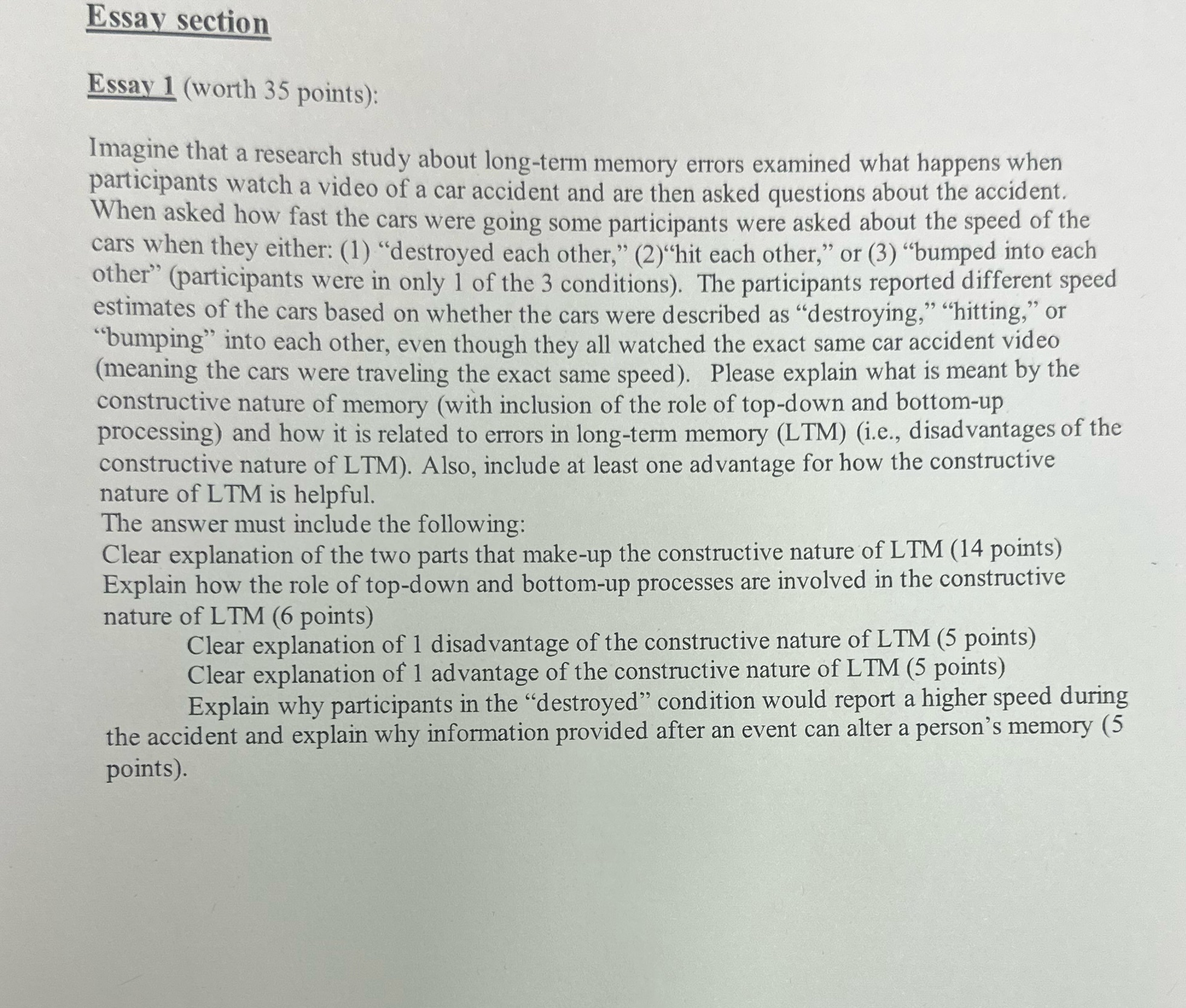
Essay section Essay 1 (worth 35 points): Imagine that a research study about long-term memory errors examined what happens when participants watch a video of a car accident and are then asked questions about the accident. When asked how fast the cars were going some participants were asked about the speed of the cars when they either: (1) "destroyed each other," (2) "hit each other," or (3) "bumped into each other" (participants were in only 1 of the 3 conditions). The participants reported different speed estimates of the cars based on whether the cars were described as "destroying," "hitting," or "bumping" into each other, even though they all watched the exact same car accident video (meaning the cars were traveling the exact same speed). Please explain what is meant by the constructive nature of memory (with inclusion of the role of top-down and bottom-up processing) and how it is related to errors in long-term memory (LTM) (i.e., disadvantages of the constructive nature of LTM). Also, include at least one advantage for how the constructive nature of LTM is helpful. The answer must include the following: Clear explanation of the two parts that make-up the constructive nature of LTM (14 points) Explain how the role of top-down and bottom-up processes are involved in the constructive nature of LTM (6 points) Clear explanation of 1 disadvantage of the constructive nature of LTM (5 points) Clear explanation of 1 advantage of the constructive nature of LTM (5 points) Explain why participants in the "destroyed" condition would report a higher speed during the accident and explain why information provided after an event can alter a person's memory (5 points).
Step by Step Solution
There are 3 Steps involved in it

Get step-by-step solutions from verified subject matter experts