







Question: Estimating Share Value Using the DCF Model Following are forecasted sales, NOPAT, and NOA for AT&T for 2019 through 2022 a. Forecast the terminal period
Estimating Share Value Using the DCF Model
Following are forecasted sales, NOPAT, and NOA for AT&T for 2019 through 2022
a. Forecast the terminal period values assuming a 2% terminal period growth rate.
Round answers to the nearest dollar.

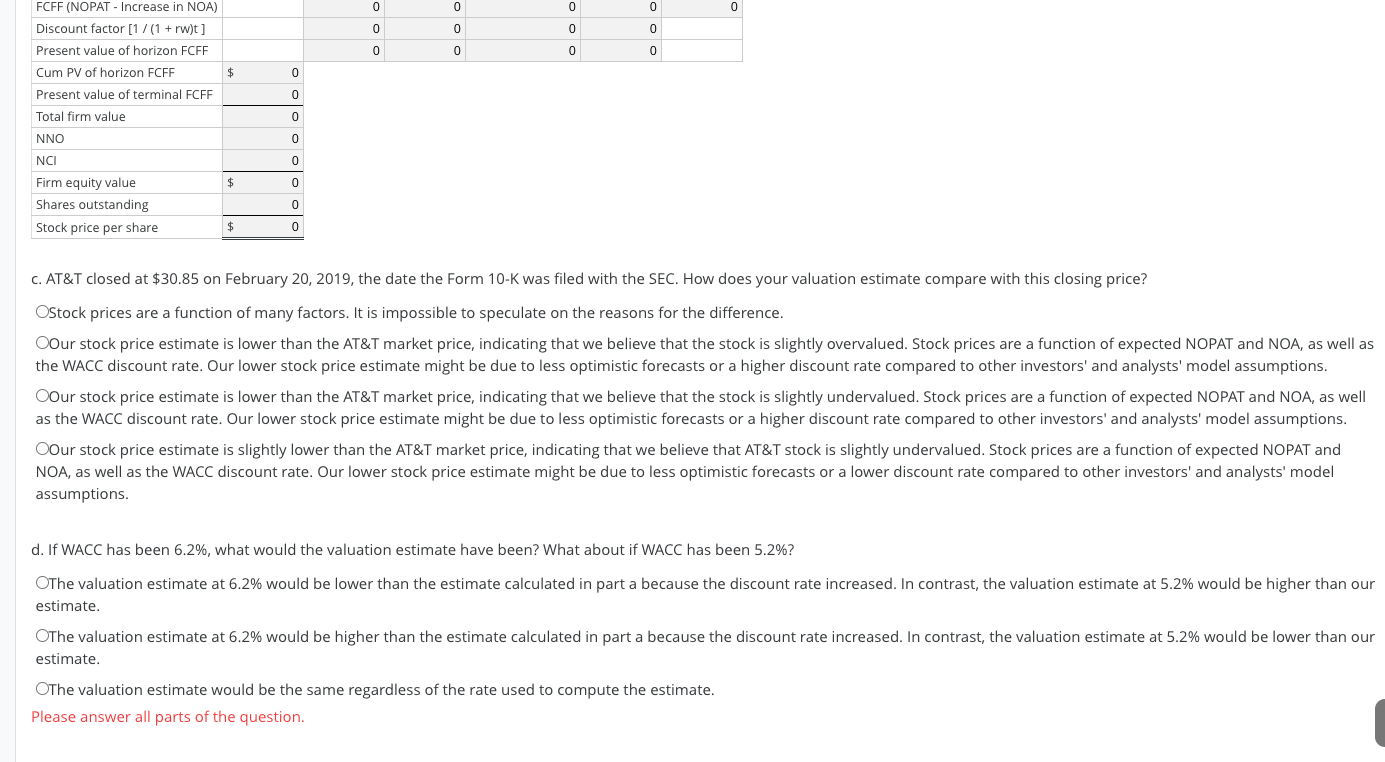
Estimating Share Value Using the DCF Model Following are forecasted sales, NOPAT, and NOA for AT&T for 2019 through 2022 a. Forecast the terminal period values assuming a 2% terminal period growth rate. Round answers to the nearest dollar. Reported Forecast Horizon $ millions 2018 2019 2020 2021 2022 Terminal Period Sales $170,756 $181,001 $191,861 $203,373 $215,576 $ 0 NOPAT 20,895 22,082 23,407 24,812 26,300 $ 0 NOA 369,039 390,931 414,387 439,251 465,607 $ 0 b. Estimate the value of a share of AT&T common stock using the discounted cash flow (DCF) model as of December 31, 2018; assume a discount rate (WACC) of 5.7%, common shares outstanding of 7,281.6 million, net nonoperating obligations (NNO) of $175,155 million, and noncontrolling interest (NCI) from the balance sheet of $9,795 million. Rounding instructions: Use rounded answers for subsequent computations. Round answers to the nearest whole number unless otherwise noted (do not round shares outstanding). Round discount factor to 5 decimal places and stock price per share to two decimal places. Use negative signs for your FCFF and Present value of horizon FCFF answers, when appropriate. Otherwise, do not use negative signs with your answers. TXRH Reported 2018 2019 2020 2022 Forecast Horizon 2021 0 $ 0 $ 0 0 Terminal Period 0 $ 0 $ 0 $ 0 0 0 0 0 0 0 0 0 0 0 $ 0 $ thousands Increase in NOA FCFF (NOPAT - Increase in NOA) Discount factor (1/(1 + rw)t ] Present value of horizon FCFF Cum PV of horizon FCFF Present value of terminal FCFF Total firm value NNO NCI Firm equity value Shares outstanding Stock price per share 0 0 0 0 $ 0 0 $ 0 0 0 0 0 0 0 0 0 0 0 0 0 $ 0 0 FCFF (NOPAT - Increase in NOA) Discount factor [1/(1 + rw)t] Present value of horizon FCFF Cum PV of horizon FCFF Present value of terminal FCFF Total firm value NNO NCI Firm equity value Shares outstanding Stock price per share 0 0 0 $ 0 0 $ 0 C. AT&T closed at $30.85 on February 20, 2019, the date the Form 10-K was filed with the SEC. How does your valuation estimate compare with this closing price? Ostock prices are a function of many factors. It is impossible to speculate on the reasons for the difference. OOur stock price estimate is lower than the AT&T market price, indicating that we believe that the stock is slightly overvalued. Stock prices are a function of expected NOPAT and NOA, as well as the WACC discount rate. Our lower stock price estimate might be due to less optimistic forecasts or a higher discount rate compared to other investors' and analysts' model assumptions. Our stock price estimate is lower than the AT&T market price, indicating that we believe that the stock is slightly undervalued. Stock prices are a function of expected NOPAT and NOA, as well as the WACC discount rate. Our lower stock price estimate might be due to less optimistic forecasts or a higher discount rate compared to other investors' and analysts' model assumptions. Our stock price estimate is slightly lower than the AT&T market price, indicating that we believe that AT&T stock is slightly undervalued. Stock prices are a function of expected NOPAT and NOA, as well as the WACC discount rate. Our lower stock price estimate might be due to less optimistic forecasts or a lower discount rate compared to other investors' and analysts' model assumptions. d. If WACC has been 6.2%, what would the valuation estimate have been? What about if WACC has been 5.2%? The valuation estimate at 6.2% would be lower than the estimate calculated in part a because the discount rate increased. In contrast, the valuation estimate at 5.2% would be higher than our estimate. OThe valuation estimate at 6.2% would be higher than the estimate calculated in part a because the discount rate increased. In contrast, the valuation estimate at 5.2% would be lower than our estimate The valuation estimate would be the same regardless of the rate used to compute the estimate. Please answer all parts of the question. Estimating Share Value Using the DCF Model Following are forecasted sales, NOPAT, and NOA for AT&T for 2019 through 2022 a. Forecast the terminal period values assuming a 2% terminal period growth rate. Round answers to the nearest dollar. Reported Forecast Horizon $ millions 2018 2019 2020 2021 2022 Terminal Period Sales $170,756 $181,001 $191,861 $203,373 $215,576 $ 0 NOPAT 20,895 22,082 23,407 24,812 26,300 $ 0 NOA 369,039 390,931 414,387 439,251 465,607 $ 0 b. Estimate the value of a share of AT&T common stock using the discounted cash flow (DCF) model as of December 31, 2018; assume a discount rate (WACC) of 5.7%, common shares outstanding of 7,281.6 million, net nonoperating obligations (NNO) of $175,155 million, and noncontrolling interest (NCI) from the balance sheet of $9,795 million. Rounding instructions: Use rounded answers for subsequent computations. Round answers to the nearest whole number unless otherwise noted (do not round shares outstanding). Round discount factor to 5 decimal places and stock price per share to two decimal places. Use negative signs for your FCFF and Present value of horizon FCFF answers, when appropriate. Otherwise, do not use negative signs with your answers. TXRH Reported 2018 2019 2020 2022 Forecast Horizon 2021 0 $ 0 $ 0 0 Terminal Period 0 $ 0 $ 0 $ 0 0 0 0 0 0 0 0 0 0 0 $ 0 $ thousands Increase in NOA FCFF (NOPAT - Increase in NOA) Discount factor (1/(1 + rw)t ] Present value of horizon FCFF Cum PV of horizon FCFF Present value of terminal FCFF Total firm value NNO NCI Firm equity value Shares outstanding Stock price per share 0 0 0 0 $ 0 0 $ 0 0 0 0 0 0 0 0 0 0 0 0 0 $ 0 0 FCFF (NOPAT - Increase in NOA) Discount factor [1/(1 + rw)t] Present value of horizon FCFF Cum PV of horizon FCFF Present value of terminal FCFF Total firm value NNO NCI Firm equity value Shares outstanding Stock price per share 0 0 0 $ 0 0 $ 0 C. AT&T closed at $30.85 on February 20, 2019, the date the Form 10-K was filed with the SEC. How does your valuation estimate compare with this closing price? Ostock prices are a function of many factors. It is impossible to speculate on the reasons for the difference. OOur stock price estimate is lower than the AT&T market price, indicating that we believe that the stock is slightly overvalued. Stock prices are a function of expected NOPAT and NOA, as well as the WACC discount rate. Our lower stock price estimate might be due to less optimistic forecasts or a higher discount rate compared to other investors' and analysts' model assumptions. Our stock price estimate is lower than the AT&T market price, indicating that we believe that the stock is slightly undervalued. Stock prices are a function of expected NOPAT and NOA, as well as the WACC discount rate. Our lower stock price estimate might be due to less optimistic forecasts or a higher discount rate compared to other investors' and analysts' model assumptions. Our stock price estimate is slightly lower than the AT&T market price, indicating that we believe that AT&T stock is slightly undervalued. Stock prices are a function of expected NOPAT and NOA, as well as the WACC discount rate. Our lower stock price estimate might be due to less optimistic forecasts or a lower discount rate compared to other investors' and analysts' model assumptions. d. If WACC has been 6.2%, what would the valuation estimate have been? What about if WACC has been 5.2%? The valuation estimate at 6.2% would be lower than the estimate calculated in part a because the discount rate increased. In contrast, the valuation estimate at 5.2% would be higher than our estimate. OThe valuation estimate at 6.2% would be higher than the estimate calculated in part a because the discount rate increased. In contrast, the valuation estimate at 5.2% would be lower than our estimate The valuation estimate would be the same regardless of the rate used to compute the estimate. Please answer all parts of the
Step by Step Solution
There are 3 Steps involved in it

Get step-by-step solutions from verified subject matter experts
 Study Help