



Question: Estimating Share Value Using the DCF Model Following are forecasts of Home Depot's sales, net operating profit after tax (NOPAT), and net operating assets
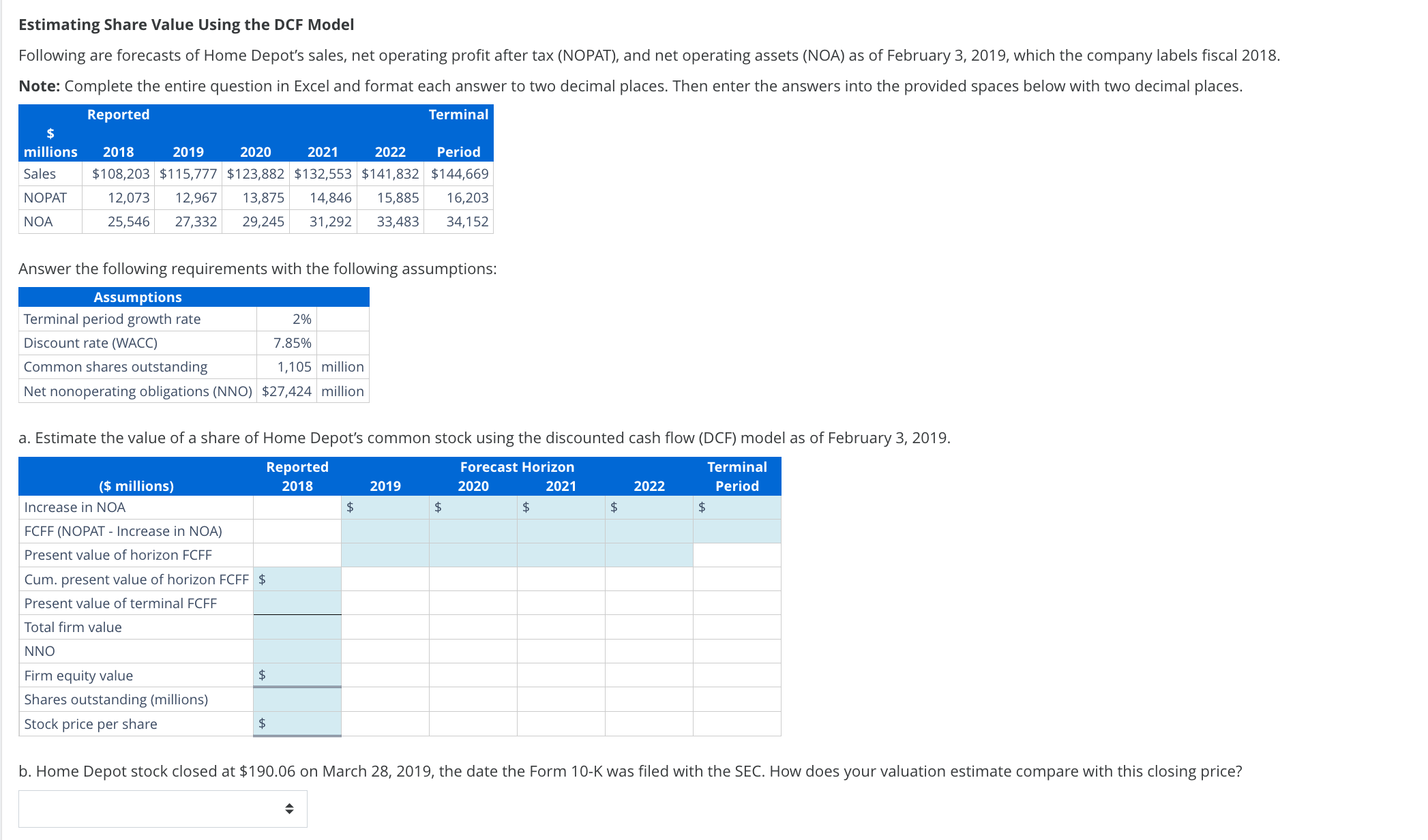
Estimating Share Value Using the DCF Model Following are forecasts of Home Depot's sales, net operating profit after tax (NOPAT), and net operating assets (NOA) as of February 3, 2019, which the company labels fiscal 2018. Note: Complete the entire question in Excel and format each answer to two decimal places. Then enter the answers into the provided spaces below with two decimal places. Reported millions Sales NOPAT NOA Terminal 2018 2019 2020 2021 2022 Period $108,203 $115,777 $123,882 $132,553 $141,832 $144,669 12,073 12,967 13,875 14,846 15,885 16,203 25,546 27,332 29,245 31,292 33,483 34,152 Answer the following requirements with the following assumptions: Assumptions Terminal period growth rate Discount rate (WACC) 2% 7.85% Common shares outstanding 1,105 million Net nonoperating obligations (NNO) $27,424 million a. Estimate the value of a share of Home Depot's common stock using the discounted cash flow (DCF) model as of February 3, 2019. ($ millions) Increase in NOA FCFF (NOPAT - Increase in NOA) Present value of horizon FCFF Cum. present value of horizon FCFF $ Present value of terminal FCFF Total firm value NNO Firm equity value $ Shares outstanding (millions) $ Reported 2018 Forecast Horizon Terminal 2019 2020 2021 2022 Period $ $ $ $ $ Stock price per share b. Home Depot stock closed at $190.06 on March 28, 2019, the date the Form 10-K was filed with the SEC. How does your valuation estimate compare with this closing price?
Step by Step Solution
There are 3 Steps involved in it

Get step-by-step solutions from verified subject matter experts