







Question: Ethical Decision-Making Field Manual #3:The Expense Report Reflection Page Case Summary: The Expense Report Transcript for Comments from Sonia Gandhi, CFA, Director, Ethics Education and
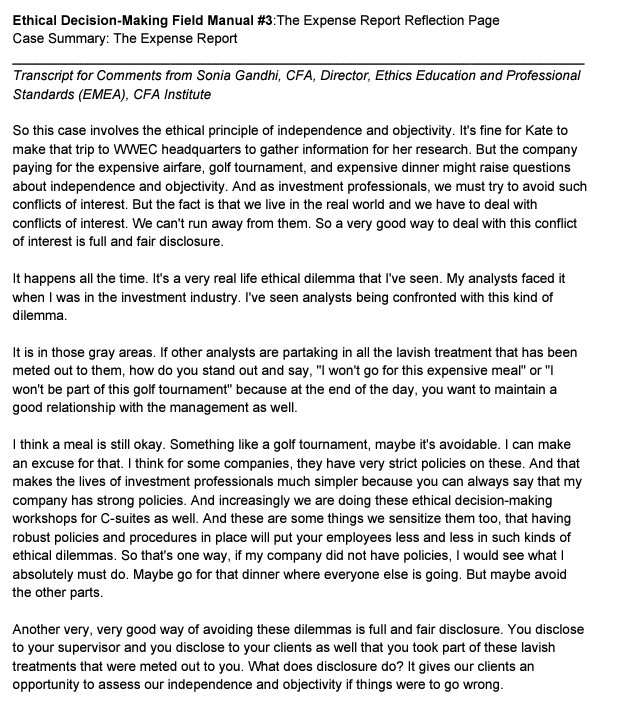
Ethical Decision-Making Field Manual \#3:The Expense Report Reflection Page Case Summary: The Expense Report Transcript for Comments from Sonia Gandhi, CFA, Director, Ethics Education and Professional Standards (EMEA), CFA Institute So this case involves the ethical principle of independence and objectivity. It's fine for Kate to make that trip to WWEC headquarters to gather information for her research. But the company paying for the expensive airfare, golf tournament, and expensive dinner might raise questions about independence and objectivity. And as investment professionals, we must try to avoid such conflicts of interest. But the fact is that we live in the real world and we have to deal with conflicts of interest. We can't run away from them. So a very good way to deal with this conflict of interest is full and fair disclosure. It happens all the time. It's a very real life ethical dilemma that I've seen. My analysts faced it when I was in the investment industry. I've seen analysts being confronted with this kind of dilemma. It is in those gray areas. If other analysts are partaking in all the lavish treatment that has been meted out to them, how do you stand out and say, "I won't go for this expensive meal" or "I won't be part of this golf tournament" because at the end of the day, you want to maintain a good relationship with the management as well. I think a meal is still okay. Something like a golf tournament, maybe it's avoidable. I can make an excuse for that. I think for some companies, they have very strict policies on these. And that makes the lives of investment professionals much simpler because you can always say that my company has strong policies. And increasingly we are doing these ethical decision-making workshops for C-suites as well. And these are some things we sensitize them too, that having robust policies and procedures in place will put your employees less and less in such kinds of ethical dilemmas. So that's one way, if my company did not have policies, I would see what I absolutely must do. Maybe go for that dinner where everyone else is going. But maybe avoid the other parts. Another very, very good way of avoiding these dilemmas is full and fair disclosure. You disclose to your supervisor and you disclose to your clients as well that you took part of these lavish treatments that were meted out to you. What does disclosure do? It gives our clients an opportunity to assess our independence and objectivity if things were to go wrong. This case involves independence and objectivity. It's fine for Kate to make a trip to visit WWEC headquarters to gather information for her research and analysis. But the expensive airfare, resort stay, golf tournament, and celebrity dinner all raise the issue of whether Kate's analysis and recommendations are influenced by this favorable treatment. As investment professionals, we must avoid conflicts of interest like these or try to mitigate the conflicts through disclosure to clients. You can read about another case involving independence and objectivity in this Resource. Discussion: Maintaining Independence and Objectivity Sonia offers some ideas for how to handle situations like the one Kate faced in this case. What else could work? Have you been in similar situations and come up with ways to maintain your independence and objectivity while socializing with clients? Have you struggled to do so? Share your thoughts in 420 characters or fewer
Step by Step Solution
There are 3 Steps involved in it

Get step-by-step solutions from verified subject matter experts
 Study Help