



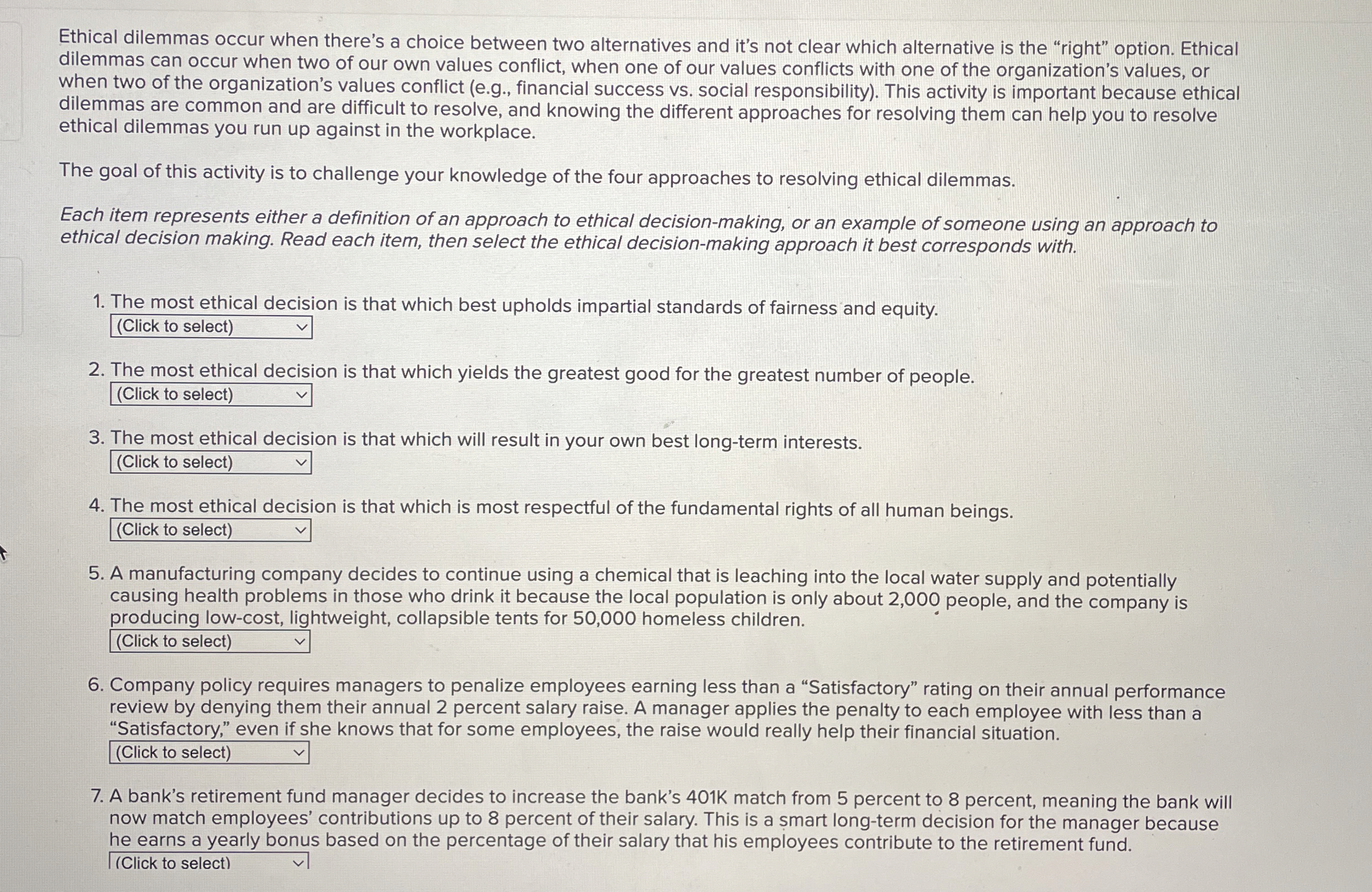
Question: Ethical dilemmas occur when there's a choice between two alternatives and it's not clear which alternative is the right option. Ethical dilemmas can occur when
Ethical dilemmas occur when there's a choice between two alternatives and it's not clear which alternative is the "right" option. Ethical
dilemmas can occur when two of our own values conflict, when one of our values conflicts with one of the organization's values, or
when two of the organization's values conflict eg financial success vs social responsibility This activity is important because ethical
dilemmas are common and are difficult to resolve, and knowing the different approaches for resolving them can help you to resolve
ethical dilemmas you run up against in the workplace.
The goal of this activity is to challenge your knowledge of the four approaches to resolving ethical dilemmas.
Each item represents either a definition of an approach to ethical decisionmaking, or an example of someone using an approach to
ethical decision making. Read each item, then select the ethical decisionmaking approach it best corresponds with.
The most ethical decision is that which best upholds impartial standards of fairness and equity.
The most ethical decision is that which yields the greatest good for the greatest number of people.
The most ethical decision is that which will result in your own best longterm interests.
The most ethical decision is that which is most respectful of the fundamental rights of all human beings.
A manufacturing company decides to continue using a chemical that is leaching into the local water supply and potentially
causing health problems in those who drink it because the local population is only about people, and the company is
producina lowcost liahtweight, collapsible tents for homeless children.
Company policy requires managers to penalize employees earning less than a "Satisfactory" rating on their annual performance
review by denying them their annual percent salary raise. A manager applies the penalty to each employee with less than a
"Satisfactory," even if she knows that for some employees, the raise would really help their financial situation.
A bank's retirement fund manager decides to increase the bank's K match from percent to percent, meaning the bank will
now match employees' contributions up to percent of their salary. This is a smart longterm decision for the manager because
he earns a yearly bonus based on the percentage of their salary that his employees contribute to the retirement fund.
Step by Step Solution
There are 3 Steps involved in it
1 Expert Approved Answer
Step: 1 Unlock

Question Has Been Solved by an Expert!
Get step-by-step solutions from verified subject matter experts
Step: 2 Unlock
Step: 3 Unlock