







Question: Ethics Case Analysis #3: Everlane: Ethical Chic and Radical Transparency Team Assignment Your task is to read Case #24: Everlane: Ethical Chic and Radical Transparency.
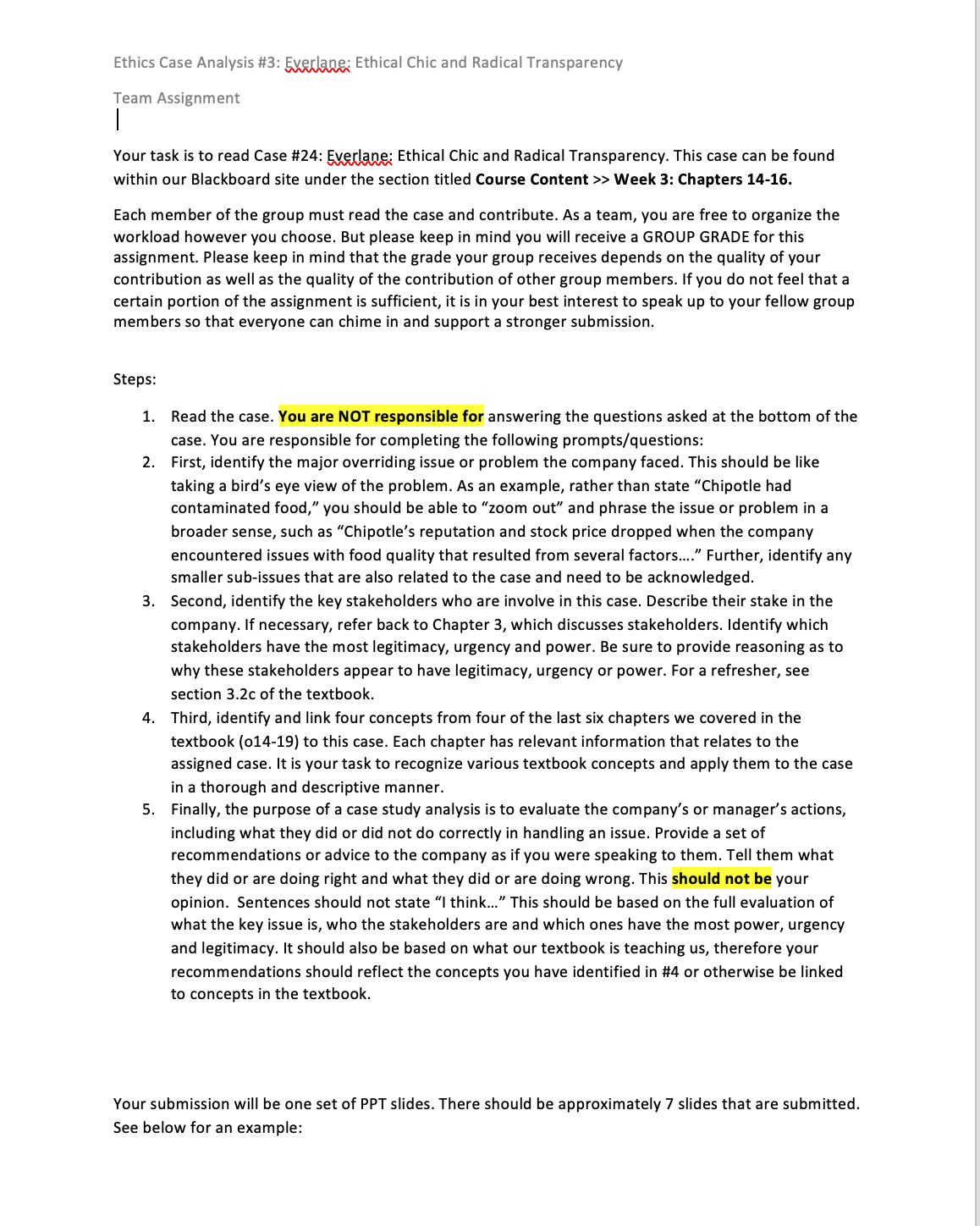
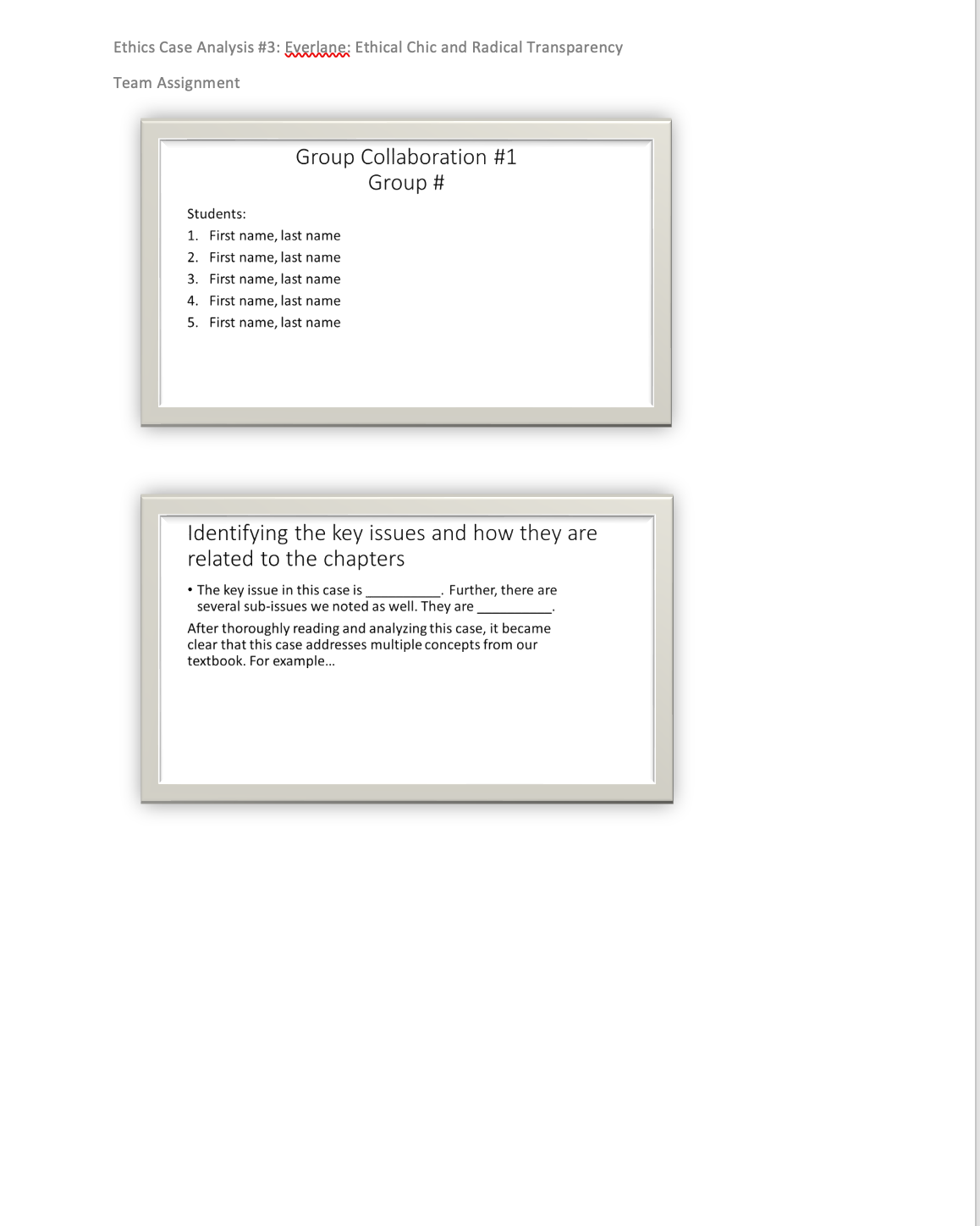
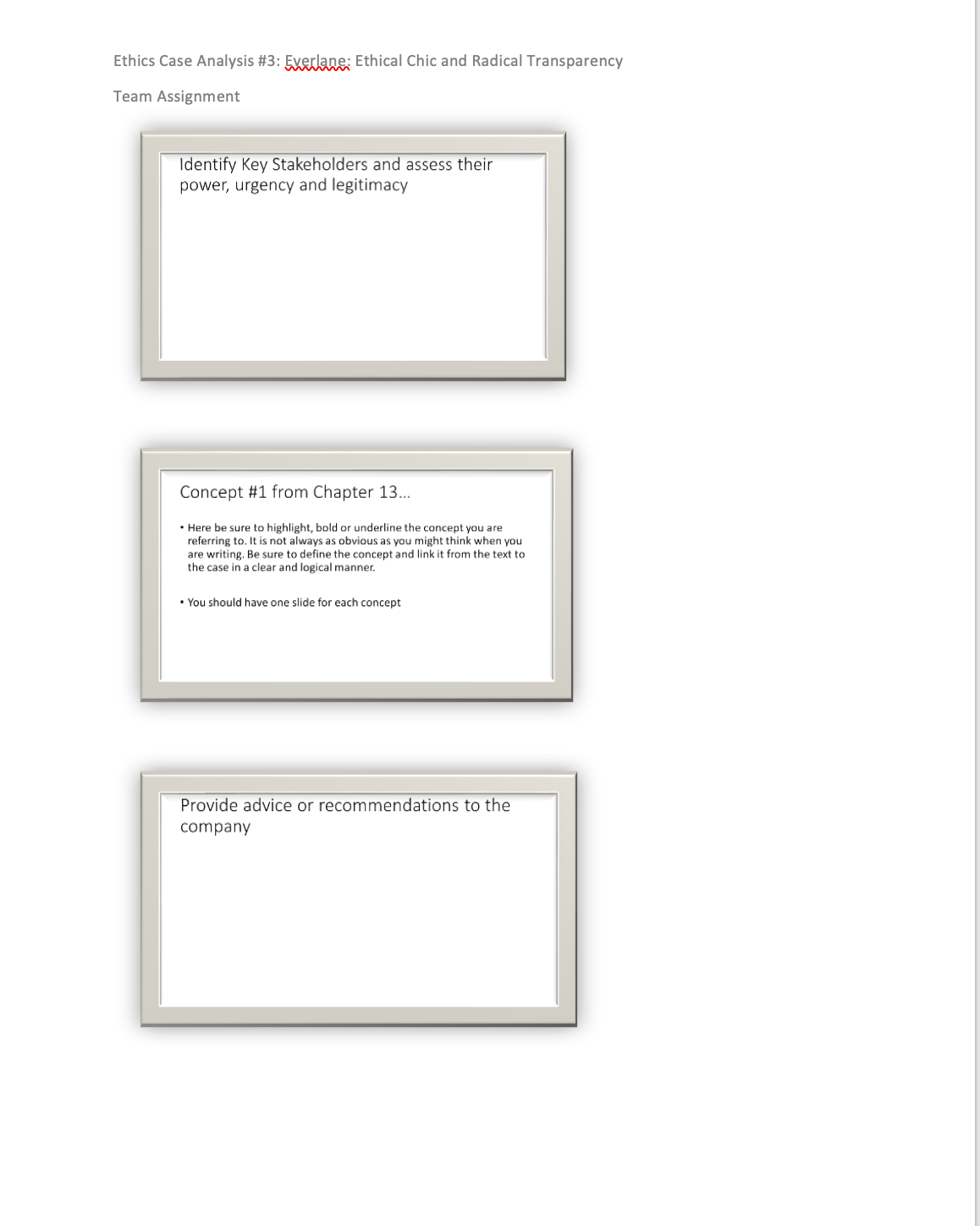
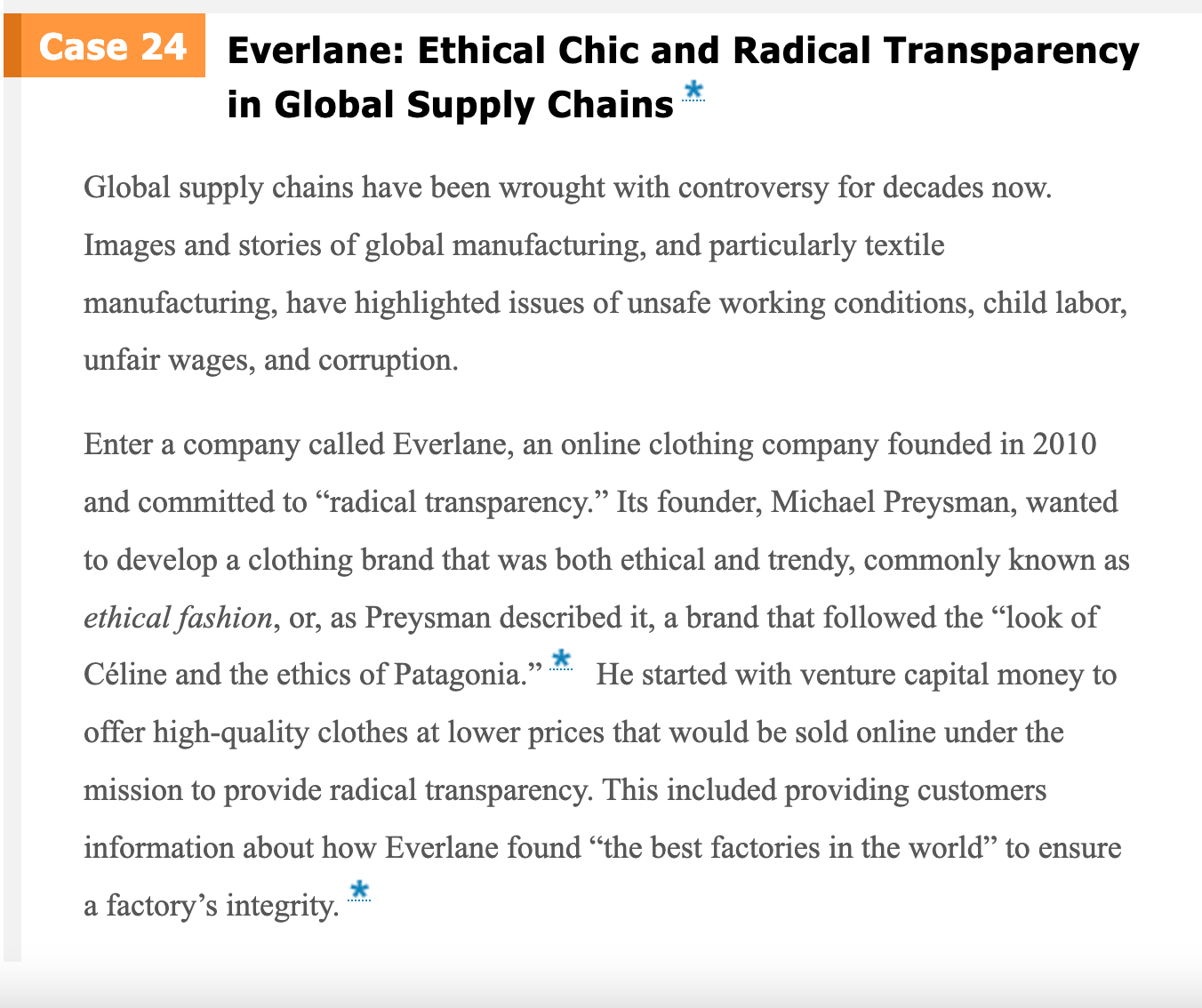
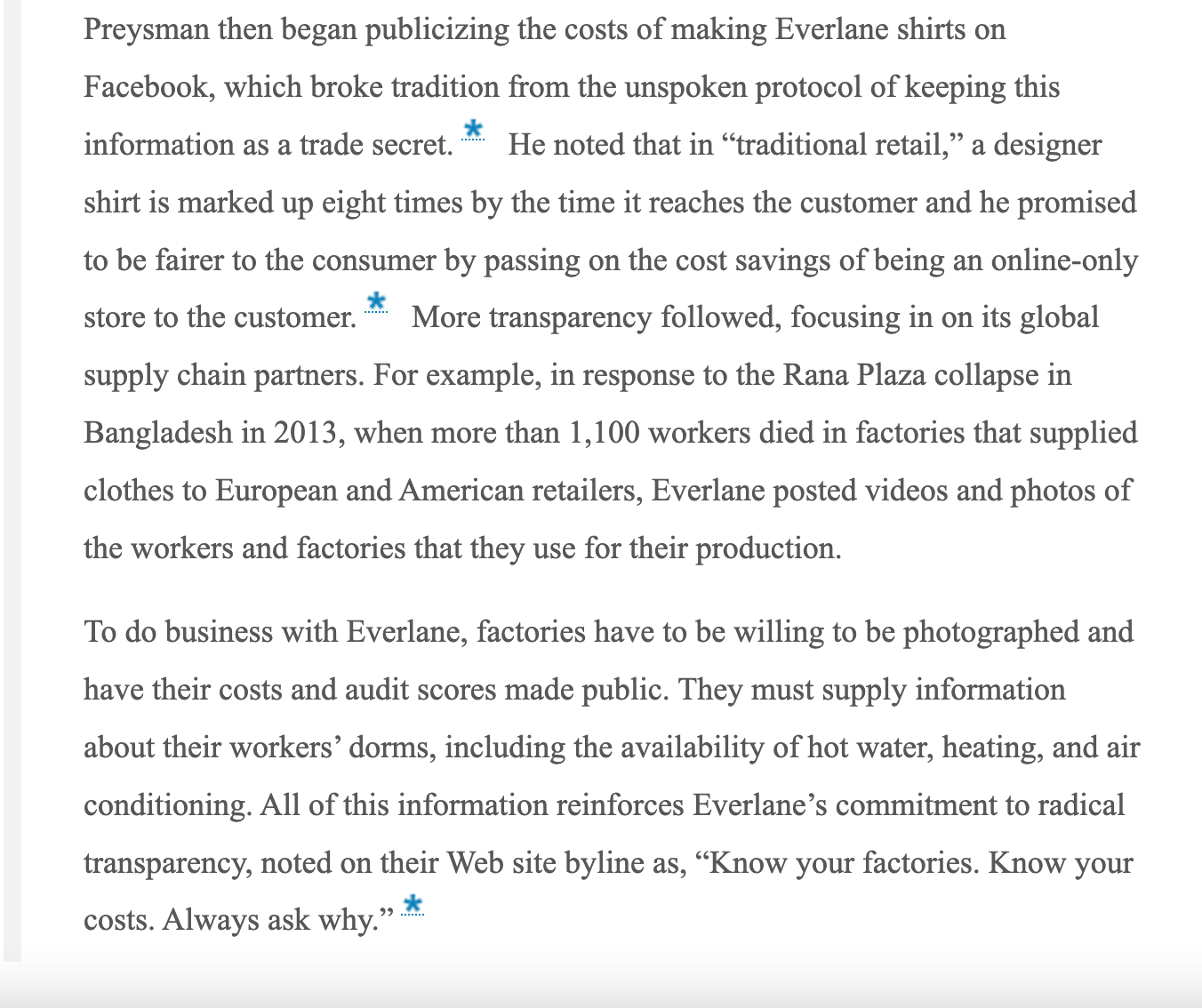
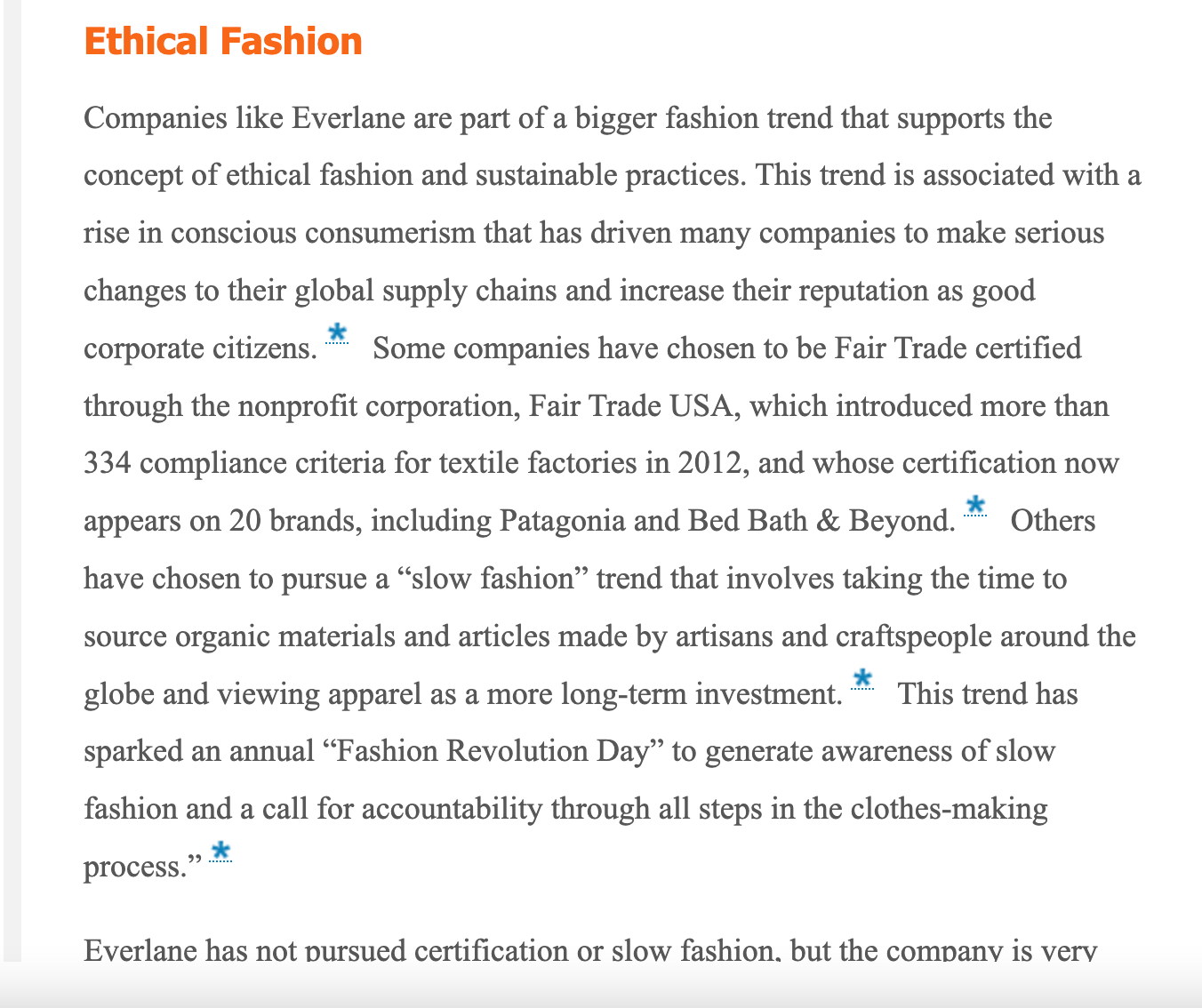
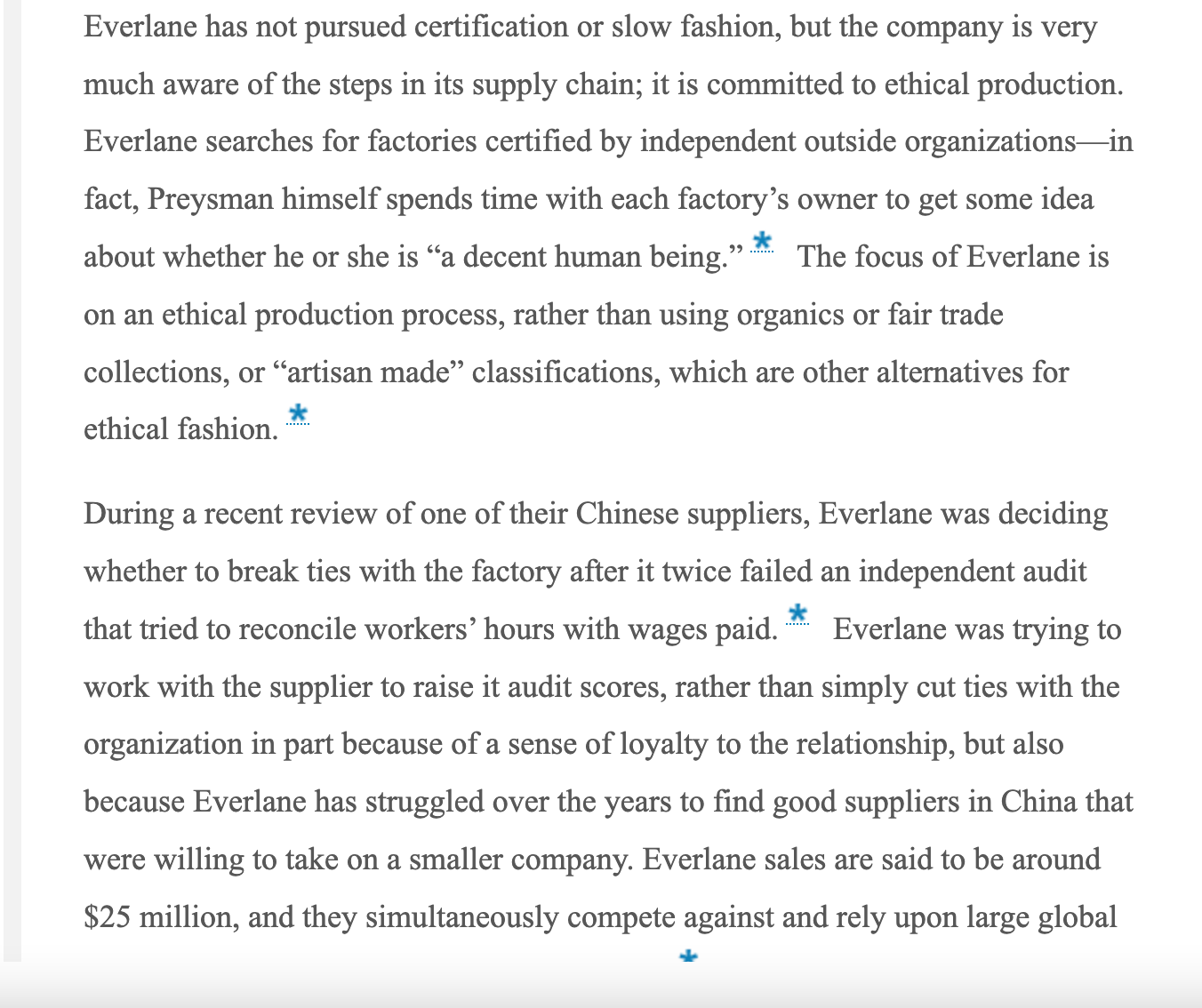
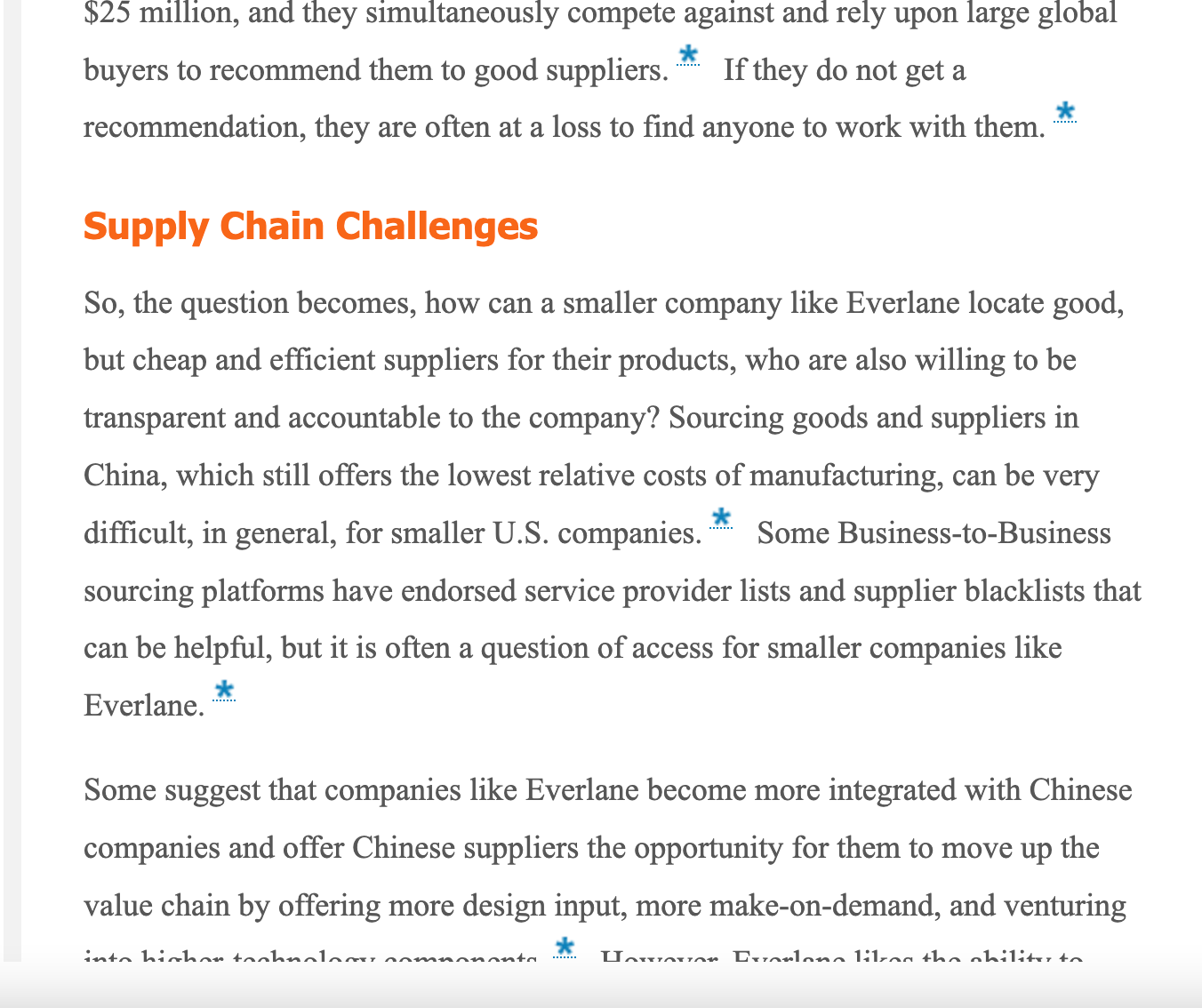
Ethics Case Analysis #3: Everlane: Ethical Chic and Radical Transparency Team Assignment Your task is to read Case #24: Everlane: Ethical Chic and Radical Transparency. This case can be found within our Blackboard site under the section titled Course Content > > Week 3: Chapters 14-16. Each member of the group must read the case and contribute. As a team, you are free to organize the workload however you choose. But please keep in mind you will receive a GROUP GRADE for this assignment. Please keep in mind that the grade your group receives depends on the quality of your contribution as well as the quality of the contribution of other group members. If you do not feel that a certain portion of the assignment is sufficient, it is in your best interest to speak up to your fellow group members so that everyone can chime in and support a stronger submission. Steps: 1. Read the case. You are NOT responsible for answering the questions asked at the bottom of the case. You are responsible for completing the following prompts/questions: 2. First, identify the major overriding issue or problem the company faced. This should be like taking a bird's eye view of the problem. As an example, rather than state "Chipotle had contaminated food," you should be able to "zoom out" and phrase the issue or problem in a broader sense, such as "Chipotle's reputation and stock price dropped when the company encountered issues with food quality that resulted from several factors...." Further, identify any smaller sub-issues that are also related to the case and need to be acknowledged. 3. Second, identify the key stakeholders who are involve in this case. Describe their stake in the company. If necessary, refer back to Chapter 3, which discusses stakeholders. Identify which stakeholders have the most legitimacy, urgency and power. Be sure to provide reasoning as to why these stakeholders appear to have legitimacy, urgency or power. For a refresher, see section 3.2c of the textbook. 4. Third, identify and link four concepts from four of the last six chapters we covered in the textbook (014-19) to this case. Each chapter has relevant information that relates to the assigned case. It is your task to recognize various textbook concepts and apply them to the case in a thorough and descriptive manner. 5. Finally, the purpose of a case study analysis is to evaluate the company's or manager's actions, including what they did or did not do correctly in handling an issue. Provide a set of recommendations or advice to the company as if you were speaking to them. Tell them what they did or are doing right and what they did or are doing wrong. This should not be your opinion. Sentences should not state "I think..." This should be based on the full evaluation of what the key issue is, who the stakeholders are and which ones have the most power, urgency and legitimacy. It should also be based on what our textbook is teaching us, therefore your recommendations should reflect the concepts you have identified in #4 or otherwise be linked to concepts in the textbook. Your submission will be one set of PPT slides. There should be approximately 7 slides that are submitted. See below for an example:Ethics Case Analysis #3: Everlane: Ethical Chic and Radical Transparency Team Assignment Group Collaboration #1 Group # Students: 1. First name, last name 2. First name, last name 3. First name, last name 4. First name, last name 5. First name, last name Identifying the key issues and how they are related to the chapters The key issue in this case is . Further, there are several sub-issues we noted as well. They are_ After thoroughly reading and analyzing this case, it became clear that this case addresses multiple concepts from our textbook. For example...Ethics Case Analysis #3: Everlane: Ethical Chic and Radical Transparency Team Assignment Identify Key Stakeholders and assess their power, urgency and legitimacy Concept #1 from Chapter 13... . Here be sure to highlight, bold or underline the concept you are referring to. It is not always as obvious as you might think when you are writing. Be sure to define the concept and link it from the text to the case in a clear and logical manner. . You should have one slide for each concept Provide advice or recommendations to the companyCase 24 Everlane: Ethical Chic and Radical Transparency in Global Supply Chains Global supply chains have been wrought with controversy for decades now. Images and stories of global manufacturing, and particularly textile manufacturing, have highlighted issues of unsafe working conditions, child labor, unfair wages, and corruption. Enter a company called Everlane, an online clothing company founded in 2010 and committed to "radical transparency." Its founder, Michael Preysman, wanted to develop a clothing brand that was both ethical and trendy, commonly known as ethical fashion, or, as Preysman described it, a brand that followed the "look of Celine and the ethics of Patagonia." . He started with venture capital money to offer high-quality clothes at lower prices that would be sold online under the mission to provide radical transparency. This included providing customers information about how Everlane found "the best factories in the world" to ensure a factory's integrity.Preysman then began publicizing the costs of making Everlane shirts on Facebook, which broke tradition from the unspoken protocol of keeping this information as a trade secret. " He noted that in "traditional retail," a designer shirt is marked up eight times by the time it reaches the customer and he promised to be fairer to the consumer by passing on the cost savings of being an online-only store to the customer. More transparency followed, focusing in on its global supply chain partners. For example, in response to the Rana Plaza collapse in Bangladesh in 2013, when more than 1,100 workers died in factories that supplied clothes to European and American retailers, Everlane posted videos and photos of the workers and factories that they use for their production. To do business with Everlane, factories have to be willing to be photographed and have their costs and audit scores made public. They must supply information about their workers' dorms, including the availability of hot water, heating, and air conditioning. All of this information reinforces Everlane's commitment to radical transparency, noted on their Web site byline as, "Know your factories. Know your costs. Always ask why.".Ethical Fashion Companies like Everlane are part of a bigger fashion trend that supports the concept of ethical fashion and sustainable practices. This trend is associated with a rise in conscious consumerism that has driven many companies to make serious changes to their global supply chains and increase their reputation as good corporate citizens. "Some companies have chosen to be Fair Trade certified through the nonprofit corporation, Fair Trade USA, which introduced more than 334 compliance criteria for textile factories in 2012, and whose certification now appears on 20 brands, including Patagonia and Bed Bath & Beyond. Others have chosen to pursue a "slow fashion" trend that involves taking the time to source organic materials and articles made by artisans and craftspeople around the globe and viewing apparel as a more long-term investment. This trend has sparked an annual "Fashion Revolution Day" to generate awareness of slow fashion and a call for accountability through all steps in the clothes-making process. Everlane has not pursued certification or slow fashion. but the company is veryEverlane has not pursued certification or slow fashion, but the company is very much aware of the steps in its supply chain; it is committed to ethical production. Everlane searches for factories certified by independent outside organizations-in fact, Preysman himself spends time with each factory's owner to get some idea about whether he or she is "a decent human being." The focus of Everlane is on an ethical production process, rather than using organics or fair trade collections, or "artisan made" classifications, which are other alternatives for ethical fashion. " During a recent review of one of their Chinese suppliers, Everlane was deciding whether to break ties with the factory after it twice failed an independent audit that tried to reconcile workers' hours with wages paid. Everlane was trying to work with the supplier to raise it audit scores, rather than simply cut ties with the organization in part because of a sense of loyalty to the relationship, but also because Everlane has struggled over the years to find good suppliers in China that were willing to take on a smaller company. Everlane sales are said to be around $25 million, and they simultaneously compete against and rely upon large global$25 million, and they simultaneously compete against and rely upon large global buyers to recommend them to good suppliers. If they do not get a recommendation, they are often at a loss to find anyone to work with them. Supply Chain Challenges So, the question becomes, how can a smaller company like Everlane locate good, but cheap and efficient suppliers for their products, who are also willing to be transparent and accountable to the company? Sourcing goods and suppliers in China, which still offers the lowest relative costs of manufacturing, can be very difficult, in general, for smaller U.S. companies. Some Business-to-Business sourcing platforms have endorsed service provider lists and supplier blacklists that can be helpful, but it is often a question of access for smaller companies like Everlane. Some suggest that companies like Everlane become more integrated with Chinese companies and offer Chinese suppliers the opportunity for them to move up the value chain by offering more design input, more make-on-demand, and venturing into hishan tanhanlon Ammanmonth UniTATIAN DrawlAnn lilran the shiliter toSome suggest that companies like Everlane become more integrated with Chinese companies and offer Chinese suppliers the opportunity for them to move up the value chain by offering more design input, more make-on-demand, and venturing into higher-technology components. However, Everlane likes the ability to control costs and quality in their current model. They share production costs with their customers, and when they see an increase in costs, they try to figure out how to lower them. " Therefore, while it is difficult to get in the door with suppliers who agree to be transparent, once they are in the door, they work hard to train their suppliers to be efficient as well. Transparency at All Costs On the upside, because Everlane is relatively small, it has the opportunity to visit, vet, and negotiate with suppliers. For example, executives from Everlane, including Preysman, often visit Chinese suppliers after the Lunar New Year holiday in February, when they can get a sense of how many workers return to work after the holiday-an important indicator of how well the factory treats them. . So, while Everlane faces some significant challenges in holding to itsto lower them. " Therefore, while it is difficult to get in the door with suppliers who agree to be transparent, once they are in the door, they work hard to train their suppliers to be efficient as well. Transparency at All Costs On the upside, because Everlane is relatively small, it has the opportunity to visit, vet, and negotiate with suppliers. For example, executives from Everlane, including Preysman, often visit Chinese suppliers after the Lunar New Year holiday in February, when they can get a sense of how many workers return to work after the holiday-an important indicator of how well the factory treats them. " So, while Everlane faces some significant challenges in holding to its mission of ethical production through transparency, they feel comfortable with a model that allows them some control over cost and quality. According to Preysman, "We look for partners with the same aesthetics." While some worry that Everlane's ambitions to be ethical and transparent cannot keep up with its growth, Preysman argues that the bigger his company is, the more impact he can make. Foot
Step by Step Solution
There are 3 Steps involved in it

Get step-by-step solutions from verified subject matter experts
 Study Help