







Question: Ethics for Communication Training Professionals: Case-Stems lo Codes Rationale Communication trainers have no licensing, no credentialing, and no minimum competency levels. Yet, trainers are often
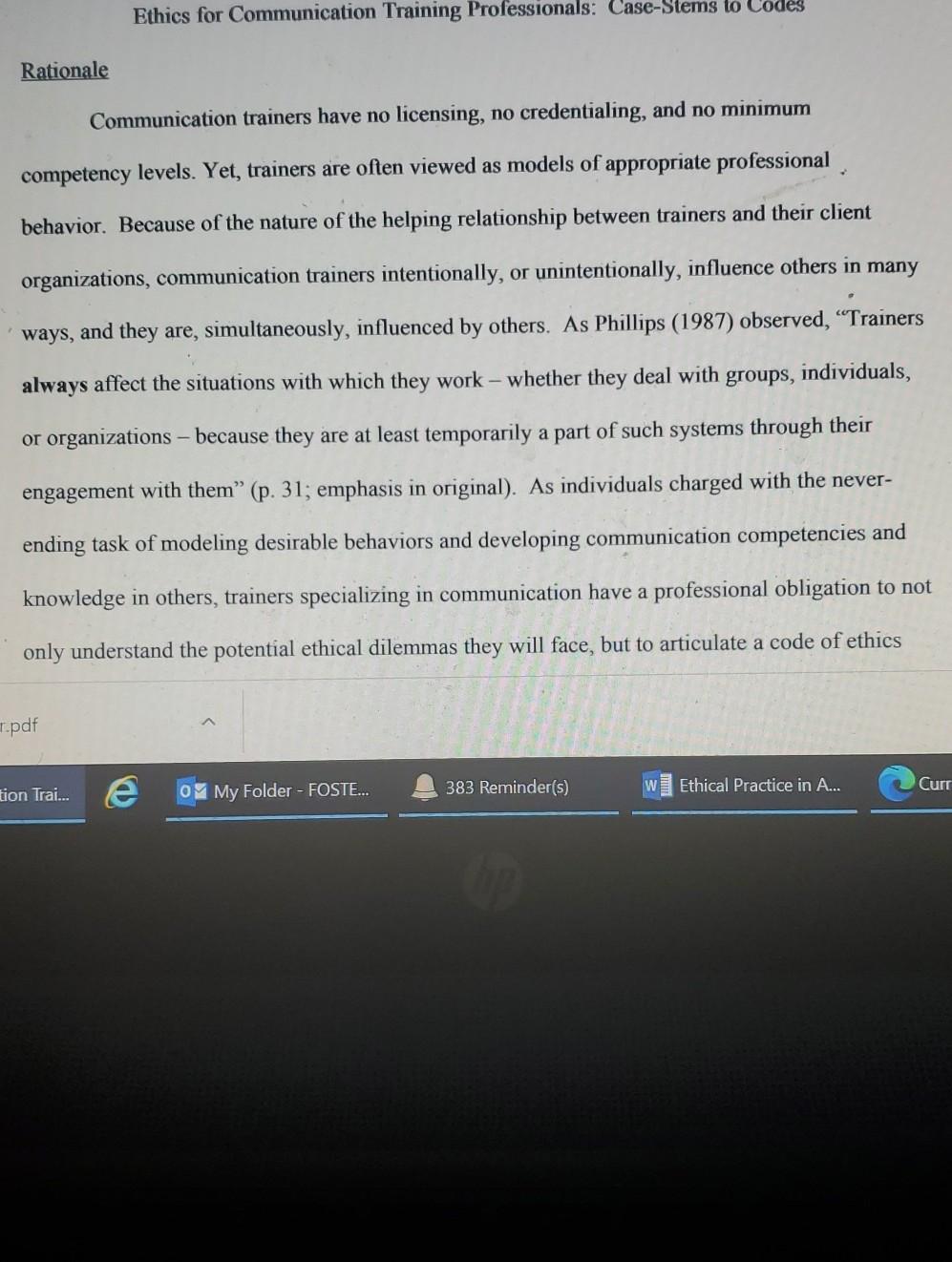
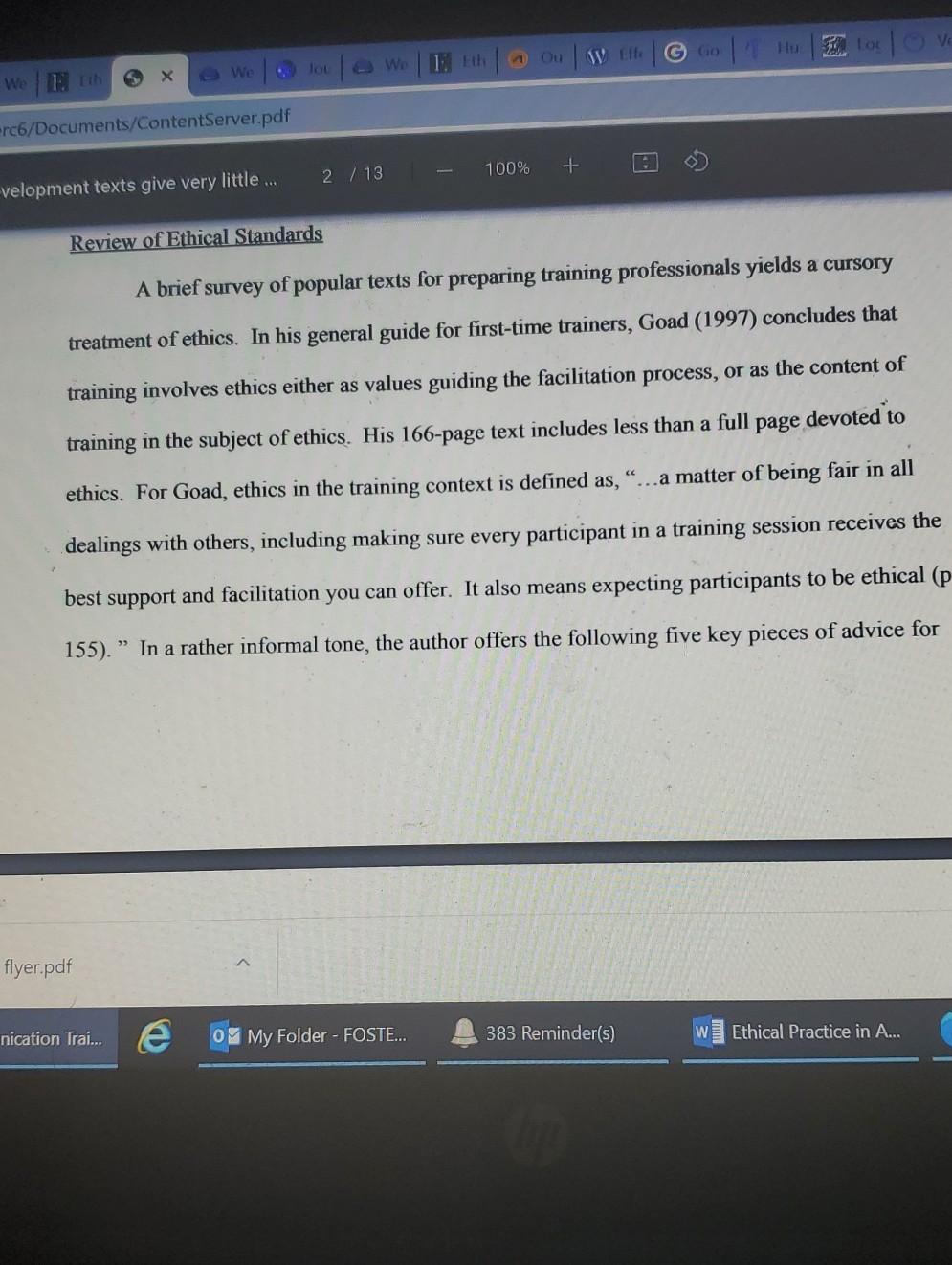
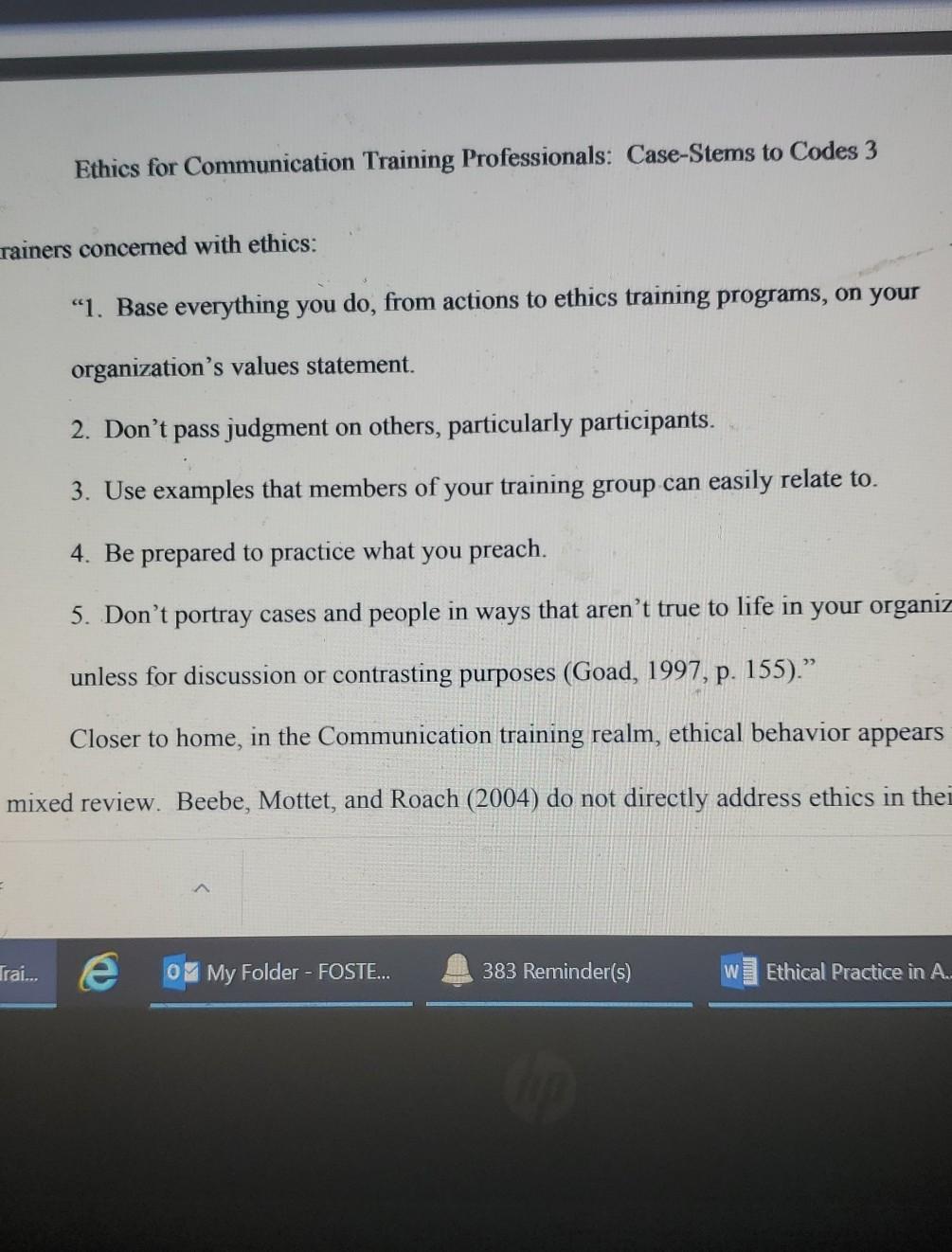


Ethics for Communication Training Professionals: Case-Stems lo Codes Rationale Communication trainers have no licensing, no credentialing, and no minimum competency levels. Yet, trainers are often viewed as models of appropriate professional behavior. Because of the nature of the helping relationship between trainers and their client organizations, communication trainers intentionally, or unintentionally, influence others in many ways, and they are, simultaneously, influenced by others. As Phillips (1987) observed, Trainers always affect the situations with which they work - whether they deal with groups, individuals, or organizations - because they are at least temporarily a part of such systems through their engagement with them (p. 31; emphasis in original). As individuals charged with the never- ending task of modeling desirable behaviors and developing communication competencies and knowledge in others, trainers specializing in communication have a professional obligation to not only understand the potential ethical dilemmas they will face, but to articulate a code of ethics I.pdf Ethical Practice in A... Curr tion Tra... e 383 Reminder(s) 0 My Folder - FOSTE... G GO I love 1 Eth ou W Efte to lowo a We We E FIN rc6/Documents/ContentServer.pdf 2 / 13 100% + velopment texts give very little ... Review of Ethical Standards A brief survey of popular texts for preparing training professionals yields a cursory treatment of ethics. In his general guide for first-time trainers, Goad (1997) concludes that training involves ethics either as values guiding the facilitation process, or as the content of training in the subject of ethics. His 166-page text includes less than a full page devoted to ...a matter of being fair in all ethics. For Goad, ethics in the training context is defined as, dealings with others, including making sure every participant in a training session receives the best support and facilitation you can offer. It also means expecting participants to be ethical (p 155). In a rather informal tone, the author offers the following five key pieces of advice for flyer.pdf nication Tra... e OM My Folder - FOSTE... W 383 Reminder(s) Ethical Practice in A... Ethics for Communication Training Professionals: Case-Stems to Codes 3 rainers concerned with ethics: "1. Base everything you do, from actions to ethics training programs, on your organization's values statement. 2. Don't pass judgment on others, particularly participants. 3. Use examples that members of your training group can easily relate to. 4. Be prepared to practice what you preach. 5. Don't portray cases and people in ways that aren't true to life in your organiz unless for discussion or contrasting purposes (Goad, 1997, p. 155)." Closer to home, in the Communication training realm, ethical behavior appears mixed review. Beebe, Mottet, and Roach (2004) do not directly address ethics in thei Tra... e 0 My Folder - FOSTE... 383 Reminder(s) WEthical Practice in A Closer to home, in the Communication training realm, ethical behavior appears to receive a mixed review. Beebe, Mottet, and Roach (2004) do not directly address ethics in their text. Instead, the authors appear to equate unethical behaviors with misbehaviors" (based on research on professors' misbehavior). Beebe et al provide a very helpful and concise 28-item list of how to avoid common professors' misbehaviors. For instance, to be effective, Make sure materials are audience centered, Keep close to your planned agenda," and "Make sure testing addresses desired objectives" (Beebe, et al, 2004. p. 234). An explicit treatment of ethics in communication training and development is offered by Arnold and McClure (1996), who devote a 5-page chapter to the issue. Arnold and McClure's (1996) list of common ethical concerns include: making recommendations for organizational change that might not include training, including making recommendations beyond the trainers' expertise level; maintaining confidentiality in presenting needs assessment and other organizational data; performing and reporting accurate needs assessments regardless of outcomes; and proper citation and responsit .pdf Ethics for Communication Training Professionals: Case-Stems to Codes 4 Development (ASTD) offers the most comprehensive ethical code. Established in 1944, ASTD provides its members with a clearly articulated code of ethics that enjoins trainers to be self- managing professionals, with high standards of integrity and competence, who will positively promote workplace learning and performance. More specifically, the ASTD code urges professionals to strive to: "recognize the rights and dignities of each individual develop human potential provide my employer, clients, and learners with the highest level quality education, training, and development comply with all copyright laws and the laws and regulations governing my position . . keep informed of pertinent knowledge and competence in the workplace learning an performance field training, and development comply with all copyright laws and the laws and regulations governing my position . keep informed of pertinent knowledge and competence in the workplace learning and performance field maintain confidentiality and integrity in the practice of my profession support my peers and to avoid conduct which impedes their practicing their professic conduct myself in an ethical and honest manner improve the public understanding of workplace learning and performance . fairly and accurately represent my workplace learning and performance credentials qualifications, experience, and ability contribute to the continuing growth of the profession (http://www.astd.org/ASTD/aboutus/missionAndVision/)? Based on the above sources, as well as a review of literature regarding ethics in coanizational consulting and training (Farley-Lucas 1993) the following issues surfaced a Ethics for Communication Training Professionals: Case-Stems to Codes 5 Keeping participants safe from harm, harassment, and negative experiences, Maintaining confidentiality (or anonymity when necessary), Providing accurate records of assessments, evaluations, and reports, Avoiding plagiarism, canned programs, and unidentified sources, Offering only training and services in areas which one is truly qualified, . Maintaining professional relationships with clients and participants, and Engaging in continual learning and professional development. Value of case studies Given the prevalence of ethical dilemmas in training and development, providing students with practice in fully assessing ethical situations using systematic problem-solving processes is extremely important to their professional development. As an educational approach Sypher (1997) asserts that case studies serve a variety of functions, including an epistemic yer.pdf Ethics for Communication Training Professionals: Case-Stems to Codes 6 facing communication trainers, and were based on the authors' twenty-plus years of experience as an organization development trainer and consultant. The items are called case-stems to reflect that students will be further engaged in the learning process if they are invited to add more details, dialogue, and overall depth of description to the cases they are discussing. Case- stems allow for integration of students' own organizational experiences and expectations. The following six case-stems reflect that students are active agents in the scenarios, that they have multiple issues to consider, and that there is no one clear solution. They are untitled so students can have more input in assessing the key issues. A. You witness a Human Resources Manager engaging in inappropriate touching and sexually explicit joke telling during two of your "Valuing Diversity training sessions. This behavior is pdf B. You were appointed to develop and administer a Leadership Assessment Center for identifying potential executive trainees. Participation is voluntary, and is based on recommendations from supervisors and managers. Based on its assessment, the Center will recommend individuals for further training, advancement, and promotion. During an informal lunch meeting with a Vice-President, you are told that upper management is hopeful the Center will identify slackers" so they can be weeded out or transferred to less visible and less desirable areas where they will have less impact on the organization. C. You were so excited about your excellent delivery during your Leadership Skills Training Ethics for Communication Training Professionals: Case-Stems to Codes 7 workshop that you forgot to distribute evaluation forms at the end of the last session. Your client contract calls for submission of training evaluation reports prior to issuing your payment for training services. At present, this is your only client, so you really need the income. D. You are granted a $5000 proposal to deliver training to manager-trainees on Conflict Resolution Strategies during a series of four 2-hour lunch meetings. You do not have material for this training. Luckily, you have a folder of materials you saved from your undergraduate course in Conflict and Communication. Your instructor, a seasoned trainer herself, developed a series of self-assessment instruments, dyad and group exercises, and summary sheets that would serve your purpose well. E. You are offered a bonus of $1200 to deliver a training session during one of your company's 2-hour staff meetings. Your Vice-President has decided on the topic of "Enhancing Customer Service. You have never had experience training others in this topic before and you have never had professional background in serving customers, yet your V.P. expects you to do the session. F. After working with the same organization for a few years, you find yourself romantically attracted to one of the other employees. Neither of you are in a committed relationship, you seem to get along very well, and the feelings appear mutual. Today, you see this person's name on the list of trainees for the Interpersonal Skills workshop that you are currently facilitating. You have six sessions (4 hours each) that you will be conducting with 12 trainees. Ethics for Communication Training Professionals: Case-Stems to Codes 8 Following a brief review or PowerPoint presentation that summarizes ethics in training and development, students are divided into groups of five or less to collaborate on the case- stems. Each case-stem is printed on a separate sheet of paper to allow room for group editing. Participants are instructed to embellish the case-stems and to insert any details about the context, people, dialogue that they feel will make the case more descriptive and more realistic. A reporter, recorder, and timekeeper should be elected within each group. Allowing about 15 minutes per case, the items can be distributed among groups as class time allows. Once the case has been edited and embellished by the group, group discussion should center on the following analysis questions: 1. What are the ethical issues suggested by the case? 2. How are various people in this case potentially affected by this ethical issue? Trainer? Participants? Organizational Leaders? Client? Others? jer.pdf Once the case has been edited and embellished by the group, group discussion should center on the following analysis questions: 1. What are the ethical issues suggested by the case? 2. How are various people in this case potentially affected by this ethical issue? Trainer? Participants? Organizational Leaders? Client? Others? 3. What are the likely outcomes if no action or intervention is taken? 4. What are the variety of actions that can be taken to address each issue? 5. What are the pros and cons of each of these actions? 6. Based on your assessment of the issue, which action do you recommend? Why? If time allows, each group could be assigned a case and they could create a role-play dialogue that illustrates the issues under investigation. The emphasis should be on a problem- solution approach, rather than on illustrating unethical or questionable behaviors and practice After performing the role-plays for their classmates, class-wide discussion can center on answering the analysis questions collectively and reflecting on the wide diversity of approaches and outcomes possible for each case situation. Debriefing Ethics for Communication Training Professionals: Case-Stems to Codes 9 Debriefing should tie the various ethical dilemmas to the complex interpersonal and organizational dynamics experienced by the trainer and the participants alike. Student discussions during this exercise tend to be very lively and engaging, so it is important to keep focusing on the ethical issues. It is also important to monitor the discussion for misperceptions ment texts give very focusing on the ethical issues. It is also important to monitor the discussion for misperceptions or exaggerated expectations, and to point the discussion toward helpful behaviors. The temptation to "get by" with minimal training experience in order to earn extra money, along with organizational recognition for providing expertise, tend to be very salient issues for college students. I often share the maxim that it is easier to be ethical when you are not starving." I also point out the costs of taking assignments for which one is not qualified, including: poor performance with a session, not meeting organizational needs or objectives, decreased credibility, professional embarrassment, waste of time and money, and loss of productivity. Co-facilitating with an experienced trainer, conducting thorough needs assessments, engaging in direct communication with clients and sponsors, and modifying existing materials (with proper citations) to meet organizational objectives are popular suggestions. Regarding managing complex interpersonal relationships, several opportunities are provided for students to apply concepts and skills from their previous coursework and f Ethics for Communication Training Professionals: Case-Stems to Codes 10 Following Arnold and McClure's (1996) suggestion, students should create their own code of ethics. Thus, an excellent follow-up to this module is the creation of a personal code of ethics that each student expects to adhere to. This helps to personalize the material and move students one step closer to applying the concepts to their own professional practice. Students should be directed to summarize their top five to seven points of behaviors, activities, or standards that will guide their professional dealings. The code should be channeled into a document that can be shared with potential clients as part of an identity kit," and should be both grammatically accurate and visually pleasing. Once completed, students can share their codes via in-class discussions, electronic postings to the course website or WIKI, or as professional- quality posters taped to the classroom wall. This public display contributes to making ethics ..pdf audus Students' in-class comments reflect that they particularly enjoy using "case-stems because they can embellish the cases with phrases and dialogues that are more reflective of their organizational experiences and their expectations of training situations. As one student commented, the minimalist case-stem framework made the process of creating a case study less of a mystery and more fun. While not all students enjoy role-plays, more vocal and more extroverted students did enjoy engaging directly in the material and reported feeling more like a trainer" for their classmates. Written end-of-semester course evaluations often point to this as a memorable segment, and students' written learning summaries nearly always reference a few items from their personal codes of conduct. Previous successes with this instructional module have led to guest lectures for other sections of Communication Training and Development. As in all instructional pursuits, the module offered here can be modified to meet course objectives, Ethics for Communication Training Professionals: Case-Stems to Codes 11 time constraints, and student interest. In sum, it is an instructional module that actively engage students on several levels and guides them into articulating their own code of ethics. Due Thursday Respond to the following in a minimum of 175 words: This week focuses on ethical communication in the field of adult education and training. Refer to the "Ethics for Communication Training Professionals: Case-Stems to Codes" article in this week's University Library Readings. . What are some of the most common ethical concerns for individuals working in communication training and development? What are some of the most prevalent ethical issues for communication trainers
Step by Step Solution
There are 3 Steps involved in it
1 Expert Approved Answer
Step: 1 Unlock

Question Has Been Solved by an Expert!
Get step-by-step solutions from verified subject matter experts
Step: 2 Unlock
Step: 3 Unlock
 Study Help