







Question: EU 2020 Strategy and other relevant documents recognize the impact that entrepreneurship has on economy and society and consequently support human capital development in the
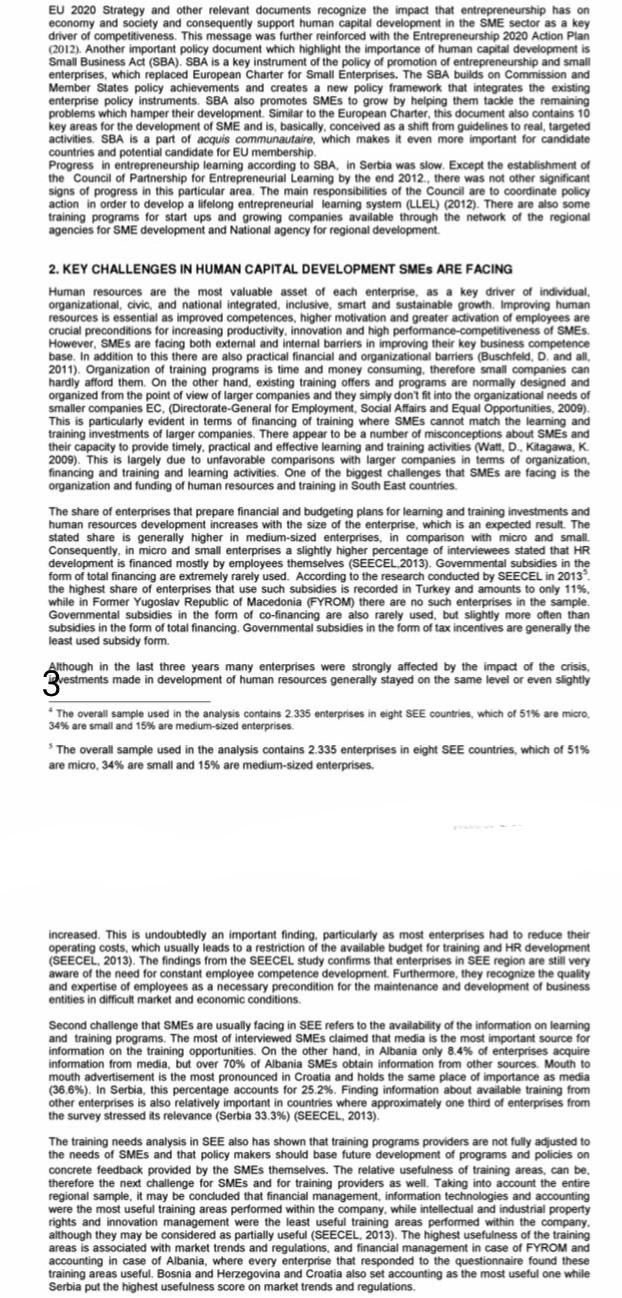
EU 2020 Strategy and other relevant documents recognize the impact that entrepreneurship has on economy and society and consequently support human capital development in the SME sector as a key driver of competitiveness. This message was further reinforced with the Entrepreneurship 2020 Action Plan (2012). Another important policy document which highlight the importance of human capital development is Small Business Act (SBA). SBA is a key instrument of the policy of promotion of entrepreneurship and small Member States policy achievements and creates a new policy framework that integrates the existing enterprise policy instruments. SBA also promotes SMEs to grow by helping them tackle the remaining problems which hamper their development. Similar to the European Charter, this document also contains 10 key areas for the development of SME and is basically, conceived as a shift from guidelines to real, targeted activities. SBA is a part of acquis communautaire, which makes it even more important for candidate countries and potential candidate for EU membership Progress in entrepreneurship leaming according to SBA in Serbia was slow. Except the establishment of the Council of Partnership for Entrepreneurial Leaming by the end 2012, there was not other significant signs of progress in this particular area. The main responsibilities of the Council are to coordinate policy action in order to develop a lifelong entrepreneurial learning system (LLEL) (2012). There are also some training programs for start ups and growing companies available through the network of the regional agencies for SME development and National agency for regional development 2. KEY CHALLENGES IN HUMAN CAPITAL DEVELOPMENT SMES ARE FACING Human resources are the most valuable asset of each enterprise, as a key driver of individual, organizational, civic, and national integrated, inclusive, smart and sustainable growth. Improving human resources is essential as improved competences, higher motivation and greater activation of employees are crucial preconditions for increasing productivity, innovation and high performance competitiveness of SMEs. However, SMEs are facing both external and internal barriers in improving their key business competence base. In addition to this there are also practical financial and organizational barriers (Buschfeld, D. and all, 2011). Organization of training programs is time and money consuming, therefore small companies can hardly afford them. On the other hand, existing training offers and programs are normally designed and organized from the point of view of larger companies and they simply don't fit into the organizational needs of smaller companies EC. (Directorate-General for Employment, Social Affairs and Equal Opportunities. 2009). This is particularly evident in terms of financing of training where SMEs cannot match the learning and training investments of larger companies. There appear to be a number of misconceptions about SMEs and their capacity to provide timely, practical and effective learning and training activities (Watt, D. Kitagawa. K 2009). This is largely due to unfavorable comparisons with larger companies in terms of organization, financing and training and learning activities. One of the biggest challenges that SMEs are facing is the organization and funding of human resources and training in South East countries The share of enterprises that prepare financial and budgeting plans for learning and training investments and human resources development increases with the size of the enterprise, which is an expected result. The stated share is generally higher in medium-sized enterprises, in comparison with micro and small. Consequently, in micro and small enterprises a slightly higher percentage of interviewees stated that HR development is financed mostly by employees themselves (SEECEL 2013). Governmental subsidies in the form of total financing are extremely rarely used. According to the research conducted by SEECEL in 2013. the highest share of enterprises that use such subsidies is recorded in Turkey and amounts to only 11% while in Former Yugoslav Republic of Macedonia (FYROM) there are no such enterprises in the sample Governmental subsidies in the form of co-financing are also rarely used, but slightly more often than subsidies in the form of total financing, Governmental subsidies in the form of tax incentives are generally the least used subsidy form. Although in the last three years many enterprises were strongly affected by the impact of the crisis. vestments made in development of human resources generally stayed on the same level or even slightly * The overall sample used in the analysis contains 2.335 enterprises in eight SEE countries, which of 51% are micro 34% are small and 15% are medium-sized enterprises The overall sample used in the analysis contains 2.335 enterprises in eight SEE countries, which of 51% are micro, 34% are small and 15% are medium-sized enterprises. increased. This is undoubtedly an important finding, particularly as most enterprises had to reduce their operating costs, which usually leads to a restriction of the available budget for training and HR development (SEECEL, 2013). The findings from the SEECEL study confirms that enterprises in SEE region are still very aware of the need for constant employee competence development. Furthermore, they recognize the quality and expertise of employees as a necessary precondition for the maintenance and development of business entities in difficult market and economic conditions Second challenge that SMEs are usually facing in SEE refers to the availability of the information on learning and training programs. The most of interviewed SMEs claimed that media is the most important source for information on the training opportunities. On the other hand, in Albania only 8.4% of enterprises acquire information from media, but over 70% of Albania SMEs obtain information from other sources. Mouth to mouth advertisement is the most pronounced in Croatia and holds the same place of importance as media (36.6%), in Serbia, this percentage accounts for 25.2%. Finding information about available training from other enterprises is also relatively important in countries where approximately one third of enterprises from the survey stressed its relevance (Serbia 33.3%) (SEECEL, 2013). The training needs analysis in SEE also has shown that training programs providers are not fully adjusted to the needs of SMEs and that policy makers should base future development of programs and policies on concrete feedback provided by the SMEs themselves. The relative usefulness of training areas, can be therefore the next challenge for SMEs and for training providers as well. Taking into account the entire regional sample, it may be concluded that financial management, information technologies and accounting were the most useful training areas performed within the company, while intellectual and industrial property rights and innovation management were the least useful training areas performed within the company. although they may be considered as partially useful (SEECEL, 2013). The highest usefulness of the training areas is associated with market trends and regulations, and financial management in case of FYROM and accounting in case of Albania, where every enterprise that responded to the questionnaire found these training areas useful. Bosnia and Herzegovina and Croatia also set accounting as the most useful one while Serbia put the highest usefulness score on market trends and regulations
Step by Step Solution
There are 3 Steps involved in it
1 Expert Approved Answer
Step: 1 Unlock

Question Has Been Solved by an Expert!
Get step-by-step solutions from verified subject matter experts
Step: 2 Unlock
Step: 3 Unlock
 Study Help