







Question: Euclidean Distance import stdio import sys # Return the Euclidean distance between x and y, calculated as as the square # root of the sums
Euclidean Distance
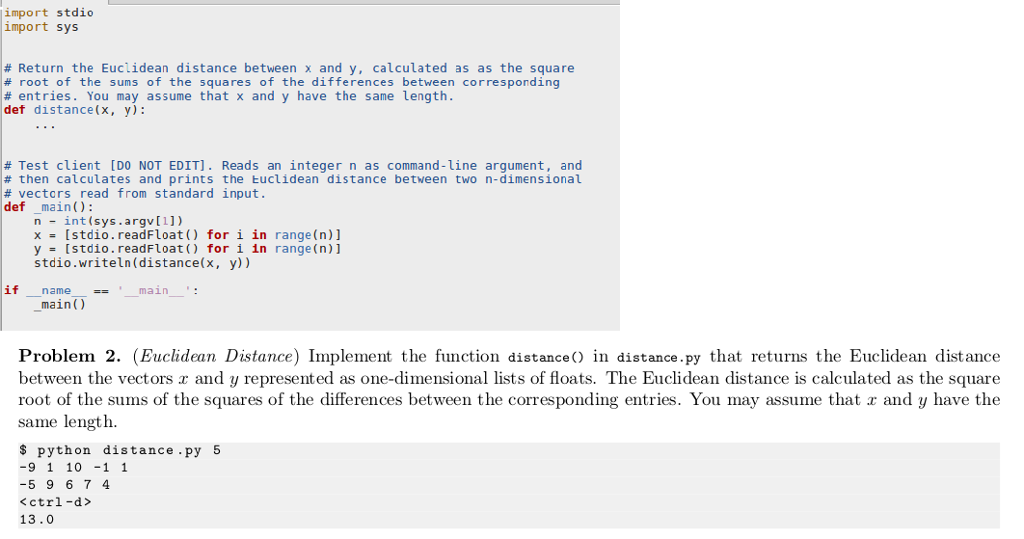
import stdio import sys # Return the Euclidean distance between x and y, calculated as as the square # root of the sums of the squares of the differences between corresponding # entries. You may assume that x and y have the same length, det distance(x, y): ... # Test client [DO NOT EDIT]. Reads an integer n as command-line argument, and # then calculates and prints the Euclidean distance between two n-dimensional # vectors read from standard input, def _main(): n = int(sys.argv[1]) x = [stdio.readFloat() for i in range(n)] y = [stdio.readFloat() for i in range(n)] stdio.writeln(distance(x, y)) if_name_ == '_main_': _main() Implement the function distance() in distance.py that returns the Euclidean distance between the vectors x and y represented as one-dimensional lists of floats. The Euclidean distance is calculated as the squareroot of the sums of the squares of the differences between the corresponding entries. You may assume that x and y have the same length. $ python distance.py 5 -9 1 10 -1 1 -5 9 6 7 4
Step by Step Solution
There are 3 Steps involved in it

Get step-by-step solutions from verified subject matter experts
 Study Help