Question: Euler's Method and Modified Euler's Method: Find a numerical solution to the initial value problem (dy / dx) = 2x + y, y(0) = 1
Euler's Method and Modified Euler's Method:
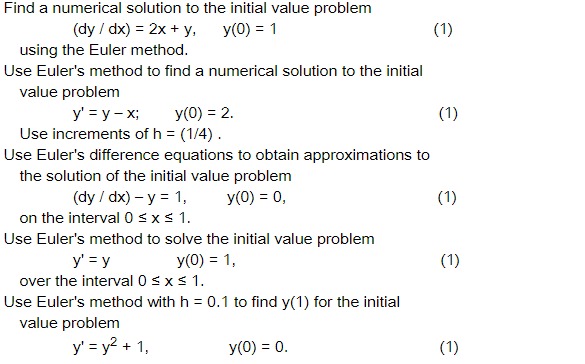
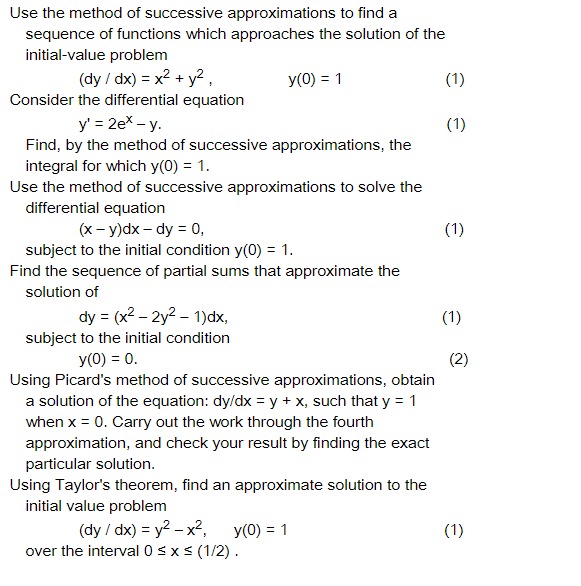
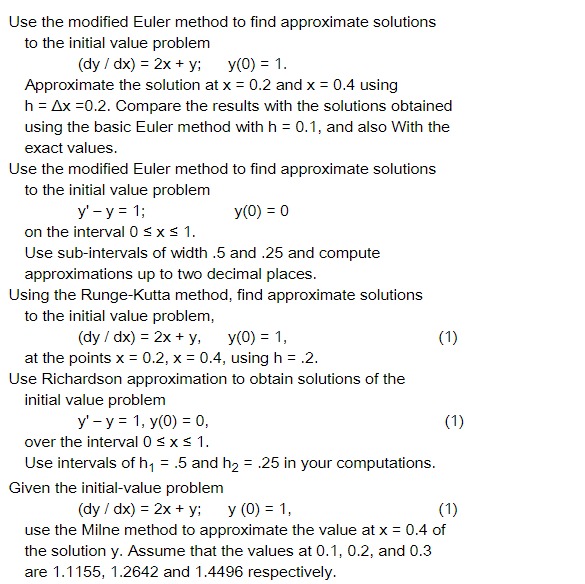
Find a numerical solution to the initial value problem (dy / dx) = 2x + y, y(0) = 1 (1) using the Euler method. Use Euler's method to find a numerical solution to the initial value problem y'=y-x; y(0) = 2. (1) Use increments of h = (1/4) . Use Euler's difference equations to obtain approximations to the solution of the initial value problem (dy / dx) - y = 1, y(0) = 0, (1) on the interval 0 s x $ 1. Use Euler's method to solve the initial value problem y'= y y(0) = 1, (1) over the interval 0 s x = 1. Use Euler's method with h = 0.1 to find y(1) for the initial value problem y' = y2 + 1, y(0) = 0. (1)Use the method of successive approximations to nd a sequence of functions which approaches the solution of the initialvalue problem (dwdxt=x2+y2. \"01:1 {1} Consider the differential equation x' = 12E" - x- {1} Find, by the method of successive approximations, the integral for which t!) = 1. Use the method of successive approximations to solve the differential equation (I-x)dI-dx=. {1] subject to the initial condition vf} = 1. Find the sequence of partial sums that approximate the solution of dv=th2y21:~dx. (1) subject to the initial condition xiii} = '3- {2} Using Picard's method of successive approximations, obtain a solution of the equation: dvfdx = v + x, such that v = 1 when x = . Carry out the work through the fourth approximation, and check your result by nding the exact particular solution. Using Taylor's theorem, find an approximate solution to the initial value problem (dwarf, xtl=1 (1) over the interval [I s x s {\"2} . Use the modified Euler method to find approximate solutions to the initial value problem (dy / dx) = 2x + y; y(0) = 1. Approximate the solution at x = 0.2 and x = 0.4 using h = Ax =0.2. Compare the results with the solutions obtained using the basic Euler method with h = 0.1, and also With the exact values. Use the modified Euler method to find approximate solutions to the initial value problem y' - y = 1; y(0) = 0 on the interval 0 = x = 1. Use sub-intervals of width .5 and .25 and compute approximations up to two decimal places. Using the Runge-Kutta method, find approximate solutions to the initial value problem, (dy / dx) = 2x + y, y(0) = 1, (1) at the points x = 0.2, x = 0.4, using h = .2. Use Richardson approximation to obtain solutions of the initial value problem y' - y = 1, y(0) = 0, (1) over the interval 0 = x = 1. Use intervals of h, = .5 and h2 = .25 in your computations. Given the initial-value problem (dy / dx) = 2x+ y; y (0) = 1, (1) use the Milne method to approximate the value at x = 0.4 of the solution y. Assume that the values at 0.1, 0.2, and 0.3 are 1.1155, 1.2642 and 1.4496 respectively









 Study Help