







Question: EVEN NUMBERS PLEASE cher? APTER 1 Introduction to Statistics 10. Sexuality of Women The sexuality of women was discussed in Shere Hite's book Women and
EVEN NUMBERS PLEASE
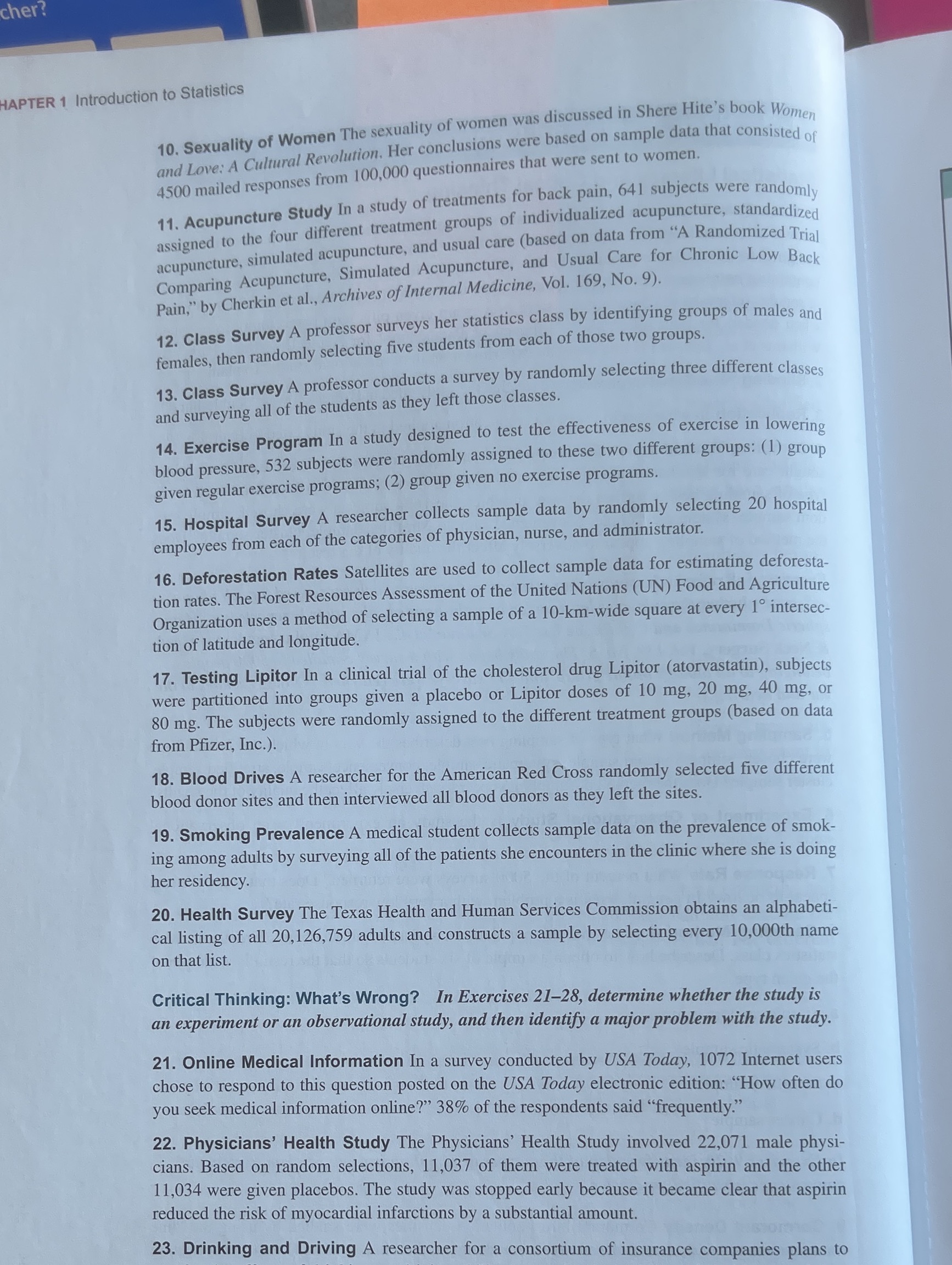
cher? APTER 1 Introduction to Statistics 10. Sexuality of Women The sexuality of women was discussed in Shere Hite's book Women and Love: A Cultural Revolution. Her conclusions were based on sample data that consisted of 4500 mailed responses from 100,000 questionnaires that were sent to women. 11. Acupuncture Study In a study of treatments for back pain, 641 subjects were randomly assigned to the four different treatment groups of individualized acupuncture, standardized acupuncture, simulated acupuncture, and usual care (based on data from "A Randomized Trial Comparing Acupuncture, Simulated Acupuncture, and Usual Care for Chronic Low Back Pain," by Cherkin et al., Archives of Internal Medicine, Vol. 169, No. 9). 12. Class Survey A professor surveys her statistics class by identifying groups of males and females, then randomly selecting five students from each of those two groups. 13. Class Survey A professor conducts a survey by randomly selecting three different classes and surveying all of the students as they left those classes. 14. Exercise Program In a study designed to test the effectiveness of exercise in lowering blood pressure, 532 subjects were randomly assigned to these two different groups: (1) group given regular exercise programs; (2) group given no exercise programs. 15. Hospital Survey A researcher collects sample data by randomly selecting 20 hospital employees from each of the categories of physician, nurse, and administrator. 16. Deforestation Rates Satellites are used to collect sample data for estimating deforesta- tion rates. The Forest Resources Assessment of the United Nations (UN) Food and Agriculture Organization uses a method of selecting a sample of a 10-km-wide square at every 10 intersec- tion of latitude and longitude. 17. Testing Lipitor In a clinical trial of the cholesterol drug Lipitor (atorvastatin), subjects were partitioned into groups given a placebo or Lipitor doses of 10 mg, 20 mg, 40 mg, or 80 mg. The subjects were randomly assigned to the different treatment groups (based on data from Pfizer, Inc.). 18. Blood Drives A researcher for the American Red Cross randomly selected five different blood donor sites and then interviewed all blood donors as they left the sites. 19. Smoking Prevalence A medical student collects sample data on the prevalence of smok- ing among adults by surveying all of the patients she encounters in the clinic where she is doing her residency. 20. Health Survey The Texas Health and Human Services Commission obtains an alphabeti- cal listing of all 20, 126,759 adults and constructs a sample by selecting every 10,000th name on that list. Critical Thinking: What's Wrong? In Exercises 21-28, determine whether the study is an experiment or an observational study, and then identify a major problem with the study. 21. Online Medical Information In a survey conducted by USA Today, 1072 Internet users chose to respond to this question posted on the USA Today electronic edition: "How often do you seek medical information online?" 38% of the respondents said "frequently." 22. Physicians' Health Study The Physicians' Health Study involved 22,071 male physi- cians. Based on random selections, 11,037 of them were treated with aspirin and the other 11,034 were given placebos. The study was stopped early because it became clear that aspirin reduced the risk of myocardial infarctions by a substantial amount. 23. Drinking and Driving A researcher for a consortium of insurance companies plans to
Step by Step Solution
There are 3 Steps involved in it

Get step-by-step solutions from verified subject matter experts
 Study Help