







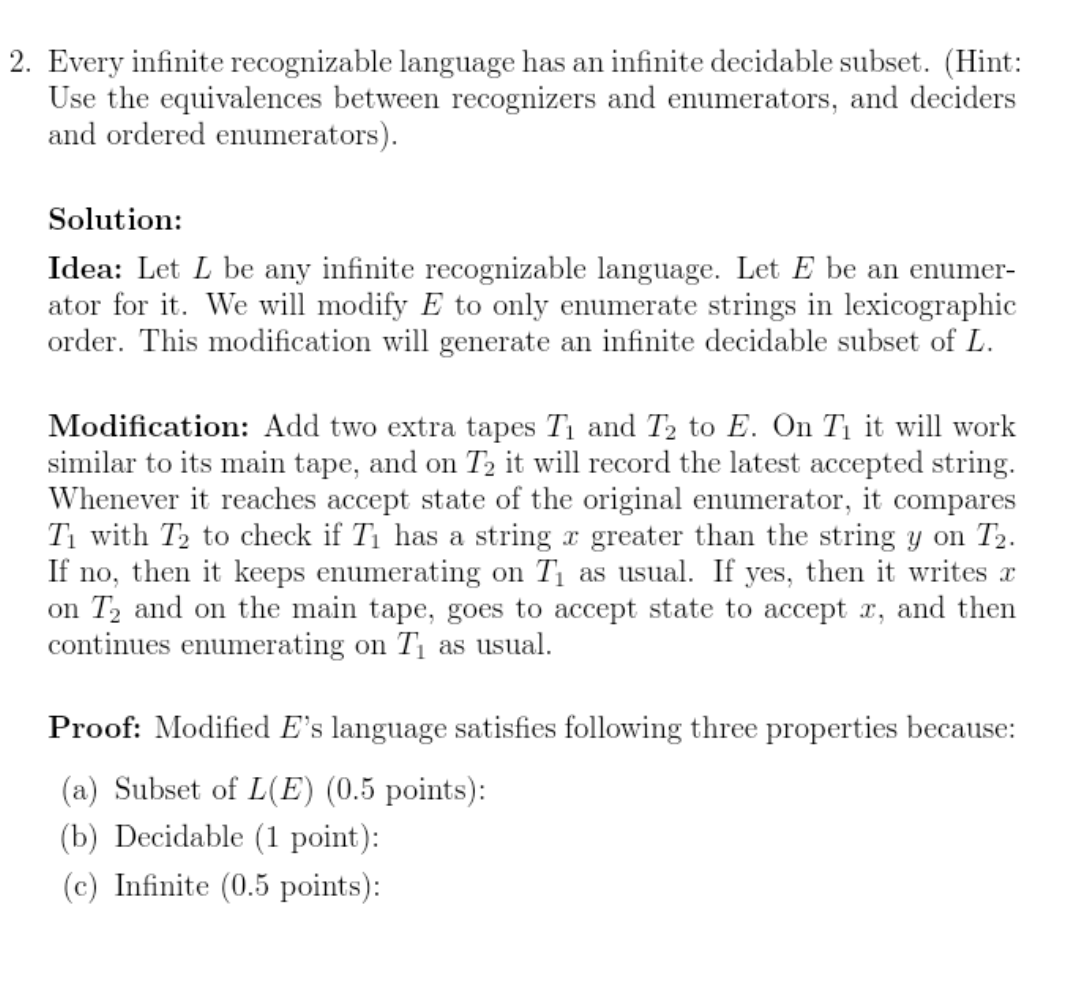
Question: Every infinite recognizable language has an infinite decidable subset. ( Hint: Use the equivalences between recognizers and enumerators, and deciders and ordered enumerators ) .
Every infinite recognizable language has an infinite decidable subset. Hint: Use the equivalences between recognizers and enumerators, and deciders and ordered enumerators
Solution:
Idea: Let be any infinite recognizable language. Let be an enumerator for it We will modify to only enumerate strings in lexicographic order. This modification will generate an infinite decidable subset of
Modification: Add two extra tapes and to On it will work similar to its main tape, and on it will record the latest accepted string. Whenever it reaches accept state of the original enumerator, it compares with to check if has a string greater than the string on If no then it keeps enumerating on as usual. If yes, then it writes on and on the main tape, goes to accept state to accept and then continues enumerating on as usual.
Proof: Modified Es language satisfies following three properties because:
a Subset of points:
b Decidable point:
c Infinite points:
Step by Step Solution
There are 3 Steps involved in it
1 Expert Approved Answer
Step: 1 Unlock

Question Has Been Solved by an Expert!
Get step-by-step solutions from verified subject matter experts
Step: 2 Unlock
Step: 3 Unlock
 Study Help