







Question: Every time when we go to Starbucks, we join a line with a number of people ahead of us. Let us build a probabilistic model
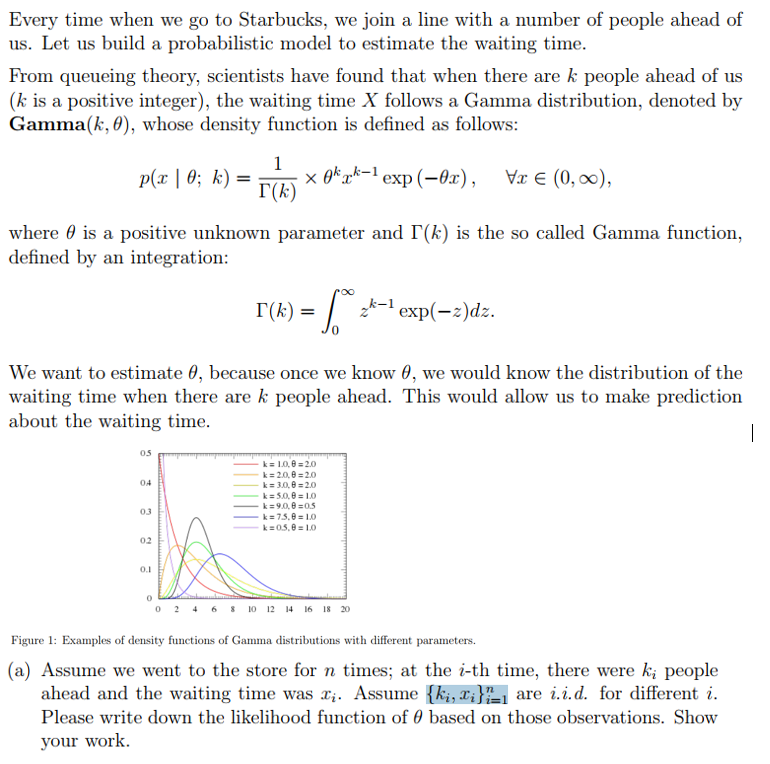
Every time when we go to Starbucks, we join a line with a number of people ahead of us. Let us build a probabilistic model to estimate the waiting time. From queueing theory, scientists have found that when there are & people ahead of us (k is a positive integer), the waiting time X follows a Gamma distribution, denoted by Gamma(k, 0), whose density function is defined as follows: p(x | 0; k) = T( k) 1 x 0krk-1 exp (-0x) , VI E (0,00), where 0 is a positive unknown parameter and I(k) is the so called Gamma function, defined by an integration: T (k) = [ expl - 2 ) da. We want to estimate 0, because once we know 0, we would know the distribution of the waiting time when there are & people ahead. This would allow us to make prediction about the waiting time. 05 = 10.0 =20 k=20.0=20 k = 30.0 =20 k=50.0 = 10 03 k =9.0.0 =05 k =75.0 = 10 k=05.0 = 10 0.2 10 12 14 1 Figure 1: Examples of density functions of Gamma distributions with different parameters. (a) Assume we went to the store for n times; at the i-th time, there were k; people ahead and the waiting time was mi. Assume {ki, it_ are i.i.d. for different i. Please write down the likelihood function of 0 based on those observations. Show your work
Step by Step Solution
There are 3 Steps involved in it

Get step-by-step solutions from verified subject matter experts
 Study Help