







Question: everything that is done so far is correct, just need help finding the debit and credit amounts Problem 20-13 (Algo) Accounting changes and error correction;
![correction; seven situations; tax effects considered [LO20-1, 20-2, 20-3, 20-4, 20-6] Williams-Santana,](https://dsd5zvtm8ll6.cloudfront.net/si.experts.images/questions/2024/10/67168b28b5d2e_66467168b284a229.jpg)
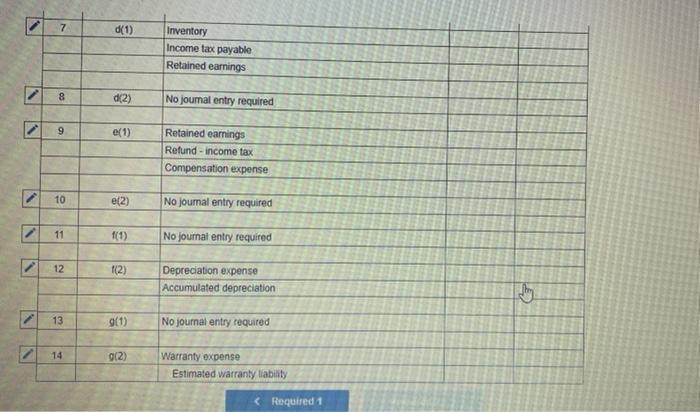
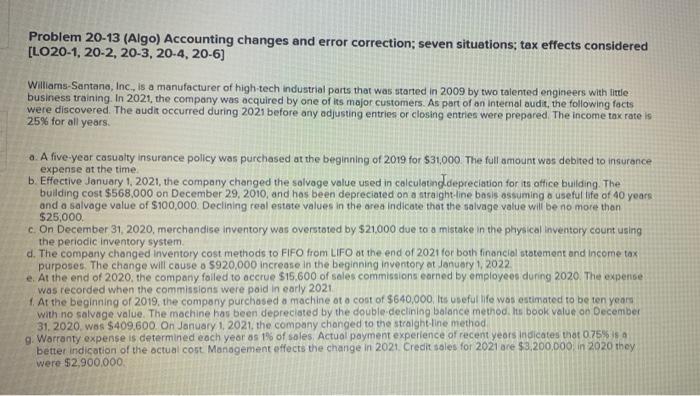
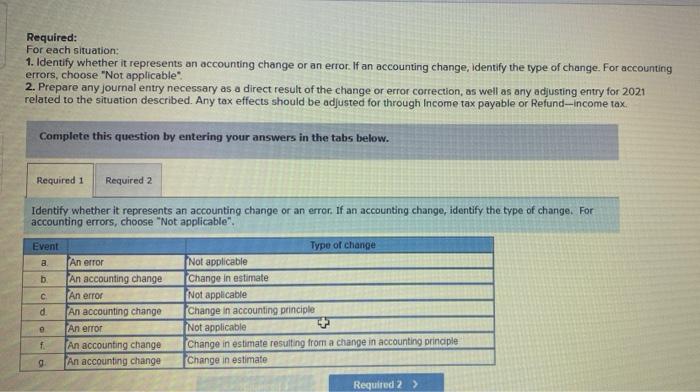
Problem 20-13 (Algo) Accounting changes and error correction; seven situations; tax effects considered [LO20-1, 20-2, 20-3, 20-4, 20-6] Williams-Santana, Inc., is a manufacturer of high-tech industrial parts that was started in 2009 by two talented engineers with little business training. In 2021, the company was acquired by one of its major customers. As part of an internal audit, the following facts were discovered. The audit occurred during 2021 before any adjusting entries or closing entries were prepared. The income tax rate is 25% for all years. a. A five-year casualty insurance policy was purchased at the beginning of 2019 for $31,000. The full amount was debited to insurance expense at the time. b. Effective January 1, 2021, the company changed the salvage value used in calculating depreciation for its office building. The building cost $568,000 on December 29, 2010, and has been depreciated on a straight-line basis assuming a useful life of 40 years and a salvage value of $100,000. Declining real estate values in the area indicate that the salvage value will be no more than $25,000. c. On December 31, 2020, merchandise inventory was overstated by $21,000 due to a mistake in the physical inventory count using the periodic inventory system. d. The company changed inventory cost methods to FIFO from LIFO at the end of 2021 for both financial statement and income tax purposes. The change will cause a $920,000 increase in the beginning inventory at January 1, 2022. e. At the end of 2020, the company failed to accrue $15,600 of sales commissions earned by employees during 2020. The expense was recorded when the commissions were paid in early 2021. f. At the beginning of 2019, the company purchased a machine at a cost of $640,000. Its useful life was estimated to be ten years with no salvage value. The machine has been depreciated by the double-declining balance method. Its book value on December 31, 2020, was $409,600. On January 1, 2021, the company changed to the straight-line method g. Warranty expense is determined each year as 1% of sales. Actual payment experience of recent years indicates that 0.75% is a better indication of the actual cost Management effects the change in 2021. Credit sales for 2021 are $3,200,000, in 2020 they were $2,900,000. Required: For each situation: 1. Identify whether it represents an accounting change or an error. If an accounting change, identify the type of change. For accounting errors, choose "Not applicable". 2. Prepare any journal entry necessary as a direct result of the change or error correction, as well as any adjusting entry for 2021 related to the situation described. Any tax effects should be adjusted for through Income tax payable or Refund-income tax. Complete this question by entering your answers in the tabs below. Required 1 Required 2 Identify whether it represents an accounting change or an error. If an accounting change, identify the type of change. For accounting errors, choose "Not applicable". Event Type of change 8 An error Not applicable b. An accounting change Change in estimate C An error Not applicable d. An accounting change Change in accounting principle An error Not applicable An accounting change Change in estimate resulting from a change in accounting principle An accounting change Change in estimate Required 2 > e f g N N IN N No 1 2 N 3 4 5 1 6 7 8 Transaction a(1) a(2) b(1) b(2) c(1) c(2) d(1) d(2) General Joumal Prepaid insurance Income tax payable Retained earnings Insurance expense Prepaid insurance No journal entry required Depreciation expense Accumulated depreciation Retained earnings Refund income tax Inventory No journal entry required Inventory Income tax payable Retained earnings No journal entry required Debit G Credit IN N N N N IN 7 8 9 10 11 12 13 14 d(1) d(2) e(1) e(2) 1(1) 1(2) g(1) g(2) Inventory Income tax payable Retained earnings No journal entry required Retained earnings Refund-income tax Compensation expense No journal entry required No journal entry required Depreciation expense Accumulated depreciation No journal entry required Warranty expense Estimated warranty liability
Step by Step Solution
There are 3 Steps involved in it

Get step-by-step solutions from verified subject matter experts
 Study Help