







Question: EViews Computer Exercises Please present your answers by using EViews outputs if appropriate. Typed works and Word files are allowed. Question 1 (100 Marks) A
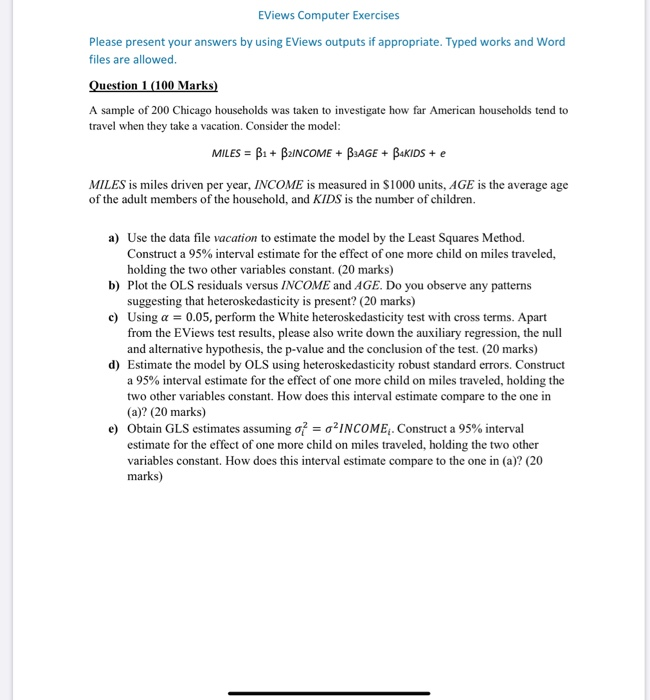
EViews Computer Exercises Please present your answers by using EViews outputs if appropriate. Typed works and Word files are allowed. Question 1 (100 Marks) A sample of 200 Chicago households was taken to investigate how far American households tend to travel when they take a vacation. Consider the model: MILES = B1 + B2INCOME + BAGE + BAKIDS + e MILES is miles driven per year, INCOME is measured in $1000 units, AGE is the average age of the adult members of the household, and KIDS is the number of children. a) Use the data file vacation to estimate the model by the Least Squares Method. Construct a 95% interval estimate for the effect of one more child on miles traveled, holding the two other variables constant. (20 marks) b) Plot the OLS residuals versus INCOME and AGE. Do you observe any patterns suggesting that heteroskedasticity is present? (20 marks) c) Using a = 0.05, perform the White heteroskedasticity test with cross terms. Apart from the EViews test results, please also write down the auxiliary regression, the null and alternative hypothesis, the p-value and the conclusion of the test. (20 marks) d) Estimate the model by OLS using heteroskedasticity robust standard errors. Construct a 95% interval estimate for the effect of one more child on miles traveled, holding the two other variables constant. How does this interval estimate compare to the one in (a)? (20 marks) e) Obtain GLS estimates assuming 07 = oINCOME. Construct a 95% interval estimate for the effect of one more child on miles traveled, holding the two other variables constant. How does this interval estimate compare to the one in (a)? (20 marks) EViews Computer Exercises Please present your answers by using EViews outputs if appropriate. Typed works and Word files are allowed. Question 1 (100 Marks) A sample of 200 Chicago households was taken to investigate how far American households tend to travel when they take a vacation. Consider the model: MILES = B1 + B2INCOME + BAGE + BAKIDS + e MILES is miles driven per year, INCOME is measured in $1000 units, AGE is the average age of the adult members of the household, and KIDS is the number of children. a) Use the data file vacation to estimate the model by the Least Squares Method. Construct a 95% interval estimate for the effect of one more child on miles traveled, holding the two other variables constant. (20 marks) b) Plot the OLS residuals versus INCOME and AGE. Do you observe any patterns suggesting that heteroskedasticity is present? (20 marks) c) Using a = 0.05, perform the White heteroskedasticity test with cross terms. Apart from the EViews test results, please also write down the auxiliary regression, the null and alternative hypothesis, the p-value and the conclusion of the test. (20 marks) d) Estimate the model by OLS using heteroskedasticity robust standard errors. Construct a 95% interval estimate for the effect of one more child on miles traveled, holding the two other variables constant. How does this interval estimate compare to the one in (a)? (20 marks) e) Obtain GLS estimates assuming 07 = oINCOME. Construct a 95% interval estimate for the effect of one more child on miles traveled, holding the two other variables constant. How does this interval estimate compare to the one in (a)? (20 marks)
Step by Step Solution
There are 3 Steps involved in it

Get step-by-step solutions from verified subject matter experts
 Study Help