







Question: Ex 17.3: Fish and Coconuts, Part II Let's decentralize the model from exercise 5.2. Now, let's think of Chuck as two firms and one consumer.
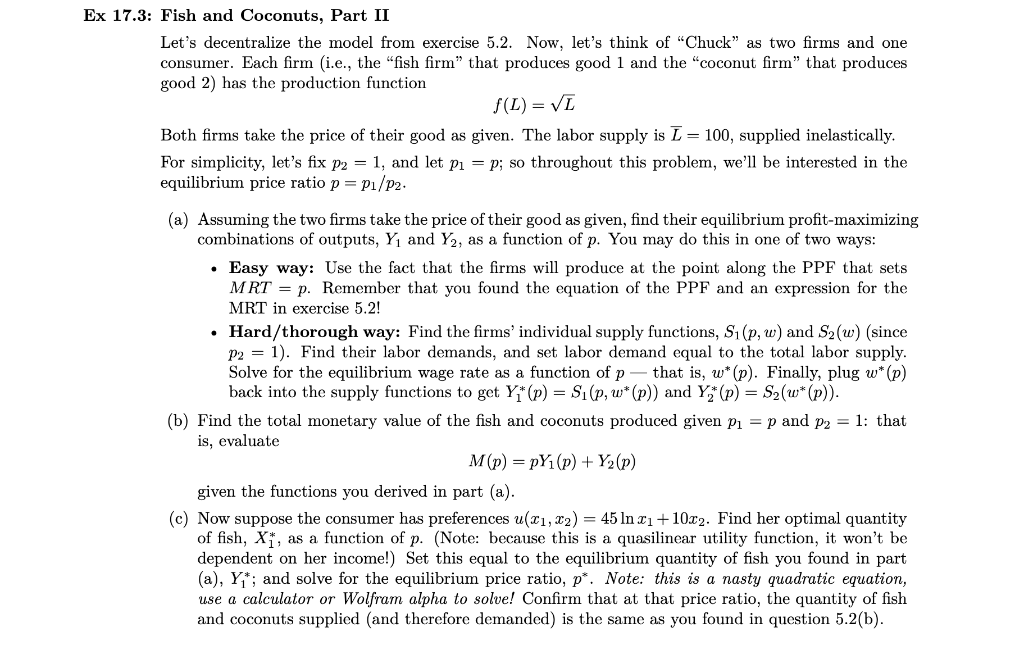
Ex 17.3: Fish and Coconuts, Part II Let's decentralize the model from exercise 5.2. Now, let's think of "Chuck" as two firms and one consumer. Each firm (i.e., the "fish firm" that produces good 1 and the coconut firm that produces good 2) has the production function S(L) = VL Both firms take the price of their good as given. The labor supply is L = 100, supplied inelastically. For simplicity, let's fix p2 = 1, and let p = p; so throughout this problem, we'll be interested in the equilibrium price ratio p = p/P2. . (a) Assuming the two firms take the price of their good as given, find their equilibrium profit-maximizing combinations of outputs, Y1 and Y2, as a function of p. You may do this in one of two ways: Easy way: Use the fact that the firms will produce at the point along the PPF that sets MRT = p. Remember that you found the equation of the PPF and an expression for the MRT in exercise 5.2! Hard/thorough way: Find the firms' individual supply functions, Si(p, w) and S2(w) (since P2 = 1). Find their labor demands, and set labor demand equal to the total labor supply. Solve for the equilibrium wage rate as a function of p that is, w* (p). Finally, plug w* (p) back into the supply functions to get Y* (P) = S(P, w*(p)) and Y; (p) = S2(w*(p)). (b) Find the total monetary value of the fish and coconuts produced given p = p and P2 = 1: that is, evaluate MP) = pY1(p) + Y2(p) given the functions you derived in part (a). (c) Now suppose the consumer has preferences u(x1,x2) = 45 In 21 +10x2. Find her optimal quantity of fish, X1, as a function of p. (Note: because this is a quasilinear utility function, it won't be dependent on her income!) Set this equal to the equilibrium quantity of fish you found in part (a), Y*; and solve for the equilibrium price ratio, p*. Note: this is a nasty quadratic equation, use a calculator or Wolfram alpha to solve! Confirm that at that price ratio, the quantity of fish and coconuts supplied (and therefore demanded) is the same as you found in question 5.2(b). Ex 17.3: Fish and Coconuts, Part II Let's decentralize the model from exercise 5.2. Now, let's think of "Chuck" as two firms and one consumer. Each firm (i.e., the "fish firm" that produces good 1 and the coconut firm that produces good 2) has the production function S(L) = VL Both firms take the price of their good as given. The labor supply is L = 100, supplied inelastically. For simplicity, let's fix p2 = 1, and let p = p; so throughout this problem, we'll be interested in the equilibrium price ratio p = p/P2. . (a) Assuming the two firms take the price of their good as given, find their equilibrium profit-maximizing combinations of outputs, Y1 and Y2, as a function of p. You may do this in one of two ways: Easy way: Use the fact that the firms will produce at the point along the PPF that sets MRT = p. Remember that you found the equation of the PPF and an expression for the MRT in exercise 5.2! Hard/thorough way: Find the firms' individual supply functions, Si(p, w) and S2(w) (since P2 = 1). Find their labor demands, and set labor demand equal to the total labor supply. Solve for the equilibrium wage rate as a function of p that is, w* (p). Finally, plug w* (p) back into the supply functions to get Y* (P) = S(P, w*(p)) and Y; (p) = S2(w*(p)). (b) Find the total monetary value of the fish and coconuts produced given p = p and P2 = 1: that is, evaluate MP) = pY1(p) + Y2(p) given the functions you derived in part (a). (c) Now suppose the consumer has preferences u(x1,x2) = 45 In 21 +10x2. Find her optimal quantity of fish, X1, as a function of p. (Note: because this is a quasilinear utility function, it won't be dependent on her income!) Set this equal to the equilibrium quantity of fish you found in part (a), Y*; and solve for the equilibrium price ratio, p*. Note: this is a nasty quadratic equation, use a calculator or Wolfram alpha to solve! Confirm that at that price ratio, the quantity of fish and coconuts supplied (and therefore demanded) is the same as you found in question 5.2(b)
Step by Step Solution
There are 3 Steps involved in it

Get step-by-step solutions from verified subject matter experts
 Study Help