







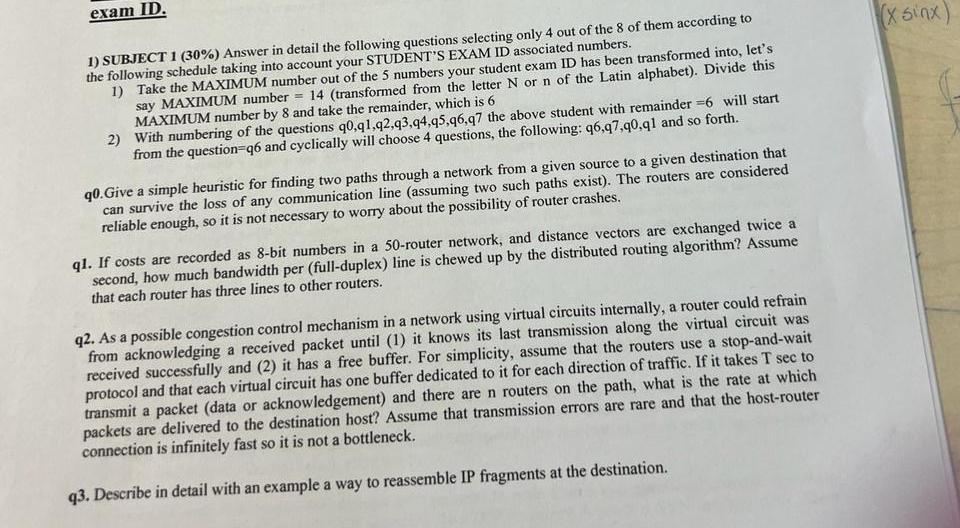
Question: exam ID . SUBJECT 1 ( 3 0 % ) Answer in detail the following questions selecting only 4 out of the 8 of them
exam ID
SUBJECT Answer in detail the following questions selecting only out of the of them according to the following schedule taking into account your STUDENT'S EXAM ID associated numbers.
Take the MAXIMUM number out of the numbers your student exam has been transformed into, let's say MAXIMUM number transformed from the letter or of the Latin alphabet Divide this MAXIMUM number by and take the remainder, which is
With numbering of the questions the above student with remainder will start from the questionq and cyclically will choose questions, the following: and so forth.
q Give a simple heuristic for finding two paths through a network from a given source to a given destination that can survive the loss of any communication line assuming two such paths exist The routers are considered reliable enough, so it is not necessary to worry about the possibility of router crashes.
q If costs are recorded as bit numbers in a router network, and distance vectors are exchanged twice a second, how much bandwidth per fullduplex line is chewed up by the distributed routing algorithm? Assume that each router has three lines to other routers.
q As a possible congestion control mechanism in a network using virtual circuits internally, a router could refrain from acknowledging a received packet until it knows its last transmission along the virtual circuit was received successfully and it has a free buffer. For simplicity, assume that the routers use a stopandwait protocol and that each virtual circuit has one buffer dedicated to it for each direction of traffic. If it takes sec to transmit a packet data or acknowledgement and there are routers on the path, what is the rate at which packets are delivered to the destination host? Assume that transmission errors are rare and that the hostrouter connection is infinitely fast so it is not a bottleneck.
q Describe in detail with an example a way to reassemble IP fragments at the destination.
Step by Step Solution
There are 3 Steps involved in it
1 Expert Approved Answer
Step: 1 Unlock

Question Has Been Solved by an Expert!
Get step-by-step solutions from verified subject matter experts
Step: 2 Unlock
Step: 3 Unlock
 Study Help