







Question: Exam ProblemsF 1 1 Problem 3 UG - Choosing attributes in DT [ 3 5 ] { 6 / 7 } You are an underwriting
Exam ProblemsFProblem UG Choosing attributes in DT
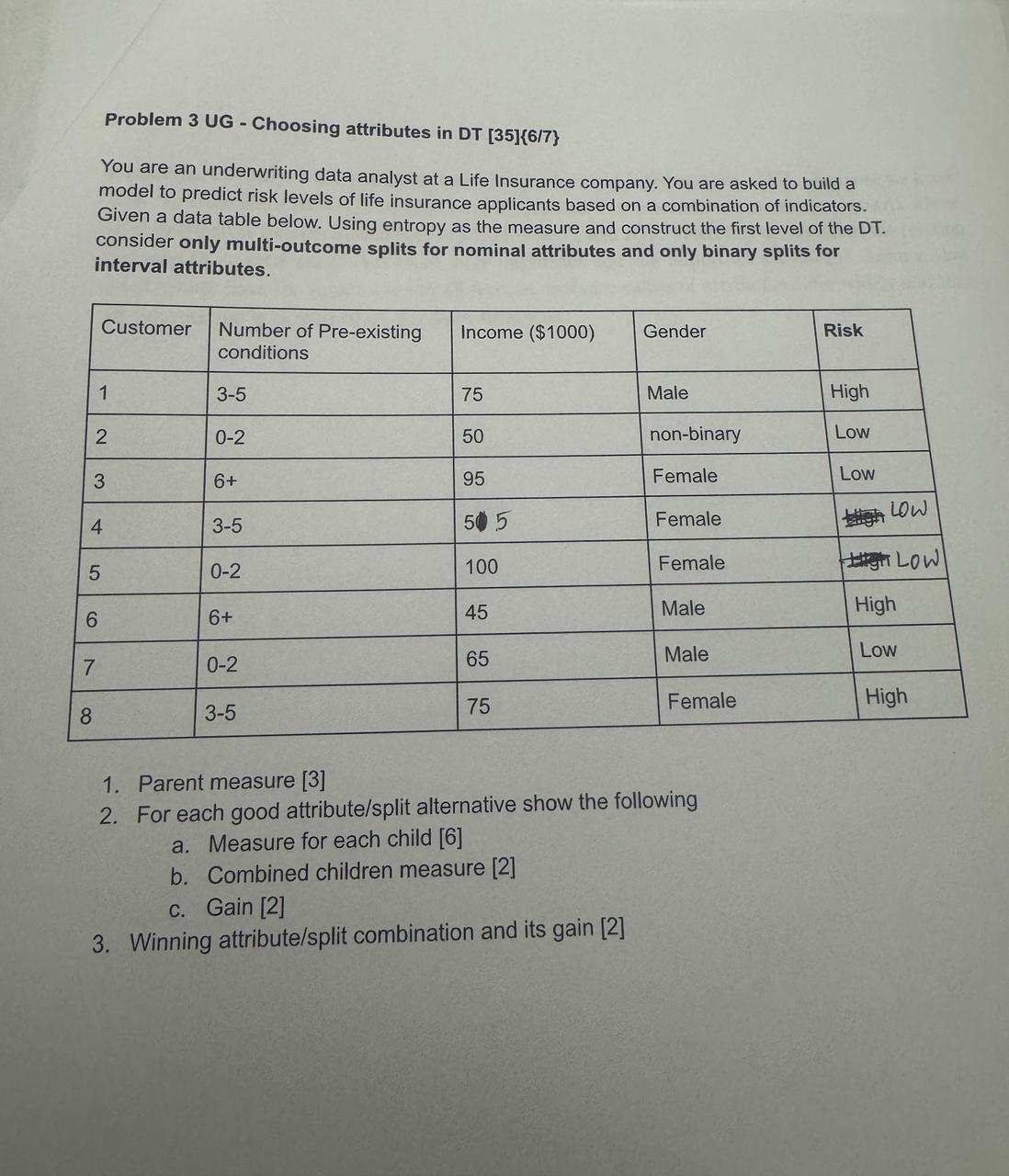
You are an underwriting data analyst at a Life Insurance company. You are asked to build a model to predict risk levels of life insurance applicants based on a combination of indicators. Given a data table below. Using entropy as the measure and construct the first level of the DT consider only multioutcome splits for nominal attributes and only binary splits for interval attributes.
tableCustomertableNumber of PreexistingconditionsIncome $Gender,RiskMale,Highnonbinary,LowFemale,LowFemale,LowFemale,LoWMale,HighMale,LowFemale,High
Parent measure
For each good attributesplit alternative show the following
a Measure for each child
b Combined children measure
c Gain
Winning attributesplit combination and its gain
problem UG GINI Index
You are a finance analyst at Company ABC. Your team is working on a binary decision tree model to predict the Central bank's decision on interest rate given today's economic environment. Your team has collectively decided to use the GINI index as the quality measure. The current node of the DT contains the records in the table below. Your manager asked you to determine which BINARY SPLIT of values for attribute "Inflation" into groups is the best with respect to GINI?
tableRecord IDInflation,Interest Rate DecisionHigh,Raise ratesMedium,Lower ratesMedium,Lower ratesLow,Lower ratesMedium,Raise ratesLow,Lower ratesMedium,Raise ratesHigh,Raise ratesLow,Lower ratesLow,Raise ratesMedium,Lower ratesMedium,Raise ratesHigh,Raise ratesMedium,Raise rates
The results for the following intermediate steps must be given:
Parent measure
For each choice of a split
a Measure for each child
b Combined children measure
c Gain
Final result and conclusion
Hint: think about how many alternative binary splits make sense if we assume that inflation is a meaningful attribute for the decision. Is inflation a nominal, ordinal, or interval attribute here?
Problem UG PCA s
Given data instances each with attributes:
The result for the following must have intermediate steps:
Multivariate mean ie vector of mean for each attribute
Centered data matrix
Covariance matrix of centered data use unbiased
Eigenvalues of covariance matrix
Principal components and transformation matrix
a Show correspondence between eigenvalues and principal components
Compute PCA transformation of the original data matrix
How many principal components are there in total? How much variance is explai
the first principal component? How many principal components should we keep
Step by Step Solution
There are 3 Steps involved in it
1 Expert Approved Answer
Step: 1 Unlock

Question Has Been Solved by an Expert!
Get step-by-step solutions from verified subject matter experts
Step: 2 Unlock
Step: 3 Unlock
 Study Help