







Question: Examine neural networks using Python. The dataset has 20 records and 19 different attributes about smartphone specifications. The goal in this analysis is to predict
Examine neural networks using Python. The dataset has 20 records and 19 different attributes about smartphone specifications. The goal in this analysis is to predict the price of a smartphone based on its attributes using neural network techniques. This data set has the following price range: 0 for low, 1 for middle, 2 for expensive, and 3 for very expensive. Preparing the data for a neural network is very important. The data needs to be divided into training (70%) and testing (30%) datasets.
| battery_power | bluetooth | clock_speed | dual_sim | frontcamerapixel | 4G | memorysize | weight | cores | primarycamerapixel |
| 842 | 0 | 2.2 | 0 | 1 | 0 | 7 | 188 | 2 | 2 |
| 1021 | 1 | 0.5 | 1 | 0 | 1 | 53 | 136 | 3 | 6 |
| 563 | 1 | 0.5 | 1 | 2 | 1 | 41 | 145 | 5 | 6 |
| 615 | 1 | 2.5 | 0 | 0 | 0 | 10 | 131 | 6 | 9 |
| 1821 | 1 | 1.2 | 0 | 13 | 1 | 44 | 141 | 2 | 14 |
| 1859 | 0 | 0.5 | 1 | 3 | 0 | 22 | 164 | 1 | 7 |
| 1821 | 0 | 1.7 | 0 | 4 | 1 | 10 | 139 | 8 | 10 |
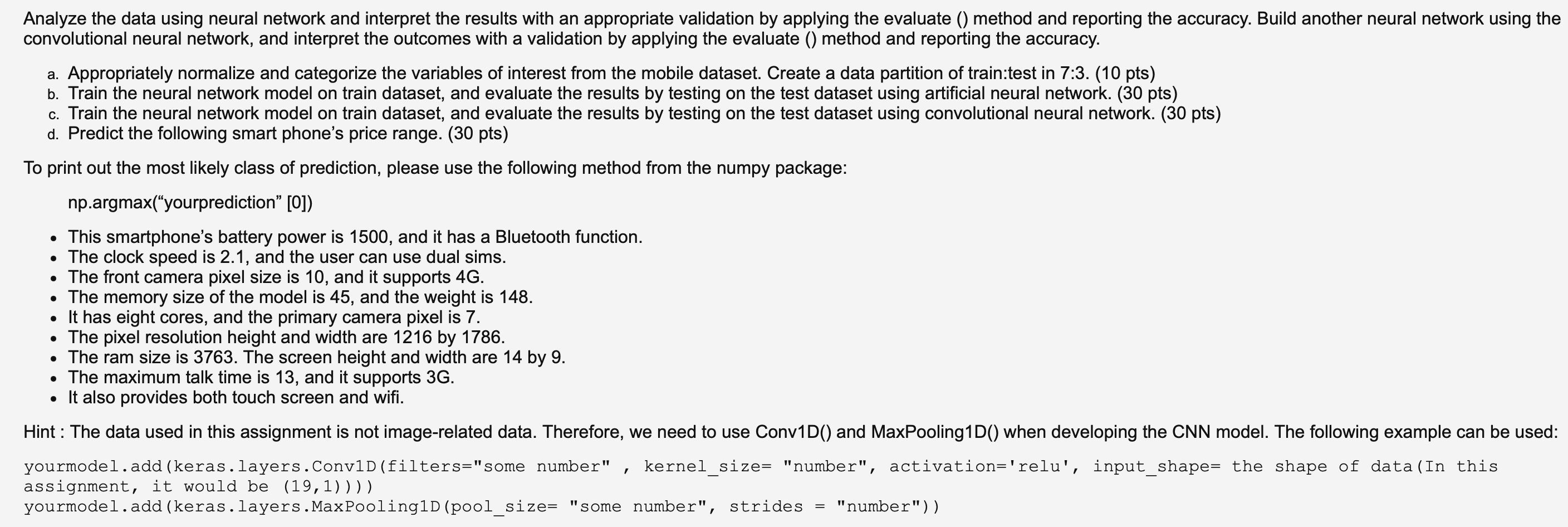
Analyze the data using neural network and interpret the results with an appropriate validation by applying the evaluate () method and reporting the accuracy. Build another neural network using the convolutional neural network, and interpret the outcomes with a validation by applying the evaluate () method and reporting the accuracy. a. Appropriately normalize and categorize the variables of interest from the mobile dataset. Create a data partition of train:test in 7:3. (10 pts) b. Train the neural network model on train dataset, and evaluate the results by testing on the test dataset using artificial neural network. (30 pts) c. Train the neural network model on train dataset, and evaluate the results by testing on the test dataset using convolutional neural network. (30 pts) d. Predict the following smart phone's price range. (30 pts) To print out the most likely class of prediction, please use the following method from the numpy package: np.argmax("yourprediction" [0]) - This smartphone's battery power is 1500 , and it has a Bluetooth function. - The clock speed is 2.1, and the user can use dual sims. - The front camera pixel size is 10 , and it supports 4G. - The memory size of the model is 45 , and the weight is 148 . - It has eight cores, and the primary camera pixel is 7. - The pixel resolution height and width are 1216 by 1786. - The ram size is 3763 . The screen height and width are 14 by 9. - The maximum talk time is 13, and it supports 3G. - It also provides both touch screen and wifi. Hint : The data used in this assignment is not image-related data. Therefore, we need to use Conv1D() and MaxPooling1D() when developing the CNN model. The following example can be used: yourmodel.add(keras.layers.Conv1D(filters="some number", kernel_size= "number", activation='relu', input_shape= the shape of data(In this assignment, it would be (19,1))) ) yourmodel.add(keras.layers.MaxPooling1D(pool_size= "some number", strides = "number"))
Step by Step Solution
There are 3 Steps involved in it

Get step-by-step solutions from verified subject matter experts
 Study Help