Question: examine three of the most recent issues available of a peer- reviewed journal in your discipline. Your goal is to provide an overview of the
examine three of the most recent issues available of a peer- reviewed journal in your discipline. Your goal is to provide an overview of the current topics and methods that are published in this journal. For each issue of the journal, answer the following questions in complete sentences and have a summary of the journal in paragraph form(double or single-spaced), and share your findings about the journal (the kinds of articles it publishes, how often it is published, and any other information you think is useful to know about this journal):
First, study the submission guidelines and editorial policy of the journal. (These are usually located near the front cover, although sometimes these are printed in the back.) Examine what kinds of topics and methods are recommended to potential contributing authors.
Second, skim several issues of the entire journal to get a feel for the topics and methods published in that journal.
Consider how many articles are typically published each issue. What sections does the journal include? (Are book reviews published? Comment and responses? Annotated bibliographies? Etc.)
Read/skim the articles in each issue. Note the range of topics and methods used in the published articles. What are the objects of study that the articles focus on (people, texts, theories, practices, experiments, material artifacts, etc.)? What types of methods are the researchers using? Theoretical, historical, archival, empirical, comparative, experimental, hermeneutical, operation, observation, or some other category?
Consider the audience targeted for the journal. Is this published for scholars? Researchers? Teachers? Or some combination.
Consider the purpose of most, if not all, of the articles. Are these contributing new knowledge? Applying knowledge to a practice (pedagogical or clinical)? Extending or challenging other research? Integrating scholarship (e.g., reviews of literature or annotated bibliography)?
You may come up with other questions or aspects of the journal to examine as you begin your analysis. Your goal is to familiarize potential readers (scholars and/or teachers) with the journal you choose.
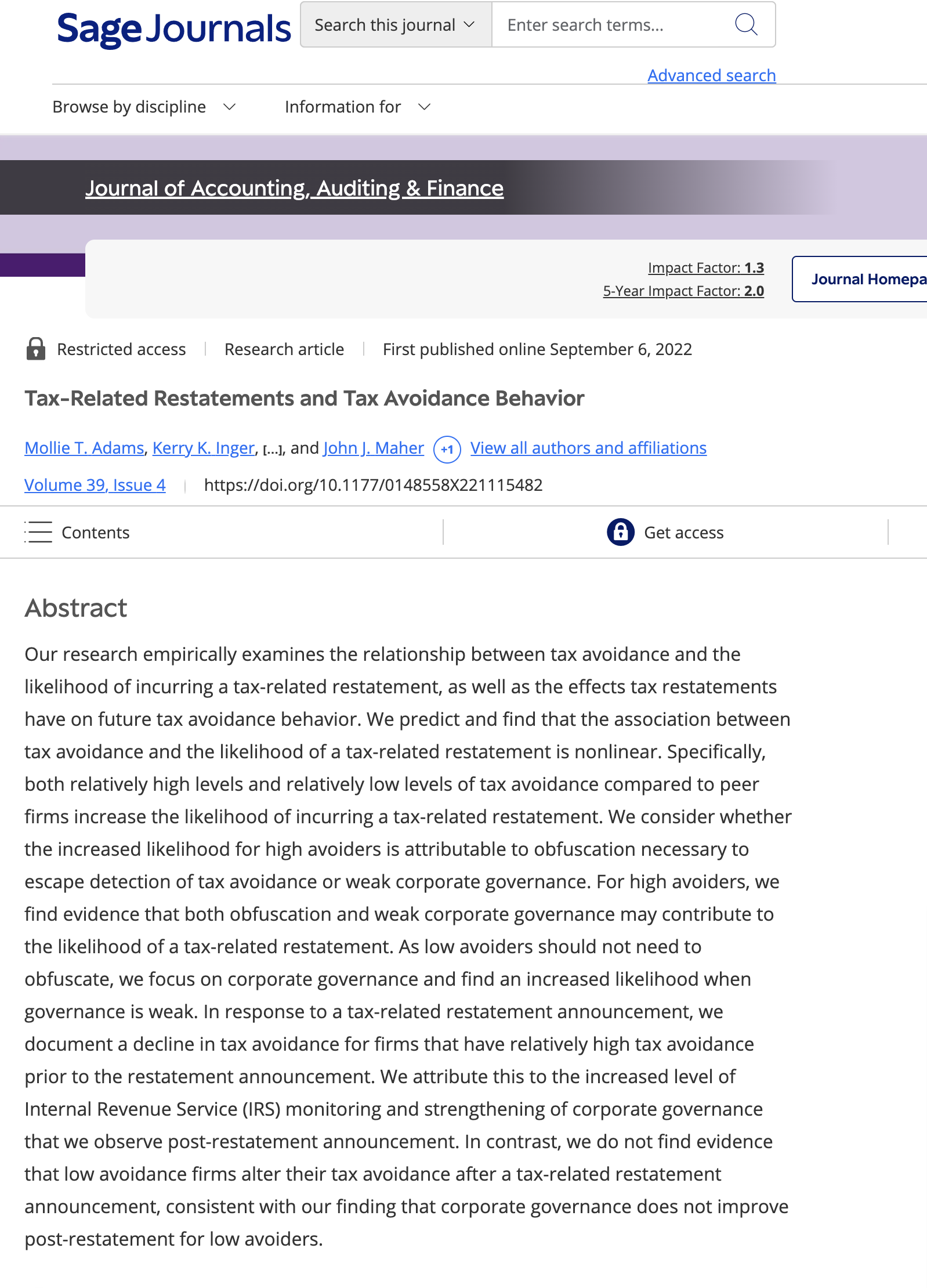
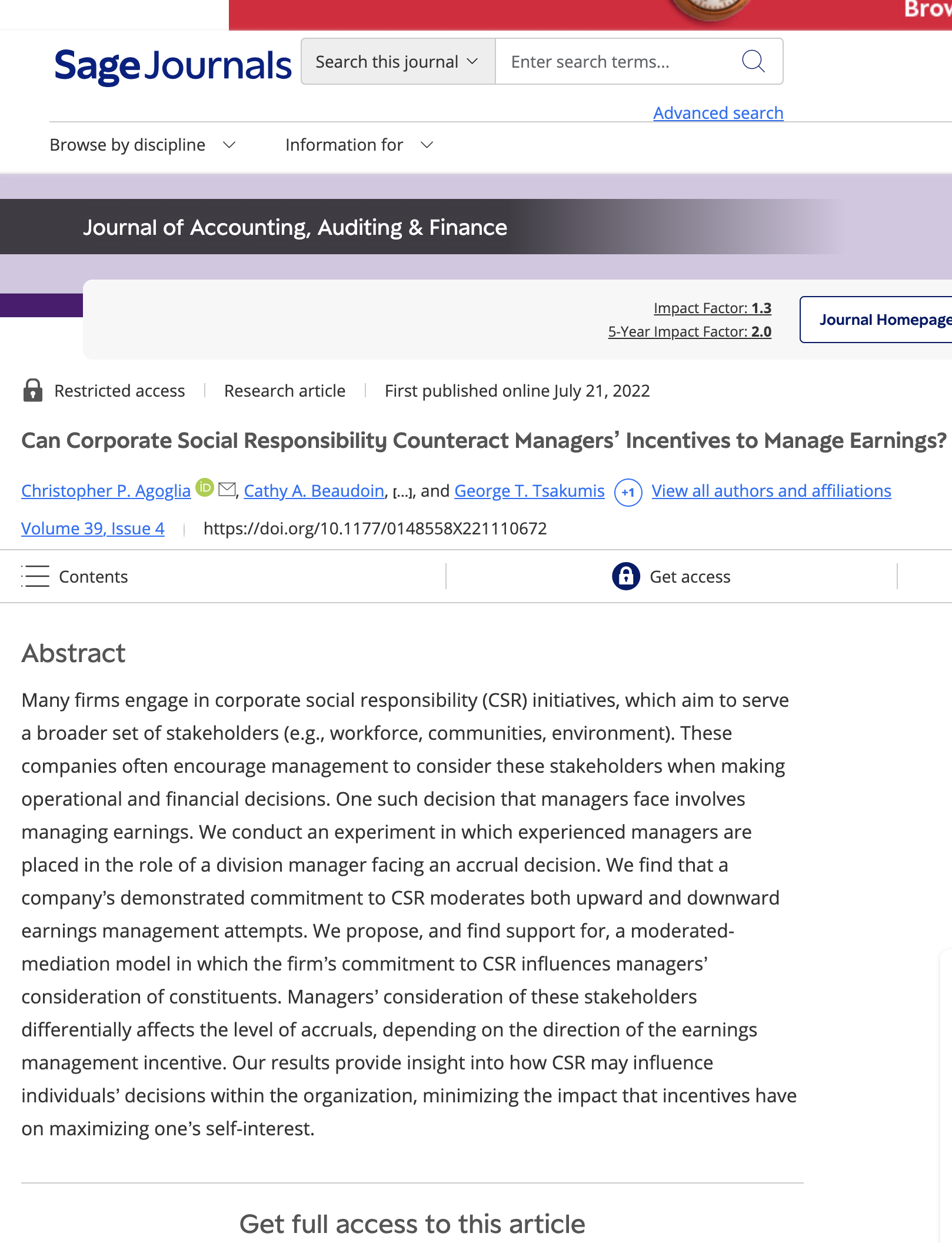
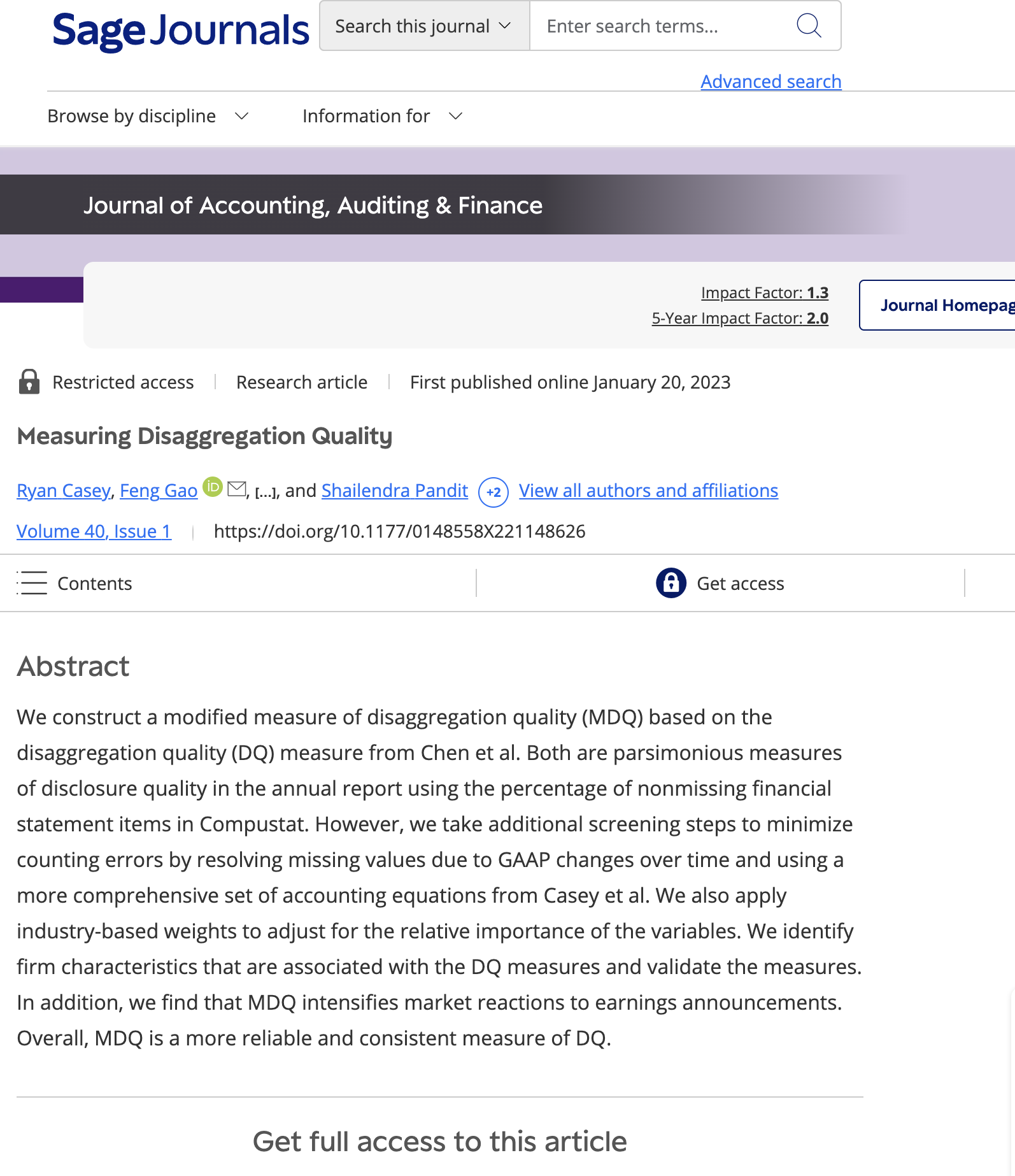
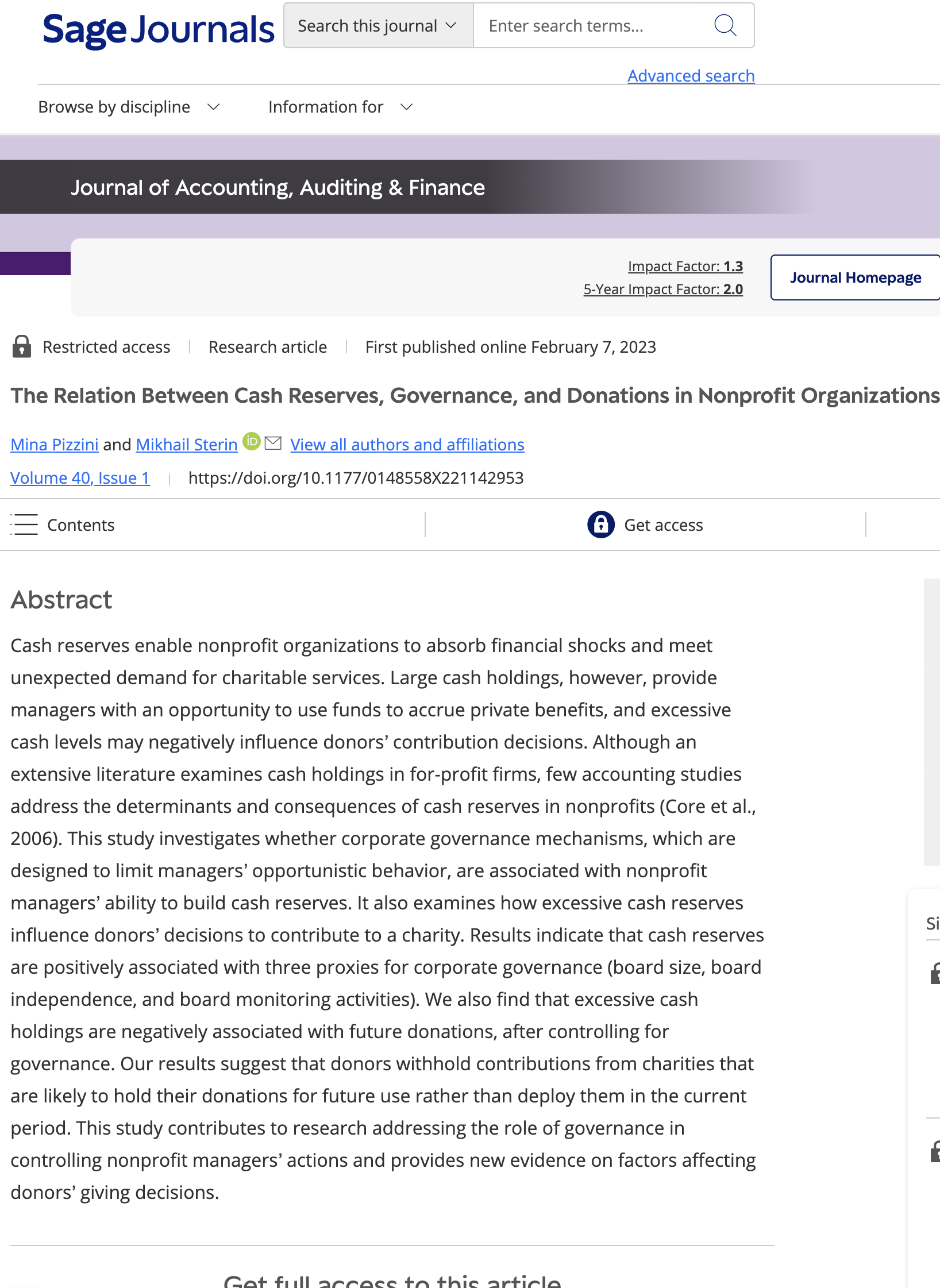
Sage Journals Search this journal Enter search terms... Q Advanced search Browse by discipline ~ Information for ~ Journal of Accounting, Auditing & Finance | Impact Factor: 1.3 Journal Homepa 5-Year Impact Factor: 2.0 a Restricted access Research article First published online September 6, 2022 Tax-Related Restatements and Tax Avoidance Behavior Mollie T. Adams, Kerry K. Inger, [..., and John J. Maher View all authors and affiliations Volume 39, Issue 4 https://doi.org/10.1177/0148558X221 115482 Contents Get access Abstract Our research empirically examines the relationship between tax avoidance and the likelinood of incurring a tax-related restatement, as well as the effects tax restatements have on future tax avoidance behavior. We predict and find that the association between tax avoidance and the likelihood of a tax-related restatement is nonlinear. Specifically, both relatively high levels and relatively low levels of tax avoidance compared to peer firms increase the likelihood of incurring a tax-related restatement. We consider whether the increased likelihood for high avoiders is attributable to obfuscation necessary to escape detection of tax avoidance or weak corporate governance. For high avoiders, we find evidence that both obfuscation and weak corporate governance may contribute to the likelihood of a tax-related restatement. As low avoiders should not need to obfuscate, we focus on corporate governance and find an increased likelihood when governance is weak. In response to a tax-related restatement announcement, we document a decline in tax avoidance for firms that have relatively high tax avoidance prior to the restatement announcement. We attribute this to the increased level of Internal Revenue Service (IRS) monitoring and strengthening of corporate governance that we observe post-restatement announcement. In contrast, we do not find evidence that low avoidance firms alter their tax avoidance after a tax-related restatement announcement, consistent with our finding that corporate governance does not improve post-restatement for low avoiders. Sage Jou rnals Search this journal ~ Enter search terms... Q Advanced search Browse by discipline ~ Information for ~ Journal of Accounting, Auditing & Finance | Impact Factor: 1.3 Journal Homepage 5-Year Impact Factor: 2.0 a Restricted access Research article First published online July 21, 2022 Can Corporate Social Responsibility Counteract Managers' Incentives to Manage Earnings? Christopher P. Agoglia \\ &), Cathy A. Beaudoin, [...1, and George T. Tsakumis (+1) View all authors and affiliations Volume 39, Issue 4 https://doi.org/10.1177/0148558X221110672 - Contents @ Get access Abstract Many firms engage in corporate social responsibility (CSR) initiatives, which aim to serve a broader set of stakeholders (e.g., workforce, communities, environment). These companies often encourage management to consider these stakeholders when making operational and financial decisions. One such decision that managers face involves managing earnings. We conduct an experiment in which experienced managers are placed in the role of a division manager facing an accrual decision. We find that a company's demonstrated commitment to CSR moderates both upward and downward earnings management attempts. We propose, and find support for, a moderated- mediation model in which the firm's commitment to CSR influences managers' consideration of constituents. Managers' consideration of these stakeholders differentially affects the level of accruals, depending on the direction of the earnings management incentive. Our results provide insight into how CSR may influence individuals' decisions within the organization, minimizing the impact that incentives have on maximizing one's self-interest. Get full access to this article Sage Journals Search this journal Enter search terms... Q Advanced search Browse by discipline v Information for Journal of Accounting, Auditing & Finance Impact Factor: 1.3 Journal Homepa 5-Year Impact Factor: 2.0 Restricted access | Research article | First published online January 20, 2023 Measuring Disaggregation Quality Ryan Casey, Feng Gao , [..], and Shailendra Pandit (+2) View all authors and affiliations Volume 40, Issue 1 | https://doi.org/10.1177/0148558X221148626 Contents Get access Abstract We construct a modified measure of disaggregation quality (MDQ) based on the disaggregation quality (DQ) measure from Chen et al. Both are parsimonious measures of disclosure quality in the annual report using the percentage of nonmissing financial statement items in Compustat. However, we take additional screening steps to minimize counting errors by resolving missing values due to GAAP changes over time and using a more comprehensive set of accounting equations from Casey et al. We also apply industry-based weights to adjust for the relative importance of the variables. We identify firm characteristics that are associated with the DQ measures and validate the measures. In addition, we find that MDQ intensifies market reactions to earnings announcements. Overall, MDQ is a more reliable and consistent measure of DQ. Get full access to this articleSageJou rals Search this journal v Enter search terms... Q Advanced search Browse by discipline ~ Information for ~ Journal of Accounting, Auditing & Finance | Impact Factor: 1.3 5-Year Impact Factor: 2.0 ao Restricted access Research article First published online February 7, 2023 Journal Homepage The Relation Between Cash Reserves, Governance, and Donations in Nonprofit Organizations Mina Pizzini and Mikhail Sterin \"2 View all authors and affiliations Volume 40, Issue 1 https://doi.org/10.1177/0148558X221142953 ' Contents Get access Abstract Cash reserves enable nonprofit organizations to absorb financial shocks and meet unexpected demand for charitable services. Large cash holdings, however, provide managers with an opportunity to use funds to accrue private benefits, and excessive cash levels may negatively influence donors' contribution decisions. Although an extensive literature examines cash holdings in for-profit firms, few accounting studies address the determinants and consequences of cash reserves in nonprofits (Core et al., 2006). This study investigates whether corporate governance mechanisms, which are designed to limit managers' opportunistic behavior, are associated with nonprofit managers' ability to build cash reserves. It also examines how excessive cash reserves influence donors' decisions to contribute to a charity. Results indicate that cash reserves are positively associated with three proxies for corporate governance (board size, board independence, and board monitoring activities). We also find that excessive cash holdings are negatively associated with future donations, after controlling for governance. Our results suggest that donors withhold contributions from charities that are likely to hold their donations for future use rather than deploy them in the current period. This study contributes to research addressing the role of governance in controlling nonprofit managers' actions and provides new evidence on factors affecting donors' giving decisions. Cat fiill anprace ta thic articla Si
Step by Step Solution
There are 3 Steps involved in it
1 Expert Approved Answer
Step: 1 Unlock
Question Has Been Solved by an Expert!
Get step-by-step solutions from verified subject matter experts
Step: 2 Unlock
Step: 3 Unlock
Students Have Also Explored These Related Accounting Questions!









 Study Help